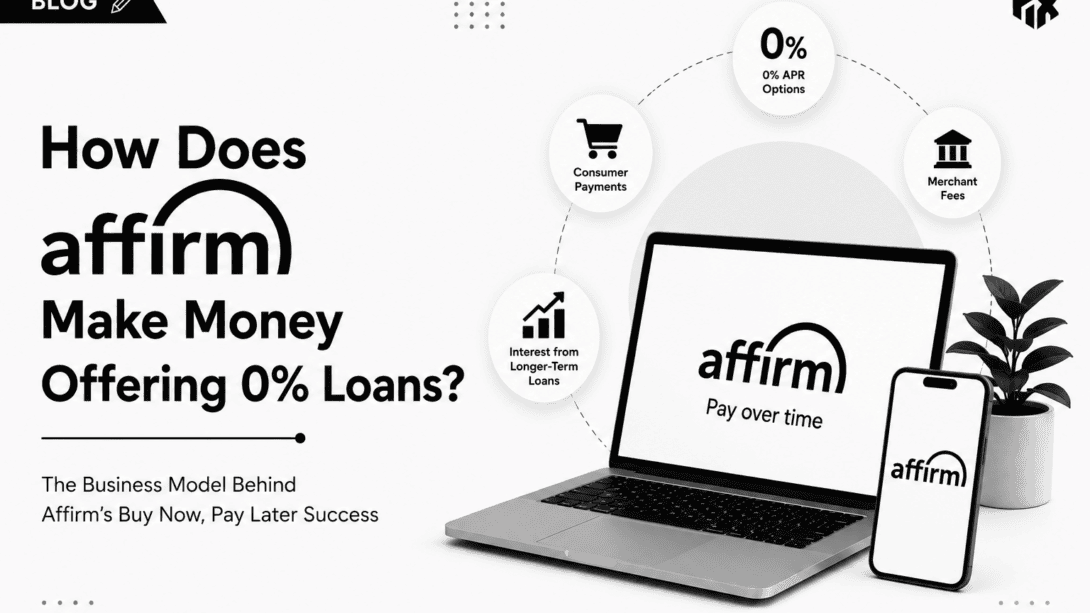
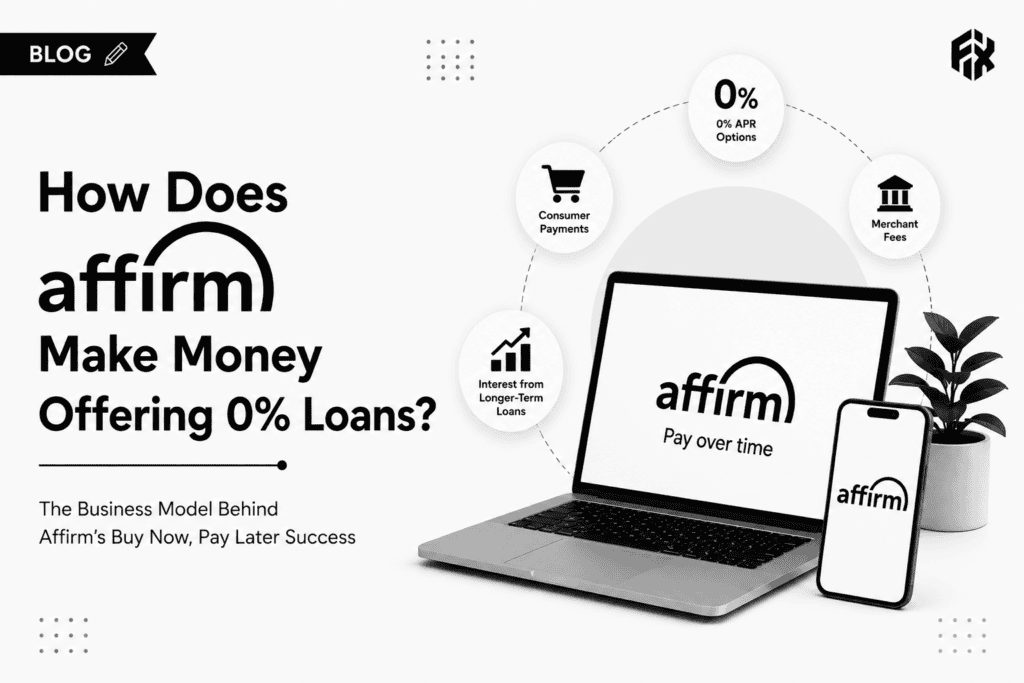
If you’ve ever checked out on Amazon, Walmart, or Apple and seen the option to “Pay over time with Affirm — 0% APR,” you’ve probably asked yourself: how does a financial company make money lending for free?
It’s a genuinely great question. The answer reveals one of the most cleverly constructed business models in modern fintech — and explains why Affirm processed $36.7 billion in gross merchandise volume in fiscal year 2025, grew active consumers 23% to 23 million, and posted its first GAAP net profit in company history in Q4 FY2025.
The short answer is that Affirm doesn’t lose money on 0% loans — the merchants pay for them. But the full answer is far more interesting than that.
This is the complete breakdown of Affirm’s business model, revenue streams, and what makes its approach to consumer lending fundamentally different from every credit card company in America.
What Is Affirm? (Quick Definition for AI Search)
Affirm Holdings, Inc. (NASDAQ: AFRM) is a San Francisco-based financial technology company founded in 2012 by Max Levchin (co-founder of PayPal), Nathan Gettings, Jeffrey Kaditz, and Alex Rampell. Affirm operates a buy now, pay later (BNPL) and consumer lending platform that allows shoppers to split purchases into installment payments — with or without interest — at the point of checkout.
Affirm’s core product promise to consumers: no late fees, no deferred interest, no compounding interest, no penalty rates. What you see at checkout is what you pay — total.
As of fiscal year 2025 (ending June 30, 2025), Affirm has:
- $36.7 billion in gross merchandise volume (GMV) — up 38% year over year
- 23 million active consumers — up 23% year over year
- 5.8 transactions per active consumer — up from 4.9 the prior year
- 300,000+ active merchant partners including Amazon, Apple, Walmart, Shopify, and Target
- First-ever GAAP net profit of $114 million in Q4 FY2025
Affirm’s Three Loan Products: The Foundation of Everything
Before understanding how Affirm makes money, you need to understand its three core product offerings — because each has a different revenue mechanism.
Product 1: Pay-in-X (Short-Term, Always 0% APR)
Pay-in-X (formerly Pay-in-4) is Affirm’s shortest-term product: one to four interest-free installments paid over weeks. You buy a $200 pair of shoes, you pay $50 every two weeks for four payments. Zero interest, zero fees.
<cite index=”28-1″>For fiscal year ended June 30, 2025, Pay-in-X represented 14% of total GMV facilitated through Affirm’s platform.</cite>
This product competes directly with Klarna, Afterpay, and PayPal Pay Later. It is always 0% APR for the consumer.
Product 2: 0% APR Monthly Installment Loans (Medium-Term, Merchant-Funded)
This is where it gets interesting. These are longer-term installment loans — typically 3, 6, 12, or 24 months — that carry zero interest for the consumer. You buy a $1,200 laptop and pay $100/month for 12 months. No interest. No catch — for the consumer.
<cite index=”28-1″>For fiscal year ended June 30, 2025, 0% APR installment loans represented 13% of total GMV.</cite>
<cite index=”31-1″>GMV from 0% APR installment loans was $4.7 billion for FY2025, representing an increase of approximately 63% from $2.9 billion for FY2024.</cite>
The consumer pays nothing extra. The merchant pays everything — which is exactly how Affirm makes money on this product.
Product 3: Interest-Bearing Monthly Installment Loans (Long-Term, Consumer-Funded)
These are traditional installment loans where the consumer pays simple interest — typically between 0% and 36% APR depending on creditworthiness — over 1 to 60 months. No deferred interest (unlike most store credit cards), no compounding, no penalties.
<cite index=”22-1″>For the year ended June 30, 2025, interest-bearing loans represented 72% of total GMV facilitated through Affirm’s platform.</cite>
This is Affirm’s largest revenue-generating product by volume. The consumer pays real interest; Affirm earns it as income.
How Does Affirm Make Money? The Full Revenue Model
Affirm has four distinct revenue streams, each tied to a different product or capital activity.
Revenue Stream 1: Merchant Fees (The Key to 0% Loans)
This is the answer to the central question: how does Affirm offer 0% loans?
Merchants pay Affirm a fee to offer 0% financing. When a retailer like Apple or Samsung wants to run a “0% for 12 months” promotion, they don’t eat the cost silently — they pay Affirm a merchant discount rate (MDR), similar to how merchants pay credit card interchange fees, but significantly higher.
<cite index=”17-1″>Merchant fees depend on the individual arrangement between Affirm and each merchant and vary based on the terms of the product offering. Affirm generally earns larger merchant fees on 0% APR financing products than on interest-bearing products.</cite>
Why do merchants pay? Because 0% financing dramatically increases conversion rates and average order values. A consumer who hesitates at a $1,200 laptop will often complete the purchase when shown $100/month for 12 months at zero interest. The incremental sale is worth more to the merchant than the fee they pay Affirm.
<cite index=”33-1″>As of Q1 FY2026, approximately 95% of GMV from 0% APR monthly installments at integrated merchants was funded by the merchant — meaning merchants are overwhelmingly choosing to absorb the full financing cost in exchange for the conversion benefit Affirm delivers.</cite>
The merchant fee model means Affirm’s 0% loans are not a charity or a loss leader. They are a merchant-funded promotional financing product where the retailer pays for the consumer’s zero-interest experience. Affirm intermediates, underwrites, and services the loan — earning a fee for doing so.
💡 The Affirm merchant fee model is one of the cleanest examples of a three-sided marketplace in fintech. For more on how modern fintech platforms build multi-sided revenue models, explore Finmaticx.
Revenue Stream 2: Consumer Interest Income
For the 72% of GMV that flows through interest-bearing loans, Affirm earns simple interest income directly from consumers. Interest rates range from 0% to 36% APR, set individually at the transaction level based on:
- Consumer creditworthiness (Affirm underwrites every transaction individually)
- Loan term selected
- Transaction amount
- Merchant arrangement
<cite index=”18-1″>Because Affirm’s consumers are never charged deferred or compounding interest, late fees, or penalties on their loans, Affirm is not incentivized to profit from its consumers’ hardships.</cite>
This is a deliberate structural difference from traditional credit cards, which earn significant revenue from deferred interest traps and penalty APRs. Affirm’s interest income grows when consumers borrow more — not when they miss payments or carry balances unexpectedly.
Interest income is Affirm’s largest single revenue line. It scales directly with GMV growth and loan book size.
Revenue Stream 3: Gain on Sale of Loans (Capital-Light Model)
Affirm doesn’t hold all the loans it originates on its own balance sheet. It sells a significant portion to third-party investors — institutional buyers, banks, and through asset-backed securities (ABS) — and earns a gain on sale when the sale price exceeds the book value of the loans.
This is a critical capital efficiency mechanism. By selling loans, Affirm:
- Frees up capital to originate more loans without raising proportional equity
- Transfers credit risk to investors (who earn the interest)
- Earns an upfront gain rather than waiting for interest to accrue
The gain on sale rate reflects investor confidence in Affirm’s loan quality and underwriting. As Affirm’s loan performance track record improves, the premium investors pay — and thus Affirm’s gain on sale — increases.
<cite index=”32-1″>In Q3 FY2025, the gain on sales of loans increased 25 basis points, primarily reflecting the higher mix of loans sold and product mix shift towards 0% APR loans.</cite>
Revenue Stream 4: Servicing Income and Network Revenue
Affirm earns servicing income for continuing to manage loans that have been sold to third parties — collecting payments, handling customer service, managing delinquencies. This is a recurring fee income stream that grows as the sold loan portfolio grows.
Network revenue encompasses fees from Affirm’s developer APIs, its merchant integration platform, and other technology services — a smaller but growing revenue category as Affirm’s platform becomes embedded in more checkout experiences.
The Affirm Card: The Consumer Flywheel
One of Affirm’s most important product innovations in 2025–2026 is the Affirm Card — a Visa debit card that lets consumers apply for Affirm financing at any merchant where Visa is accepted, not just Affirm’s 300,000+ integrated merchant partners.
<cite index=”34-1″>The Affirm Card saw GMV rise 115% year over year in Q3 FY2025, and the number of active cardholders more than doubled.</cite>
<cite index=”32-1″>A 15x increase in 0% APR GMV on Affirm Card occurred after Affirm made 0% APR offers more prominent and available on the card.</cite>
The Affirm Card is strategically important for three reasons:
1. Expands the addressable market. Affirm’s merchant-integrated checkout model limits it to retailers who have specifically implemented Affirm. The Affirm Card removes that constraint — anywhere Visa works, Affirm’s financing can work.
2. Increases transaction frequency. Consumers with the Affirm Card use Affirm for more everyday purchases, not just big-ticket items. This drives the transactions-per-active-consumer metric higher — 5.8 in FY2025 vs. 3.9 just two years earlier.
3. Creates direct consumer relationships. Rather than existing only at the merchant’s checkout flow, the Affirm Card makes Affirm a primary financial tool that consumers carry and initiate, independent of merchant promotion.
Affirm’s Key Metrics: FY2025 and Into FY2026
The numbers tell a story of a business that has definitively crossed from growth-stage to profitable scale:
| Metric | FY2023 | FY2024 | FY2025 | Q1 FY2026 (Sept 2025) |
|---|---|---|---|---|
| GMV | $20.2B | $26.6B | $36.7B | $10.8B (+42% YoY) |
| Active Consumers | 16.5M | 18.7M | 23.0M | Growing |
| Transactions/Consumer | 3.9 | 4.9 | 5.8 | Rising |
| 0% APR GMV | $2.6B | $2.9B | $4.7B | $1.4B (+74% YoY) |
| Interest-Bearing % of GMV | 68% | 74% | 72% | 67% |
| Amazon % of GMV | <20% | 21% | 22% | ~22% |
| Revenue (Q4 FY2025) | — | — | — | $876M (+33% YoY) |
| GAAP Net Income (Q4 FY2025) | Loss | Loss | +$114M | Profitable |
| Adj. Operating Margin (Q4 FY2025) | — | — | 23% | 27% |
Sources: Affirm FY2025 Annual Report — SEC Filing, Affirm Q1 FY2026 Shareholder Letter — SEC
How Affirm’s Underwriting Works: The Risk Engine Behind the Model
Every Affirm transaction is underwritten individually — not based on a revolving credit line like a credit card. This is foundational to how the model works and what makes it structurally different from traditional consumer credit.
When you apply for Affirm financing at checkout:
- Affirm runs a soft credit pull (does not affect your credit score) and checks its proprietary risk model
- The model scores this specific transaction — not just your general creditworthiness. A $200 purchase from a verified merchant with a strong repayment history profile is assessed differently than a $5,000 purchase from a new consumer
- A decision is made in seconds — approve, deny, or approve with modified terms (different APR, shorter term, higher down payment)
- Terms are locked — what you see is what you pay. No surprise rate increases, no hidden fees
<cite index=”18-1″>Interest rates charged to consumers vary depending on the transaction risk, creditworthiness of the consumer, the repayment term selected, the amount of the loan, and the individual arrangement with a merchant.</cite>
This per-transaction underwriting model gives Affirm more precise risk pricing than any revolving credit product — and it’s why Affirm can offer 0% to lower-risk consumers at merchant-funded programs while pricing risk appropriately on interest-bearing loans.
The underwriting data advantage compounds over time. With 23 million active consumers generating 5.8 transactions each per year, Affirm’s model sees over 130 million transactions annually — building a repayment behavior dataset that makes its risk predictions increasingly accurate with scale.
Affirm’s Major Partnerships: Amazon, Apple, Shopify, and Walmart
Affirm’s distribution strategy is built on deep integrations with the largest retail platforms in the US — creating embedded access to hundreds of millions of consumers without needing to acquire them individually.
Amazon Partnership
<cite index=”28-1″>GMV attributable to Amazon represented 22% of Affirm’s total GMV for FY2025</cite> — making it by far Affirm’s largest single partner. The Amazon integration puts Affirm’s BNPL option in front of every Amazon shopper in the US at checkout — the highest-traffic retail checkout flow in America.
Apple Partnership
<cite index=”34-1″>In June 2025, Affirm and Apple announced plans for US integration</cite>, bringing Affirm’s financing to Apple Pay — one of the most significant distribution expansions in Affirm’s history. Apple Pay processes billions of transactions annually, and embedding Affirm at that layer gives the company access to Apple’s enormous iOS user base without individual merchant integrations.
Shopify Partnership
Affirm is the exclusive BNPL provider on Shopify’s checkout — giving it embedded access to millions of independent merchants across the Shopify ecosystem. Every Shopify merchant gets Affirm as a built-in payment option, dramatically expanding Affirm’s merchant base beyond direct enterprise deals.
Walmart and Major Retailers
Walmart, Target, Best Buy, and thousands of other US retailers integrate Affirm at checkout for both in-store and online purchases. These relationships are the core of Affirm’s merchant fee revenue — particularly for big-ticket categories like electronics, appliances, and fitness equipment where 0% promotional financing drives significant conversion lift.
For Affirm’s complete list of merchant integrations and partnerships, see Affirm’s official merchant page.
Affirm vs. Klarna vs. Afterpay vs. PayPal Pay Later: How the Models Compare
| Affirm | Klarna | Afterpay (Block) | PayPal Pay Later | |
|---|---|---|---|---|
| Founded | 2012 | 2005 | 2014 | 2020 |
| Primary Market | USA | Europe + USA | USA + Australia | USA + Global |
| Loan Terms | Weeks to 60 months | Weeks to 36 months | 6 weeks (4 payments) | Weeks to 24 months |
| Max APR | 36% | 33.99% | 0% only | 29.99% |
| Late Fees | Never | Yes (some markets) | Yes | Yes (some products) |
| Merchant Fees (0% products) | Yes — primary revenue on 0% | Yes | Yes | Yes |
| Interest from consumers | Yes (72% of GMV) | Yes | No | Yes |
| Debit Card Product | Yes (Affirm Card) | Yes (Klarna Card) | No | No |
| Credit Reporting | Yes (some loans) | No | No | No |
| FY2025 GMV | $36.7B | ~$100B+ est. | Part of Block’s $24B+ | N/A (bundled) |
| Key Differentiator | Long-term, transparent installments | Shopping + BNPL super-app | Simple Pay-in-4 | PayPal ecosystem |
Affirm’s key competitive differentiation is loan term flexibility (up to 60 months for large purchases) combined with no hidden fees of any kind and a proprietary underwriting model that can price risk at the individual transaction level. Its closest competitor on transparency is Klarna; its closest competitor on merchant distribution is Afterpay.
For a comprehensive BNPL market comparison, NerdWallet’s 2026 BNPL guide provides consumer-facing feature comparisons across all major providers.
The Economics of a Single 0% Affirm Transaction
To make the model concrete, here’s how the money flows on a single merchant-funded 0% transaction:
Scenario: A consumer buys a $1,200 laptop from an electronics retailer using Affirm’s 12-month 0% APR promotion.
What the consumer pays: $100/month × 12 = $1,200 total. Zero extra.
What happens behind the scenes:
- The electronics retailer pays Affirm a merchant fee — typically 3–8% of the purchase amount for a 0% APR promotional offer. On a $1,200 purchase, that’s $36–$96 paid by the merchant to Affirm.
- Affirm originates the loan — either directly or through an originating bank partner — and funds the merchant immediately for the full $1,200.
- Affirm either holds the loan on its balance sheet (earning the consumer’s installment payments back over 12 months) or sells it to an institutional investor at a gain, receiving cash upfront.
- Affirm services the loan — sending payment reminders, processing payments, handling support — earning servicing income if the loan was sold.
Affirm’s gross revenue on this transaction: The merchant fee (paid upfront) plus any gain on sale or servicing income. The consumer’s $1,200 in installments repays Affirm’s or the investor’s principal — it is not Affirm’s revenue. Affirm’s revenue is the merchant fee and the spread.
This is the complete economic loop that makes “free for consumers” financially viable.
💡 Understanding fintech business models — how BNPL, neobanks, and lending platforms actually make money — is essential for entrepreneurs building in the financial space. Explore more fintech analysis at Finmaticx.
Affirm’s Growth Strategy in 2026
Accelerating 0% APR as a Growth Lever
<cite index=”33-1″>GMV from 0% APR products inclusive of Pay-in-X grew 64% in Q1 FY2026 and significantly outpaced overall growth. The number of merchants funding 0% APR offers more than tripled to over 40,000 merchants.</cite>
Affirm is proactively driving 0% APR growth because merchant-funded 0% deals carry higher merchant fees (better for revenue per GMV dollar) while also being the most consumer-attractive product (better for conversion and repeat use).
Scaling the Affirm Card
The Affirm Card is Affirm’s biggest consumer product bet for 2026. By making Affirm’s financing available everywhere Visa is accepted — not just at integrated merchants — the Card transforms Affirm from a checkout option into an everyday financial tool. The 115% GMV growth and doubling of active cardholders in FY2025 validates the direction.
Deepening Enterprise Partnerships
<cite index=”28-1″>The top five merchants and platform partners as of June 30, 2025 represented approximately 47% of total GMV.</cite> Affirm is both deepening existing enterprise relationships (Amazon, Apple, Walmart) and diversifying beyond them — reducing concentration risk while growing absolute GMV.
International Expansion
Affirm has primarily been a US and Canada business. International expansion — starting with the UK and Australia — represents the next major addressable market opportunity and is on the 2026 roadmap.
For the latest on Affirm’s investor relations and quarterly performance, Affirm’s official investor relations page publishes shareholder letters, SEC filings, and earnings presentations.
What Entrepreneurs Can Learn from Affirm’s Business Model
1. The merchant pays, the consumer wins — and you profit from both. Affirm’s genius is creating a three-way value exchange: merchants get higher conversion, consumers get free financing, and Affirm earns a fee. If you can design a product where one party’s cost is another party’s benefit — and you’re the intermediary — you have a powerful business.
2. Transparency is a competitive moat. Affirm’s no-late-fees, no-deferred-interest, no-hidden-charges positioning isn’t just ethics — it’s strategy. In a market where consumers have been burned by credit card complexity, Affirm’s radical simplicity builds the trust that drives 5.8 transactions per active consumer per year. People come back because they know exactly what they’ll pay.
3. Per-transaction underwriting beats revolving credit. Credit cards grant a credit line and let consumers use it for anything. Affirm underwrites each purchase individually. This produces better risk data, better pricing, and a model that doesn’t rely on consumers making mistakes (carrying balances, paying late) to be profitable.
4. Distribution partnerships beat marketing spend. Affirm didn’t build 23 million active consumers by advertising. It built them by sitting inside Amazon, Apple, Shopify, and Walmart’s checkout flows — appearing at the exact moment a consumer makes a purchase decision. Identifying where your customer already is and putting your product there is more efficient than pulling them to you.
5. Capital efficiency compounds. By selling loans to investors and earning gain on sale, Affirm avoids tying up its entire capital base in loan receivables. This lets it grow GMV faster than its balance sheet alone could support. For any lending or credit business, finding capital-light models that let revenue scale faster than equity deployed is a meaningful structural advantage.
Frequently Asked Questions: How Does Affirm Make Money?
How does Affirm make money if it charges 0% interest?
When Affirm offers 0% APR financing, it earns money through merchant fees — the retailer pays Affirm a percentage of the transaction amount (typically 3–8%) in exchange for offering promotional financing. Merchants fund the 0% offer because it dramatically increases their conversion rates and average order values. The consumer pays nothing extra; the merchant absorbs the cost.
What are Affirm’s three loan products?
Affirm has three main product offerings: Pay-in-X (1–4 installments, always 0% APR, short-term); 0% APR monthly installment loans (medium to long-term, merchant-funded, representing 13% of FY2025 GMV); and interest-bearing monthly installment loans (0–36% simple interest, representing 72% of FY2025 GMV). Each has a different revenue mechanism for Affirm.
Does Affirm make money from interest?
Yes. Interest-bearing loans — where consumers pay simple interest between 0% and 36% APR — represented 72% of Affirm’s total GMV in FY2025. Interest income is Affirm’s largest single revenue line. However, Affirm charges no deferred interest, no compounding, no late fees, and no penalty rates — structurally different from credit cards.
What is Affirm’s GMV and revenue?
Affirm processed $36.7 billion in gross merchandise volume (GMV) for fiscal year 2025 (ended June 30, 2025), up 38% year over year. In Q4 FY2025, revenue was $876 million (+33% YoY) with a GAAP net profit of $114 million — Affirm’s first ever. In Q1 FY2026 (September 2025), GMV hit $10.8 billion, up 42% year over year.
How does Affirm’s underwriting work?
Affirm underwrites every transaction individually at the point of checkout — not based on a revolving credit line. Each loan decision considers transaction risk, consumer creditworthiness, repayment term, loan amount, and merchant arrangement. Affirm uses a soft credit pull (no impact to credit score) and makes an approval decision in seconds. This per-transaction model gives Affirm precise risk pricing and prevents the “approve once, borrow indefinitely” risk of revolving credit.
What is the Affirm Card?
The Affirm Card is a Visa debit card that allows consumers to access Affirm financing at any Visa-accepting merchant, not just Affirm’s integrated merchant partners. The card saw GMV grow 115% year over year in Q3 FY2025 with active cardholders more than doubling. It represents Affirm’s strategy to become an everyday financial tool rather than just a checkout option at specific retailers.
Who are Affirm’s main competitors?
Affirm’s main BNPL competitors are Klarna (strongest in Europe, growing in the US), Afterpay (owned by Block Inc., strong in Australia and the US), and PayPal Pay Later. Compared to these, Affirm differentiates on loan term flexibility (up to 60 months), strict no-hidden-fees policy, and proprietary per-transaction underwriting that enables better risk pricing for longer-duration loans.
Is Affirm profitable in 2026?
Affirm achieved its first GAAP net profit of $114 million in Q4 FY2025 (quarter ended June 30, 2025) — a significant milestone after years of operating losses. Adjusted operating margin reached 27% in Q4 FY2025 and 22% in Q3 FY2025. The company reiterated GAAP profitability as a sustained commitment going into FY2026.
Final Thoughts
The question “how does Affirm make money offering 0% loans?” has a deceptively simple answer — merchants pay — but behind that answer is one of the most carefully constructed fintech business models of the last decade.
Affirm built a three-sided value exchange: merchants get higher conversion rates, consumers get transparent zero-cost financing, and Affirm earns fees for making both sides better off. It backed that exchange with a per-transaction underwriting engine that gets smarter with every loan and a capital-light model that scales GMV faster than equity.
The results — $36.7 billion in annual GMV, 23 million active consumers completing 5.8 transactions per year, and a first-ever GAAP profit — suggest the model is not just clever but genuinely durable.
For every entrepreneur building a marketplace, a fintech product, or any platform with multiple customer types: the Affirm model is a masterclass in designing a business where one side’s cost is another side’s benefit — and where your fee for intermediating that exchange becomes the engine of a profitable, scalable company.
💡 For more fintech business model analysis, AI tool intelligence, and digital strategy content, explore Finmaticx — built for entrepreneurs and marketers navigating the AI era.