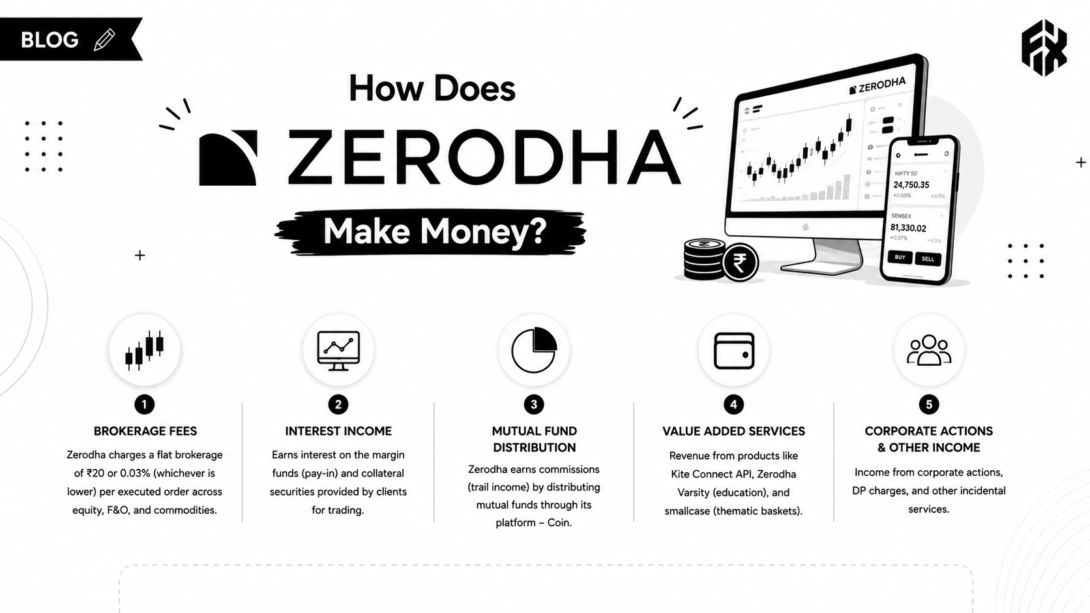
So how does Zerodha make money when opening an account is free, buying and holding stocks costs ₹0 in brokerage, and the founders have never taken a single rupee of outside investment? You place an order to buy shares of a company you believe in, hold it for years, and Zerodha never charges you a brokerage fee for that trade — not today, not when you eventually sell. And yet this same, famously stingy-on-fees company reported a net profit of ₹4,237 crore in its most recent full financial year, entirely self-funded, with founders who’ve never had to answer to a single venture capitalist.
That’s the puzzle worth unpacking. Zerodha didn’t get rich by charging people for the trades most people actually make. It got rich by charging a small, flat fee on the trades a much smaller, much more active slice of its users make constantly — and by building almost everything else around that one insight.
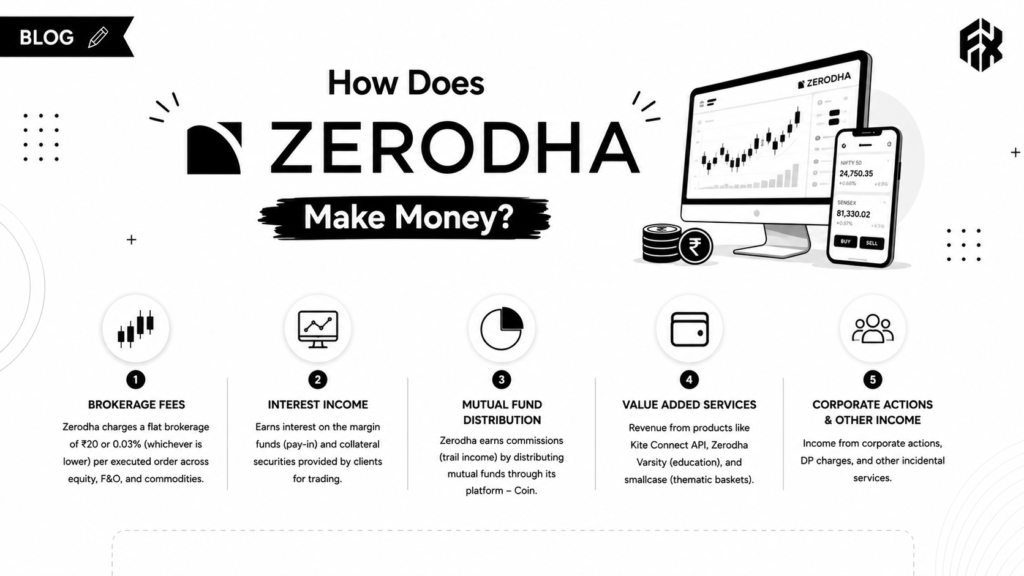
How Does Zerodha Make Money? The Short Answer
Zerodha makes money primarily through flat brokerage fees on intraday equity trades, futures and options (F&O), currency, and commodity trading — charging a fixed amount per executed order rather than a percentage of trade value, and charging nothing at all on equity delivery trades. Roughly 55% of Zerodha’s brokerage revenue comes from F&O trading alone, making it by far the single largest driver of the business. Beyond brokerage, Zerodha earns from depository participant (DP) charges, interest on client funds, margin trade funding, and a growing set of adjacent financial products including mutual fund distribution, insurance advisory, and lending against securities.
For the financial year ending March 2025 (FY25), Zerodha reported revenue from operations of ₹8,847 crore and a net profit of ₹4,237 crore — a decline from the previous year’s ₹5,496 crore profit, driven largely by new securities market regulation that specifically curbed the F&O trading volumes Zerodha depends on most. That dependence, and Zerodha’s very public effort to reduce it, is one of the more interesting business stories in Indian fintech right now.
Ten Lakh Rupees, No Investors, and a Name That Means “Zero Barriers”
Zerodha was founded in August 2010 by brothers Nithin and Nikhil Kamath in Bengaluru, starting with just ₹10 lakh (roughly $12,000 at the time) of their own personal capital. Nithin had built and run a smaller brokerage business before Zerodha; Nikhil had dropped out of school after tenth grade, worked a call center job for ₹8,000 a month, and taught himself to trade. Neither had a conventional finance-industry pedigree, and neither has ever raised a single rupee of external venture capital in the company’s entire history — an almost unheard-of choice for a fintech company that now manages roughly 10% of India’s total retail and high-net-worth individual assets under management.
The name itself explains the founding thesis: “Zerodha” combines “zero” with “rodha,” the Sanskrit word for barrier or obstruction — literally, zero barriers to trading. At the time, Indian retail brokerages typically charged a percentage of trade value, meaning a trader buying ₹1 lakh worth of shares might pay several hundred rupees in brokerage regardless of how simple the trade was. Zerodha’s founding bet was that a flat fee — the same charge whether you traded ₹10,000 or ₹10 lakh worth of shares — would be dramatically cheaper for active traders and would fundamentally change who could afford to trade frequently in Indian markets. That bet built the company that’s now India’s largest discount broker by active client count.
The brothers split responsibilities in a way that shaped the company’s culture from day one: Nithin ran operations and set the company’s public-facing tone, while Nikhil focused on trading and, later, on building out Zerodha’s broader investment activities through Rainmatter. Neither brother took outside funding even as Zerodha scaled into one of India’s most valuable private fintech companies, a decision that meant slower early growth than a venture-backed competitor might have achieved, but complete control over pricing, product decisions, and long-term strategy without investor pressure to prioritize growth metrics over sustainable unit economics. That patience is arguably why Zerodha survived — and eventually thrived through — a decade in which several well-funded Indian brokerage startups burned through investor capital chasing growth before finding a durable path to profit.
Zero Brokerage on Delivery: The Loss-Leader That Built the User Base
Here’s the piece of Zerodha’s model that looks the most counterintuitive at first: equity delivery trades — buying shares and actually holding them in your demat account, rather than selling within the same day — carry zero brokerage. You can buy and hold as much stock as you want through Zerodha and never pay a brokerage fee for the transaction itself.
This isn’t generosity for its own sake — it’s a deliberate acquisition strategy built on a simple insight. Long-term investors who buy and hold stocks trade infrequently, which means they’d generate very little brokerage revenue for Zerodha even if the company did charge them. By charging exactly ₹0 instead, Zerodha removes any reason for a long-term investor to consider a competitor on cost grounds, acquiring millions of users essentially for free and keeping them on the platform for the long haul — where some percentage will eventually also trade intraday or in F&O, which is where the real revenue lives.
Suggested image: comparison graphic showing ₹0 brokerage on equity delivery vs flat-fee brokerage on intraday and F&O trades. Filename: how-zerodha-makes-money-fee-structure.webp. Alt text: “How Zerodha makes money — comparison of zero delivery brokerage versus flat-fee intraday and F&O charges.” Caption: “Delivery trades cost nothing; intraday and F&O carry a flat fee per order.”
F&O: The Flat Fee That Quietly Built the Entire Profit
If delivery trading is the free acquisition funnel, futures and options (F&O) trading is where Zerodha’s actual profit engine lives. Unlike delivery investors, F&O traders execute orders constantly — often dozens or hundreds of times a day — and each executed order carries Zerodha’s flat brokerage fee regardless of trade size. That volume, multiplied across millions of active traders, is what turned a flat, seemingly modest per-order fee into a business generating thousands of crores in annual profit.
The scale of this dependence is genuinely striking: F&O trading alone has accounted for roughly 55% of Zerodha’s total brokerage revenue in recent years. That concentration is exactly why India’s 2024–2025 regulatory reforms targeting F&O speculation — covered in more detail further down — hit Zerodha’s revenue so directly and so visibly, in a way that a more diversified brokerage might have absorbed more gently.
It’s worth understanding why F&O trading generates so much more brokerage activity than delivery investing in the first place. Options and futures contracts have expiry dates, meaning positions naturally need to be opened and closed within defined windows rather than held indefinitely the way a delivery stock purchase can be. Many F&O traders also use these instruments specifically for short-term speculation or hedging, executing multiple trades within a single day or week rather than a single buy-and-hold decision. Multiply that trading frequency across millions of active F&O participants, and even a genuinely small flat fee per order compounds into the majority of a discount broker’s entire revenue base — which is precisely the mechanic Zerodha built its business model to capture.
The Small Fees Nobody Notices: DP Charges, Call & Trade, and Float Income
Beyond the headline brokerage structure, Zerodha earns from a handful of smaller, less-discussed fees that add up meaningfully at scale. Depository Participant (DP) charges apply whenever shares are sold out of a demat account — a modest, mostly pass-through statutory fee plus a small Zerodha component, charged per company sold rather than per order. Call & trade fees apply if a client places an order by phone rather than through the app or web platform, a deliberate nudge toward self-service that also monetizes the minority of users who prefer assisted trading.
There’s also a quieter, industry-wide revenue source common to essentially every brokerage: interest earned on client funds sitting in Zerodha’s accounts before being deployed into trades or investments. This “float income” — interest on money that technically belongs to clients but sits temporarily with the broker — is a standard, regulated part of how brokerages everywhere generate additional revenue beyond transaction fees, and it scales directly with the size of Zerodha’s overall client base and their account balances.
The 2026 Pivot: MTF, Zerodha Capital, and Reducing F&O Dependence
Following the F&O revenue shock detailed later in this piece, Nithin Kamath has been unusually candid, publicly stating the company’s explicit goal is to “pivot and reduce the reliance on F&O for revenue.” The stated plan spans several new and expanded product lines: Margin Trade Funding (MTF), where Zerodha lends clients money to buy stocks on margin and earns interest on that lending; public and private market investments made through Rainmatter, Zerodha’s investment arm; loans against securities through Zerodha Capital, letting clients borrow against their existing stock holdings rather than selling them; Zerodha Fund House, the company’s own mutual fund asset management business launched in partnership with portfolio-platform smallcase; and Ditto, an insurance advisory joint venture with financial newsletter Finshots.
Each of these represents a genuinely different monetization mechanism than flat-fee brokerage — interest income on lending (MTF, loans against securities), asset management fees (Zerodha Fund House), and commission-based advisory (Ditto insurance) — spreading Zerodha’s revenue across products whose economics don’t rise and fall with F&O trading volume the way brokerage fees do. It’s a strategic shift that looks a great deal like the diversification playbook other platforms in this series have followed when a single revenue stream became too concentrated a risk to depend on alone.
Suggested image: diagram showing Zerodha’s diversification from pure F&O brokerage toward MTF, lending, mutual funds, and insurance. Filename: zerodha-revenue-diversification-strategy.webp. Alt text: “How Zerodha makes money — diversification strategy away from F&O brokerage dependence.” Caption: “Zerodha is deliberately building revenue streams that don’t depend on F&O trading volume.”
Rainmatter: Turning Profit Into a Fintech Ecosystem
A less conventional piece of how Zerodha makes money — or rather, how it deploys the money it makes — is Rainmatter, the company’s investment arm and startup incubator. Rainmatter invests Zerodha’s own profits into fintech and health-tech startups across India, functioning simultaneously as a strategic bet on the broader ecosystem Zerodha operates in and, occasionally, a genuine source of investment returns. Kamath has noted that Zerodha’s reported profit figures in recent years haven’t even included certain unrealized gains from these investments — in one instance, roughly ₹1,000 crore in unrealized gains sitting outside the headline profit number entirely.
Rainmatter is best understood as patient, strategic capital rather than a revenue line item Zerodha reports quarter to quarter. It lets Zerodha support the broader fintech infrastructure that ultimately benefits its own core trading and investing business — better financial literacy tools, better trading infrastructure, healthier competitors and complements in the ecosystem — while occasionally generating direct investment gains as a side effect of that strategic positioning.
This kind of ecosystem investment is a genuinely unusual move for a company Zerodha’s size to fund purely from its own retained profits rather than a dedicated venture fund raised from outside limited partners. It reflects a broader philosophy Kamath has spoken about publicly: that Zerodha’s own long-term success is tied to India’s overall financial ecosystem maturing, not just to Zerodha’s individual market share. Investing profits into adjacent fintech and health-tech startups through Rainmatter is, in that sense, less a diversification tactic and more an extension of the same founding instinct that led Zerodha to build Varsity and offer free mutual fund investing — a bet that a healthier, more financially literate ecosystem around Zerodha ultimately grows Zerodha’s own business too, even if the connection isn’t always a direct, immediately monetizable one.
Kite Connect, Coin, and Varsity: Free Products With a Purpose
Zerodha runs several products that are free or nearly free to most users, and each exists for a specific strategic reason rather than as a direct profit center. Coin, Zerodha’s direct mutual fund investment platform, lets users invest in mutual funds without paying the trail commissions a traditional distributor would typically earn — another deliberate zero-fee acquisition tool that keeps investors inside Zerodha’s ecosystem for a financial activity (mutual fund investing) that might otherwise send them to a separate platform entirely.
Varsity, meanwhile, is Zerodha’s free stock market education platform — extensive, genuinely well-regarded educational content covering everything from trading basics to advanced options strategies. It generates no direct revenue at all, but it does something arguably more valuable to Zerodha’s long-term business: it builds trust and financial literacy in exactly the audience most likely to eventually become active, monetizable traders on the platform, all while reinforcing Zerodha’s brand as an educator rather than a company purely trying to extract fees from its users.
The one place Zerodha does charge developers directly is Kite Connect, its trading API that lets third-party developers and algorithmic traders build custom applications on top of Zerodha’s infrastructure. Kite Connect carries a recurring monthly subscription fee per registered app — a genuinely B2B-style revenue stream sitting alongside Zerodha’s otherwise consumer-facing, mostly-free product suite, monetizing the smaller, more technical segment of users building tools rather than simply placing trades manually.
Zerodha’s Revenue, Year by Year
Here’s the trajectory, based on Zerodha’s own consolidated financial filings with India’s Registrar of Companies:
| Fiscal Year (ending March) | Revenue | Net Profit | Notes |
|---|---|---|---|
| FY23 | ₹6,875 crore | ₹2,907 crore | — |
| FY24 | ~₹9,372 crore (total income) | ₹5,496 crore | Peak year before regulatory reforms |
| FY25 | ₹8,847 crore (revenue from operations) | ₹4,237 crore | Down 11.5% revenue, down 22.9% profit YoY |
Even with FY25’s decline, Zerodha’s operating margin actually expanded, from 55.25% in FY24 to 63.78% in FY25 — a reminder that even a meaningful revenue contraction can coincide with improved cost discipline. The company’s cash and bank balances more than doubled over the same period, from ₹10,211 crore to ₹22,679 crore, and it remains entirely debt-free. Kamath has noted that Zerodha’s net worth now sits at roughly 40% of the customer funds it manages, a direct result of three consecutive years of strong profitability being retained rather than distributed or reinvested externally, since there are no outside shareholders to pay dividends to.
The SEBI Shock That Hit the Entire Model at Once
Starting in October 2024, India’s securities regulator, SEBI, introduced sweeping reforms to the futures and options market specifically aimed at protecting retail traders from speculative losses: reducing weekly options expiries from multiple per exchange down to just one per exchange, increasing minimum contract sizes, and raising margin requirements across the board. Because these changes directly targeted the frequency and accessibility of F&O trading — the exact activity generating roughly 55% of Zerodha’s brokerage revenue — the impact showed up almost immediately. Zerodha’s brokerage revenue reportedly fell by as much as 40% year over year in a single quarter following the reforms.
The scale of that shock was significant enough that Nithin Kamath publicly acknowledged in October 2025 that Zerodha might eventually be “forced to charge brokerage” on equity delivery trades — a statement that would have been genuinely unthinkable just two years earlier, given how central the zero-delivery-brokerage model has been to Zerodha’s entire brand identity and growth story. Whether that actually happens remains to be seen, but the fact that it’s being discussed publicly at all shows how directly a single regulatory shift can reshape the economics of a business this dependent on one trading category.
Zerodha vs Groww: Bootstrapped Discipline vs Venture-Funded Scale
It’s worth situating Zerodha against Groww, its closest and fastest-growing competitor, because the two represent genuinely different paths to the same market. Groww raised significant venture capital, grew aggressively on user acquisition, overtook Zerodha in total active client count — reportedly around 13 million users versus Zerodha’s 7.5 to 7.6 million — and completed a public stock market listing, giving early investors and employees a liquidity path Zerodha’s founders have never needed to offer anyone outside the family.
But active user count isn’t the same as revenue efficiency, and this is where the comparison gets genuinely interesting: Zerodha generated ₹8,847 crore in revenue from roughly 7.5 million active clients, while Groww generated a reported ₹3,145 crore from nearly 13 million — meaning Zerodha extracts dramatically more revenue per active user than its larger, venture-backed rival. That gap likely reflects Zerodha’s older, more established user base skewing toward more active, higher-volume traders, alongside Groww’s newer, larger user base still maturing into higher-frequency trading habits. It’s a useful reminder that “more users” and “more revenue” aren’t automatically the same story, and that a smaller, more engaged base can out-earn a much larger one under the right monetization structure.
The two companies’ ownership structures also diverge just as sharply as their user-growth strategies. Zerodha’s bootstrapped, fully family-owned status means Nithin and Nikhil Kamath can set their own compensation without any board of outside investors weighing in — FY25 filings showed the brothers drew ₹96 crore each in total remuneration, even as company profit fell 23% that same year. Groww’s path through venture funding and a public listing means its governance, reporting obligations, and executive compensation now answer to public shareholders and a board with outside representation — a structural difference that shapes everything from strategic patience to how aggressively each company can spend on user acquisition without needing to justify it to external stakeholders every quarter.
What Could Threaten This Model
Even with a fortress-like balance sheet and zero debt, Zerodha’s business carries real, currently visible risks.
- F&O concentration remains the single biggest vulnerability. At roughly 55% of brokerage revenue, any further regulatory tightening around options and futures trading would hit Zerodha’s top line directly, the same way the 2024–2025 SEBI reforms already have.
- Regulatory risk in Indian brokerage has clearly intensified. Kamath himself has spoken for years about the regulatory risk inherent in running a brokerage business, and 2024–2025 was the year several of those risks — expiry reforms, margin rule changes, rising securities transaction tax — materialized simultaneously rather than gradually.
- Competitive pressure from listed, capital-rich rivals. Groww’s public listing gives it currency (its own stock) to fund acquisitions, technology investment, and aggressive marketing in ways a fully bootstrapped Zerodha, by choice, doesn’t pursue.
- The zero-brokerage delivery model may not be permanent. Kamath’s own public comments about potentially needing to charge brokerage on delivery trades signal that Zerodha’s most iconic pricing feature isn’t guaranteed to survive continued F&O revenue pressure indefinitely.
- Diversification into MTF, lending, and asset management introduces new risk categories. Margin lending and loans against securities carry credit and market risk that pure flat-fee brokerage never did — a genuinely different risk profile than the business Zerodha built its reputation on.
None of these risks have dented Zerodha’s fundamental position as India’s most profitable major discount broker, but 2024 and 2025 proved decisively that even a well-run, debt-free, fully self-funded business can see its core revenue shaken hard by a single regulatory decision — a genuinely different kind of risk than competitive pressure or slowing growth.
What This Means If You’re Actually Trading on Zerodha
Understanding how Zerodha makes money is also useful if you’re deciding how to trade on the platform. For long-term investors buying and holding stocks, the practical takeaway is simple: the zero-brokerage delivery model has held for well over a decade and remains core to Zerodha’s brand identity, even amid public discussion of possible future changes — there’s no indication a delivery brokerage fee is imminent, though Kamath’s own comments suggest it’s no longer unthinkable either.
For active intraday and F&O traders, it’s worth remembering that Zerodha’s flat fee structure rewards larger trade sizes specifically because the fee doesn’t scale with value — a ₹50,000 F&O trade and a ₹5 lakh F&O trade carry the identical flat brokerage charge, which is a genuinely different cost structure than a percentage-based full-service broker would offer. That makes Zerodha’s model disproportionately attractive to traders executing larger positions less frequently, compared to traders making many small trades, where the flat per-order fee makes up a bigger share of overall trade value.
FAQs
Does Zerodha charge brokerage on all trades? No. Equity delivery trades — buying and holding shares — carry zero brokerage. Intraday equity, F&O, currency, and commodity trades carry a flat fee per executed order, regardless of trade size.
How much revenue does Zerodha make? Zerodha reported revenue from operations of ₹8,847 crore for FY25 (year ending March 2025), down 11.5% from the prior year, with a net profit of ₹4,237 crore.
Why did Zerodha’s profit drop in FY25? SEBI introduced F&O market reforms in October 2024 — reducing weekly options expiries, raising contract sizes, and tightening margin requirements — which directly reduced trading volumes in the category responsible for roughly 55% of Zerodha’s brokerage revenue.
Has Zerodha ever raised venture capital? No. Zerodha was founded with ₹10 lakh of the Kamath brothers’ personal capital in 2010 and remains 100% owned by the Kamath family, with no external investors at any point in its history.
What does the name “Zerodha” mean? It combines “zero” with “rodha,” the Sanskrit word for barrier — reflecting the company’s founding mission to remove cost barriers to trading and investing in India.
Is Zerodha bigger than Groww? By active client count, no — Groww has more users, reportedly around 13 million versus Zerodha’s 7.5 to 7.6 million. By revenue, Zerodha still earns significantly more overall and per active client.
What is Zerodha’s Kite Connect? Kite Connect is Zerodha’s trading API, letting developers and algorithmic traders build custom applications on top of Zerodha’s platform for a recurring monthly subscription fee per registered app.
Final Word
How does Zerodha make money? By charging almost nothing for the trade most people actually make — buying and holding stocks — and a flat, volume-driven fee on the high-frequency F&O trading that a smaller, more active slice of users generates constantly. That concentration built an extraordinarily profitable, fully bootstrapped business for over a decade, but 2024 and 2025 proved it also carries real regulatory fragility. Zerodha’s next chapter — margin lending, its own mutual fund house, insurance advisory, loans against securities — is a deliberate bet that the business can stay this profitable without depending so heavily on one trading category regulators have shown they’re willing to reshape overnight.
If you’re studying fintech business models like this one for your own research or content strategy, Finmaticx’s AI Prompt Generator and Finmaticx GPT tools can help you move faster. You’ll find more platform revenue breakdowns like this one in the Finmaticx blog, and you can learn more about what we cover on our About Us page.