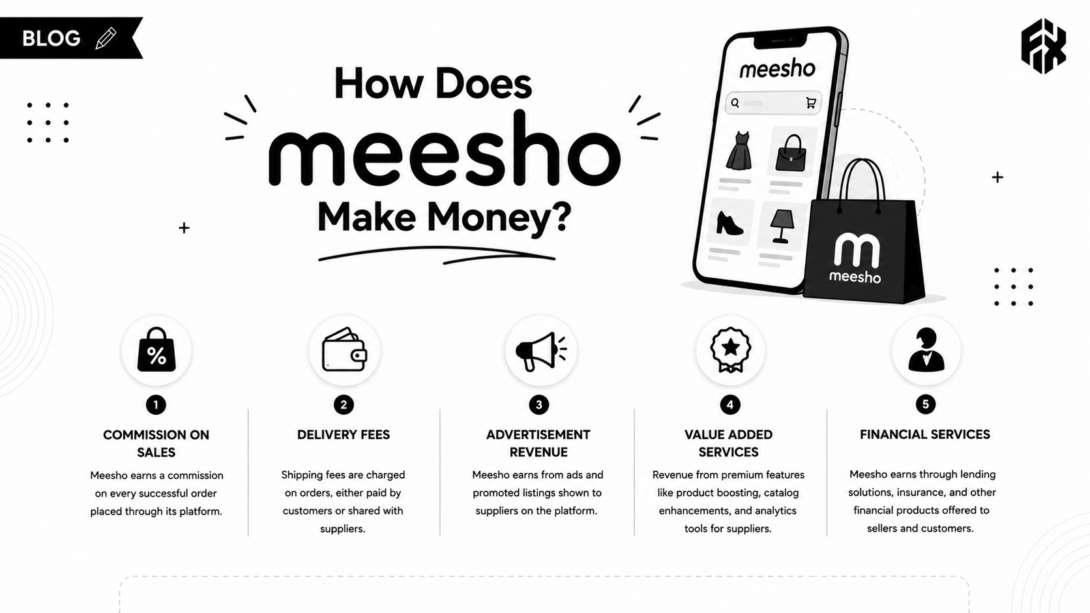
So how does Meesho make money when its entire pitch to sellers is that it won’t take a cut of their sales? A reseller in a small town lists a ₹250 kurti on Meesho, a customer three states away buys it, and Meesho — unlike Amazon or Flipkart — doesn’t charge that seller a commission on the sale itself. That’s the opposite of how nearly every major marketplace on earth makes money. And yet Meesho went public in December 2025 in one of the most oversubscribed IPOs India has seen in years, on the back of nearly ₹9,400 crore in annual revenue.
The short version: Meesho makes money almost entirely around the transaction, not on it — delivery charges, advertising, and a growing set of value-added seller services, while keeping the core promise of zero commission intact for the vast majority of listings. Understanding how Meesho makes money means understanding why giving up the most obvious revenue lever in e-commerce turned out to be the thing that built its entire competitive advantage.
How Does Meesho Make Money? The Short Answer
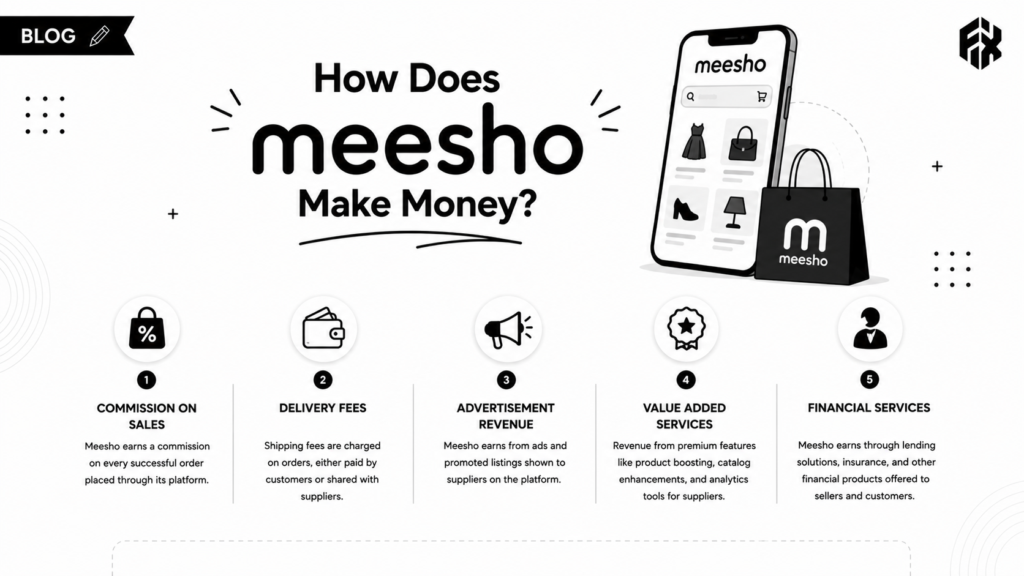
Meesho makes money primarily through delivery charges paid by customers, advertising fees paid by sellers who want better product visibility, and a smaller but growing set of value-added services including Meesho Mall (a curated section for branded goods where Meesho does charge traditional commission), paid seller analytics tools, and early-stage fintech offerings like working capital loans for sellers. Meesho’s core marketplace itself remains commission-free for the large majority of sellers — a deliberate structural choice, not an oversight.
For FY25 (the year ending March 2025), Meesho reported revenue from operations of ₹9,389.90 crore, alongside a net loss of ₹3,941.71 crore — a sharp reversal from FY24, when the company posted its first-ever annual profit of ₹327.64 crore. That reversal wasn’t really about the underlying business weakening; it was driven largely by one-time exceptional charges tied to corporate restructuring ahead of Meesho’s IPO, which is covered in detail further down. By FY26, the first full year as a listed company, revenue grew 34.5% to ₹12,626.35 crore and losses narrowed by 66%.
From WhatsApp Resellers to a Listed E-Commerce Giant
Meesho was founded in December 2015 in Bengaluru by Vidit Aatrey and Sanjeev Barnwal, originally incorporated as FashNear Technologies Private Limited. The name Meesho is short for “Meri Shop” — Hindi for “my shop” — and the original product wasn’t a marketplace at all. It was a tool that let individuals, mostly women working from home, become resellers with zero upfront capital: browse a catalog of products, share them through WhatsApp, Facebook, and Instagram to their own personal networks, and earn a margin on whatever they sold, with Meesho handling sourcing and fulfillment behind the scenes.
That reseller-first model shaped Meesho’s entire trajectory. Rather than competing head-on with Amazon and Flipkart for the same urban, brand-conscious shoppers, Meesho built its business around India’s vastly larger, historically underserved population in smaller towns and cities — value-conscious buyers looking for the lowest possible price on everyday goods, and sellers with thin margins who couldn’t absorb the commission structures larger marketplaces charged. Meesho later evolved from a pure social-reselling app into a full marketplace any registered buyer could shop on directly, but that founding orientation toward affordability and small-seller economics never left the business model, and it’s the reason the zero-commission structure exists at all.
It’s worth noting how counterintuitive this founding bet looked at the time. In the mid-2010s, most Indian e-commerce investment and attention was chasing exactly the customers Meesho deliberately avoided — urban, higher-income shoppers Amazon and Flipkart were already fighting over. Aatrey and Barnwal instead built specifically for a reseller network operating through personal WhatsApp and Facebook contacts, a distribution mechanism nobody else was taking seriously as a primary acquisition channel. That contrarian focus on India’s smaller cities turned out to represent a vastly larger, if individually lower-value, customer base than the metro market everyone else was fighting over — and it gave Meesho a genuinely differentiated position rather than having to out-discount two much better-capitalized rivals in their own core markets.
Zero Commission: The Model That Made Meesho Different
Every major e-commerce marketplace on earth, from Amazon to Flipkart to Etsy, earns a meaningful share of its revenue by taking a referral fee or commission on each sale — typically somewhere between 5% and 20% of the transaction value, depending on category. Meesho’s core marketplace charges none of that. A seller listing a product and completing a sale through Meesho’s standard marketplace keeps essentially the full sale price, minus the costs Meesho does charge for elsewhere.
This wasn’t a temporary promotional discount — it’s been the structural core of Meesho’s seller value proposition for years, and it’s precisely what let the platform undercut larger competitors on price for extremely thin-margin categories like unbranded fashion and home goods, where a typical marketplace commission could easily wipe out a small seller’s entire profit on a ₹200 to ₹300 item. Removing that cost entirely is what let Meesho build a seller base willing to list products at prices metro-market marketplaces simply couldn’t match.
Suggested image: comparison graphic showing Meesho’s zero-commission model versus typical marketplace commission rates. Filename: how-meesho-makes-money-zero-commission-model.webp. Alt text: “How Meesho makes money — zero-commission seller model compared to typical marketplace fees.” Caption: “Meesho’s core marketplace charges no commission on seller sales, unlike most major e-commerce platforms.”
Delivery Charges and Advertising: Where the Revenue Actually Lives
If commission isn’t the revenue source, two things are doing most of the work instead. The first is delivery charges — Meesho earns from the shipping and logistics fees paid by customers on each order, a cost the company has deliberately kept among the lowest in the industry to stay competitive with its value-focused positioning, but one that’s charged consistently across the platform’s enormous order volume. The second is advertising: sellers who want their listings to appear more prominently in search results or category pages can pay Meesho directly for that visibility, functioning much like sponsored product placements on any other major marketplace, just layered on top of a commission-free base rather than alongside a commission.
Together, these two streams have to do the work that commission does for competitors — and the scale of Meesho’s order volume is precisely what makes that math viable. With roughly 199 million customers transacting on the platform in FY25 alone, even modest per-order delivery and advertising economics compound into a meaningful revenue base, without ever requiring Meesho to break its core zero-commission promise to sellers.
Meesho Mall: The One Place Commission Does Apply
There’s a notable exception to Meesho’s zero-commission identity: Meesho Mall, a curated section of the platform dedicated to branded goods rather than the unbranded, value-tier products that make up most of the core marketplace. On Meesho Mall, the company moves away from its zero-commission structure entirely and charges traditional commission rates, similar to how Amazon or Flipkart would charge a branded seller.
The logic here is straightforward market segmentation. Branded sellers — established companies with recognizable products and existing distribution — have fundamentally different margin structures than a home-based reseller selling unbranded ₹200 kurtis, and they’re both willing and able to absorb a standard commission the way they would on any other marketplace. Rather than applying one universal pricing model across an extremely diverse seller base, Meesho effectively runs two different monetization strategies side by side: zero commission for the value-tier sellers who built the platform’s original identity, and standard commission for the branded sellers being courted through Meesho Mall as the platform matures and broadens its catalog.
Seller Insights, Creator Collaborations, and Seller Lending
Beyond the core revenue engines, Meesho has been layering in smaller, higher-margin services aimed specifically at its seller base. Seller Insights offers paid analytics tools — data on what’s selling, pricing intelligence, and catalog optimization guidance — helping sellers make better inventory and pricing decisions in exchange for a subscription or usage fee. Creator collaborations connect sellers with social media creators for promotional partnerships, a monetizable layer built on top of Meesho’s broader marketing ecosystem.
Perhaps the most strategically significant of these newer lines is early-stage fintech services, including working capital loans offered to sellers. This mirrors a pattern seen across several platforms in this series — once a marketplace has deep, real-time visibility into a seller’s actual sales performance, it’s uniquely positioned to underwrite short-term lending more efficiently than a traditional bank could, earning interest or fees on that lending without needing to compete purely on marketplace commission. Meesho has also continued investing in AI-driven tools for catalogue optimization, pricing intelligence, and performance analytics — infrastructure that supports both the free core marketplace experience and these newer, directly monetized seller services.
Suggested image: overview graphic of Meesho’s revenue streams — delivery fees, advertising, Meesho Mall commission, Seller Insights, and lending. Filename: meesho-revenue-streams-overview.webp. Alt text: “How Meesho makes money — overview of delivery fees, advertising, Meesho Mall commission, and seller services.” Caption: “Meesho layers multiple revenue streams around, rather than on top of, its zero-commission core marketplace.”
Why Value Commerce Works: Tier-2, Tier-3, and Beyond
Meesho’s entire monetization strategy only makes sense in the context of who it’s actually built for. The company holds notable market share in specific value-tier categories — roughly 21 to 23% in fashion, 23 to 25% in home and kitchen goods, and 8 to 10% in beauty and personal care — concentrated heavily among customers in India’s smaller cities and towns, a demographic historically underserved by Amazon and Flipkart’s more metro-centric, higher-average-order-value focus.
That focus shows up directly in Meesho’s cost discipline. Advertising and sales promotion expenses fell from ₹927.8 crore in FY23 to ₹643.5 crore in FY25, dropping from 4.8% to 2.2% of net merchandise value from its marketplace over that period — a sign that Meesho’s customer acquisition has become meaningfully more efficient as its brand recognition and organic reseller-driven distribution have matured, rather than requiring ever-larger marketing spend to sustain growth. Server and software infrastructure costs saw a similar efficiency gain, falling from 2.9% to 2.0% of marketplace NMV over the same period. Those declining cost ratios are precisely what let Meesho’s unit economics turn positive even while keeping prices and commission structures aggressively low for its core seller base.
There’s a broader lesson in that cost trend for anyone studying platform economics generally: efficiency in a marketplace business tends to come less from any single feature and more from the compounding effect of scale meeting a genuinely well-matched customer base. Meesho didn’t need to out-market Amazon or Flipkart to acquire Tier-2 and Tier-3 customers, because its original reseller network already had organic, trust-based distribution built into personal social networks — a customer acquisition channel that gets cheaper per user as the network itself grows, rather than more expensive the way paid digital advertising typically does at scale.
Meesho’s Revenue, Year by Year
Here’s the trajectory, based on Meesho’s own financial disclosures and its IPO prospectus filings:
| Fiscal Year (ending March) | Revenue from Operations | Net Profit / (Loss) | Notes |
|---|---|---|---|
| FY24 | — | +₹327.64 crore | First-ever annual profit |
| H1 FY25 | ₹4,405 crore | +₹27 crore (core marketplace) | Up 24% YoY |
| FY25 | ₹9,389.90 crore | (₹3,941.71 crore) | Loss driven by one-time exceptional items |
| Q4 FY25 | ₹2,400 crore | (₹1,391 crore) | — |
| Q4 FY26 | ₹3,531 crore | (₹166 crore) | Up 47% YoY revenue |
| FY26 (full year) | ₹12,626.35 crore | (₹1,357.74 crore) | Revenue up 34.5%, loss narrowed 66% |
The pattern worth sitting with here is the dramatic gap between FY25’s headline loss and the underlying trend both before and after it. FY24 was genuinely profitable. FY26 losses narrowed by two-thirds even as revenue grew by more than a third. FY25’s roughly ₹3,942 crore loss looks, in that context, less like a business in trouble and much more like a single year absorbing a large, mostly non-recurring accounting hit — which is exactly what happened.
The Reverse Flip and the One-Time Loss That Spooked Headlines
FY25’s headline loss requires context that a lot of surface-level coverage skipped past: Meesho, like several other India-focused startups originally incorporated overseas, completed a “reverse flip” — shifting its parent holding entity from the US back to India ahead of its planned Indian stock exchange listing. That kind of cross-border restructuring triggers real tax obligations and accounting charges in the year it happens, and Meesho’s FY25 results explicitly cite tax implications from corporate restructuring, alongside accelerated ESOP expenses tied to the same reorganization, as the primary drivers of that year’s outsized loss.
This is a genuinely common pattern for Indian consumer tech companies preparing to list domestically — PhonePe went through a similar redomiciliation process years earlier, reportedly at a cost of close to $1 billion in taxes, before its own planned IPO. Meesho’s version shows up differently in the numbers — as a large one-time loss rather than a separately disclosed tax bill — but the underlying logic is the same: absorbing a real, one-time financial cost in exchange for a cleaner path to a domestic listing that Indian retail investors can actually participate in.
This pattern has become common enough across Indian startups that it’s worth understanding as a structural feature of this generation of companies rather than a Meesho-specific quirk. Many Indian consumer internet startups incorporated their parent holding entity in Singapore or the US in their earlier funding years, largely because global investors and existing venture capital structures found those jurisdictions simpler to invest through. As Indian regulators made domestic listings increasingly attractive — and as SEBI’s rules made it clear that a foreign-domiciled parent complicates an Indian stock exchange listing — a wave of these companies, Meesho and PhonePe among them, have absorbed the one-time cost of moving the parent entity back to India specifically to enable a clean domestic IPO. Investors reading a single bad year buried inside an otherwise strong growth trajectory are increasingly likely to be looking at exactly this kind of restructuring charge rather than genuine operational deterioration — which is exactly why reading the actual RHP or annual report disclosures matters more than reacting to a headline loss figure alone.
The IPO: 79x Oversubscribed, and What Came After
Meesho’s IPO opened on December 3, 2025, and closed December 5, priced at ₹105 to ₹111 per share, with a total issue size of roughly ₹5,421 crore — split between a ₹4,250 crore fresh issue and a ₹1,171 crore offer for sale. The offering priced the company at approximately ₹50,000 to ₹53,000 crore (roughly $5.6 to $6 billion), working out to a price-to-sales multiple of around 4.5 to 5.5 times FY25 revenue — notably cheaper than the roughly 7 times sales multiple typical of comparable e-commerce listings at the time, and far below high-growth Indian internet stocks like Zomato, which has traded at multiples above 10 times sales.
The retail response was extraordinary. The IPO was oversubscribed roughly 79 times overall, with retail investor demand alone running at about 19 times the shares available — meaning only around 1 in every 19 retail applicants who applied actually received an allotment. Meesho listed with a premium of roughly 38 to 46% over its issue price on debut day, one of the stronger listing performances among recent Indian consumer tech IPOs. The combination of a relatively conservative valuation multiple, a business narrative built around India’s genuinely under-monetized value-commerce segment, and the accessibility of a sub-₹111 share price all likely contributed to that demand.
Suggested image: timeline graphic of Meesho’s IPO — price band, oversubscription rate, and listing-day premium. Filename: meesho-ipo-timeline-oversubscription.webp. Alt text: “How Meesho’s December 2025 IPO was oversubscribed 79 times with a strong listing-day premium.” Caption: “Meesho’s IPO priced conservatively relative to peers and was met with unusually strong retail demand.”
Meesho vs Amazon vs Flipkart: Profit at a Lower Price Point
It’s worth placing Meesho’s monetization approach against its two largest competitors in the Indian market, because the contrast is genuinely striking. Both Amazon India and Flipkart — the latter majority-owned by Walmart — have historically operated at a loss in the Indian market despite average order values well above Meesho’s typical basket size, absorbing heavy losses in pursuit of market share in a notoriously price-sensitive, logistics-intensive market.
Meesho, operating at a meaningfully lower average order value and with a zero-commission structure that would seem to make profitability even harder to reach, has nonetheless achieved positive contribution margins on its core marketplace and posted an actual annual profit in FY24 — a genuinely unusual outcome given the comparison. The explanation isn’t a single clever feature; it’s the cumulative effect of everything covered above: lean logistics built specifically for low-ticket items, organic reseller-driven distribution that keeps customer acquisition costs down, and a monetization strategy built entirely around delivery and advertising rather than the commission structure that’s historically been the default assumption for how a marketplace has to make money.
What Could Threaten This Model
Even with an oversubscribed IPO and improving unit economics, Meesho’s business carries real risks worth naming honestly.
- Unit economics in low-ticket categories remain genuinely tight. Logistics costs, return rates, and marketing spend on ₹200 to ₹300 items leave far less margin cushion than a marketplace selling higher-value goods, meaning small shifts in delivery costs or return rates can swing profitability meaningfully.
- Competition from Amazon and Flipkart isn’t going away. Both companies have far deeper capital reserves and are actively pushing into the same Tier-2 and Tier-3 markets Meesho built its identity around, even if they haven’t matched Meesho’s specific zero-commission structure.
- The valuation prices in continued margin improvement. At roughly 4.5 to 5.5 times FY25 revenue, Meesho’s IPO pricing assumed the business would keep converting scale into better monetization — a trend that’s held so far through FY26, but isn’t guaranteed to continue at the same pace.
- Post-IPO governance and reporting obligations are new territory. As a newly listed company, Meesho now answers to public shareholders and quarterly reporting scrutiny in a way it didn’t as a private company — a structural shift that changes how much strategic patience management can exercise compared to its pre-IPO years.
- Dependence on third-party logistics and seller reliability. Meesho’s low-cost delivery model depends heavily on logistics partners and a large, distributed base of individual sellers rather than centralized fulfillment — a structure that scales efficiently but is harder to control end-to-end than a warehouse-first model.
None of these risks have derailed Meesho’s momentum through its first year as a public company — revenue and margins both improved meaningfully in FY26 — but they’re the honest counterweight to a genuinely strong IPO debut, and worth keeping in view for anyone following the stock or the business beyond the headline growth numbers.
What This Means If You’re a Seller Considering Meesho
Understanding how Meesho makes money is genuinely useful if you’re deciding whether to list products on the platform. For sellers of unbranded, low-cost goods — exactly the category Meesho was originally built around — the zero-commission structure remains a real, structural cost advantage compared to listing the same product on a marketplace charging a standard percentage-based commission, particularly for thin-margin items where even a modest commission could erase most of the profit.
For sellers of established branded products, Meesho Mall is worth evaluating on its own terms rather than assuming the platform’s zero-commission reputation applies universally — commission there functions much like it would on any other major marketplace, and the value proposition is more about Meesho’s reach into value-conscious, Tier-2 and Tier-3 customers than about avoiding fees altogether. And for any seller relying on Meesho’s growing seller-lending options, it’s worth remembering the same general caution that applies to platform-based working capital products elsewhere in this series: convenient access to capital from a platform that already has visibility into your sales performance is genuinely useful, but total repayment terms are worth comparing against alternatives before committing.
FAQs
Does Meesho charge sellers a commission? Not on its core marketplace — Meesho operates a zero-commission model for the vast majority of sellers. The exception is Meesho Mall, a curated branded-goods section where standard commission does apply.
How does Meesho make money if it doesn’t charge commission? Primarily through delivery charges paid by customers and advertising fees paid by sellers who want better product visibility, supplemented by Meesho Mall commissions, paid seller analytics tools, and early-stage lending services for sellers.
How much revenue does Meesho make? Meesho reported ₹9,389.90 crore in revenue from operations for FY25, growing to ₹12,626.35 crore in FY26 — a 34.5% increase — as a newly listed company.
Why did Meesho report a large loss in FY25 despite being profitable the year before? FY25’s loss was driven largely by one-time exceptional items tied to a corporate restructuring ahead of its IPO, including tax implications from shifting its parent entity to India and accelerated ESOP expenses, rather than a decline in the underlying business.
When did Meesho go public? Meesho’s IPO opened December 3, 2025, and closed December 5, 2025, priced at ₹105–111 per share, valuing the company at approximately ₹50,000–53,000 crore ($5.6–6 billion). It was oversubscribed roughly 79 times.
What is Meesho Mall? Meesho Mall is a curated section of the platform for branded goods, where Meesho charges traditional commission rates rather than following its zero-commission model used for the core marketplace.
How is Meesho different from Amazon and Flipkart in India? Meesho focuses on value-conscious customers in Tier-2 and Tier-3 cities with a zero-commission seller model and lower average order values, while Amazon India and Flipkart have historically operated at higher average order values but at a loss in the Indian market.
Final Word
How does Meesho make money? By refusing to charge the fee every other major marketplace treats as non-negotiable, and building an entire business model around delivery charges, advertising, and a growing set of adjacent services instead. That structural bet — combined with genuinely lean logistics and organic, reseller-driven growth — is what let Meesho reach profitability at a lower price point than competitors with far deeper pockets, and it’s the story that carried the company through one of the most oversubscribed Indian IPOs in recent memory.
If you’re studying e-commerce and marketplace business models like this one for your own research or content strategy, Finmaticx’s AI Prompt Generator and Finmaticx GPT tools can help you move faster. You’ll find more platform revenue breakdowns like this one in the Finmaticx blog, and you can learn more about what we cover on our About Us page.