“Zero commission” is one of the most effective marketing phrases fintech ever invented. It sounds like the platform makes nothing off your trades — which is exactly the impression it’s designed to create.
But Webull isn’t a nonprofit. It’s a publicly traded company (Nasdaq: BULL) that generated $571 million in revenue in 2025. So if it’s not charging you a commission on every trade, where does that revenue actually come from?
This article breaks down every revenue stream Webull relies on, backed by its own regulatory filings, and explains exactly how a “free” trading app turns into a real business.
What Is Webull?
Webull is an online brokerage and trading app that lets users trade stocks, options, ETFs, and — depending on the market — cryptocurrencies, with no per-trade commission. It’s headquartered in New York City and, as of its 2025 public listing, operates as Webull Corporation across the US and more than a dozen other markets, including parts of Asia Pacific, Europe, and Latin America.
The platform is known for its advanced charting tools, active-trader features, and a mobile-first design aimed at retail investors who want more depth than a basic investing app typically offers.
Webull’s Founding and IPO
Webull traces back to 2016, when founder Wang Anquan — a former Alibaba employee — set up Hunan Fumi Information Technology in China. The Webull trading platform itself launched in the U.S. in 2018, built around sophisticated charting and market-data tools, before pivoting toward the broader retail-trading audience that Robinhood had helped popularize.
In April 2025, Webull went public on Nasdaq under the ticker BULL, through a $7.3 billion merger with the special purpose acquisition company (SPAC) SK Growth Opportunities Corporation. Shares, warrants, and incentive warrants began trading under BULL, BULLW, and BULLZ respectively. By that point, Webull had grown to roughly 23 million registered users across 15 markets.
How Does Webull Make Money? The Core Revenue Streams
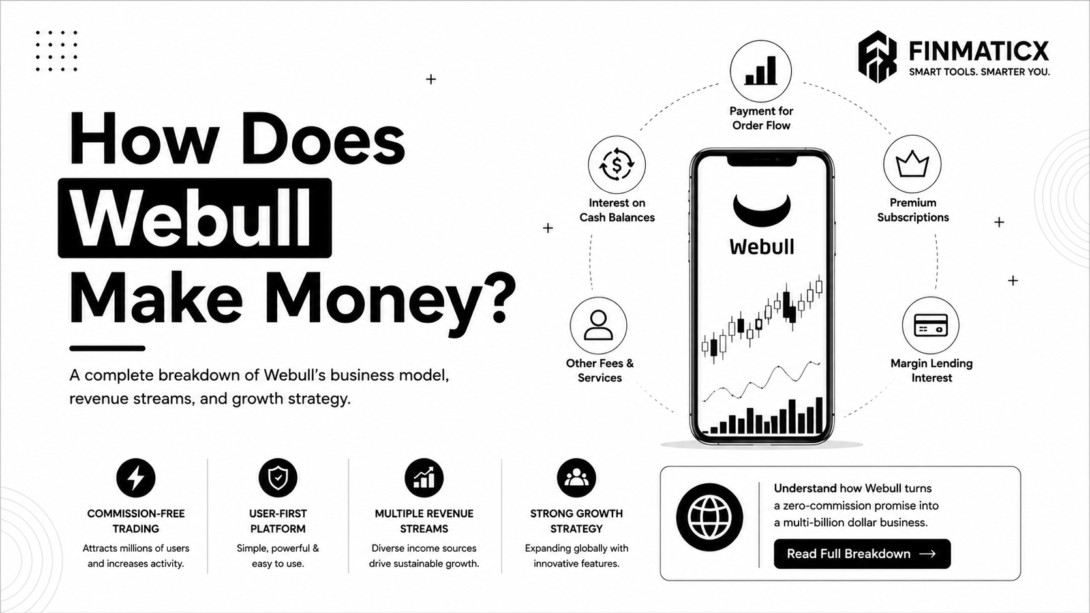
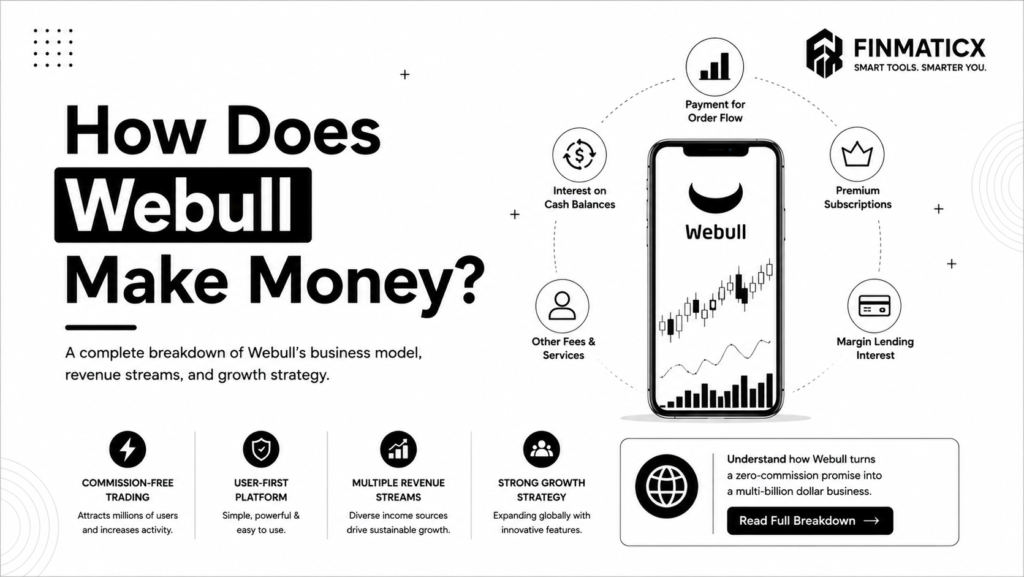
Based on Webull’s own 2025 annual report (Form 20-F, filed with the SEC in April 2026), the company’s revenue breaks down into four main categories:
- Equity and options order flow rebates (payment for order flow)
- Interest-related income (margin lending, cash sweep programs, and short-selling fees)
- Handling charge income (account and service fees)
- Other revenue (including subscriptions and smaller fee lines)
Let’s go through each one.
Payment for Order Flow (PFOF) — Webull’s Biggest Revenue Source
Payment for order flow is the mechanism that makes “commission-free” trading possible in the first place. Here’s how it works in plain terms:
- You place a trade on Webull.
- Instead of routing that order directly to a public exchange, Webull sends it to a market maker (a firm that buys and sells securities to keep markets liquid).
- The market maker pays Webull a small rebate for the right to execute that order, and profits from the difference between the buy and sell price (the bid-ask spread).
- Webull passes on zero commission to you, while collecting the rebate from the market maker instead.
On its own, each rebate is tiny — fractions of a cent per share. But multiplied across millions of trades a day, it adds up into real money. According to Webull’s own 2025 filing, order flow rebates brought in $304.1 million, making up roughly 53% of total revenue — up from about 50.5% the year before. Webull’s own risk disclosures flag this concentration as one of the business’s biggest vulnerabilities, since regulatory changes to PFOF could hit this revenue line directly.
Interest-Related Income
The second-largest piece of Webull’s revenue — $154.3 million in 2025 — comes from interest. This includes:
- Interest on margin loans users take out to trade with borrowed money
- Interest earned on uninvested cash sitting in customer accounts, which Webull can sweep into interest-bearing accounts at partner banks
- Fees related to short-selling activity, where traders borrow shares to sell
Like most modern brokerages, Webull benefits when interest rates are higher, since it earns more on both margin balances and idle cash sitting in customer accounts.
Handling Charge Income (Account and Service Fees)
Webull’s filing lists $87.3 million in 2025 under “handling charge income.” This covers a range of smaller, transaction-adjacent fees — things like regulatory pass-through fees, wire transfer charges, account transfer fees, and other administrative charges that brokerages typically pass on to active traders.
Margin Lending Interest
Beyond the interest income captured above, margin trading deserves its own mention because of how central it is to Webull’s active-trader user base. When a customer borrows money from Webull to buy more securities than their cash balance would normally allow, Webull charges interest on that borrowed amount — similar to how a credit line works. The more actively users trade on margin, the more this line item contributes.
Short-Selling / Stock-Borrow Fees
Short selling — betting that a stock’s price will fall — requires borrowing shares first. Webull, like other brokerages offering short-selling, charges interest or a borrow fee on the value of those borrowed shares for as long as the position stays open. This is typically only available to accounts holding a minimum balance, and it functions as a smaller but steady contributor to interest-related income.
Webull Premium Subscription
Webull also earns revenue through Webull Premium, a subscription tier priced at $3.99/month (or a discounted annual rate) that unlocks advanced market data, including deeper order-book visibility through Nasdaq TotalView-style data feeds. This is a much smaller revenue line than PFOF or interest income, but it represents Webull’s one direct, user-paid subscription product — the closest thing to a traditional “pay for the product” model on the platform.
Other Revenue
Webull’s filing includes an “other revenue” category totaling $25.3 million in 2025. This is a catch-all for smaller income sources that don’t fit neatly into the three main categories above — think smaller partnership arrangements, ancillary product fees, and similar minor revenue lines.
Webull’s 2025 Revenue Breakdown (From Its Own Filing)
| Revenue Stream | 2025 Amount | Share of Total Revenue |
|---|---|---|
| Equity & options order flow rebates (PFOF) | $304.1 million | ~53.3% |
| Interest-related income | $154.3 million | ~27.0% |
| Handling charge income | $87.3 million | ~15.3% |
| Other revenue | $25.3 million | ~4.4% |
| Total | $571 million | 100% |
Source: Webull Corporation’s Form 20-F, filed with the U.S. Securities and Exchange Commission in April 2026.
Is “Commission-Free” Actually Free?
Not exactly — and this is the part most new users miss. “Zero commission” only means Webull doesn’t charge you a fee per trade. It doesn’t mean trading on Webull has zero cost baked in anywhere:
- Payment for order flow can affect execution quality — the price you actually get filled at — since your order isn’t necessarily routed to whichever venue offers the absolute best price.
- Margin trading, short selling, and Webull Premium all carry direct costs if you use them.
- Uninvested cash sitting in your account may earn you little to nothing directly, even while Webull earns interest on where that cash is held.
None of this makes Webull unusual — this is standard across the commission-free brokerage industry, including competitors like Robinhood. It just means “free” describes the commission line, not the entire cost structure.
Webull vs Robinhood: Revenue Model Comparison
| Factor | Webull | Robinhood |
|---|---|---|
| Primary revenue source | Payment for order flow (~53%) | Payment for order flow (largest single category) |
| Premium subscription | Webull Premium — $3.99/month | Robinhood Gold — subscription tier |
| Public listing | Nasdaq: BULL (SPAC merger, April 2025) | Nasdaq: HOOD (traditional IPO, 2021) |
| Margin & interest income | Significant secondary revenue line | Significant secondary revenue line |
| Advanced data tools | Level 2 market data via subscription | Level 2 data via Robinhood Gold |
Both platforms rely on a nearly identical underlying model: eliminate the visible commission, then monetize order flow, interest, and optional subscriptions instead.
Is Webull Profitable?
Based on its own 2025 filing, Webull turned net income positive that year, with revenue growing to $571 million. That said, operating expenses also grew — driven in part by spending to attract new customer deposits — so the margin between revenue growth and expense growth is worth watching in future filings rather than assuming it holds steady.
FAQ: How Webull Makes Money
Does Webull charge commissions on trades? No, Webull does not charge a per-trade commission on most stock, ETF, and options trades. It makes money instead through payment for order flow, interest income, and other fees.
What is payment for order flow (PFOF)? Payment for order flow is a practice where a brokerage routes customer orders to a market maker in exchange for a rebate, allowing the brokerage to offer commission-free trading while still earning revenue on each trade.
How much does Webull make from payment for order flow? According to Webull’s 2025 annual filing, order flow rebates generated $304.1 million, about 53% of its total revenue that year.
Is Webull Premium worth it? Webull Premium costs $3.99/month and unlocks deeper market data (Level 2 quotes); whether it’s worth it depends on how actively you trade and whether that data materially improves your decisions.
Is Webull publicly traded? Yes. Webull Corporation went public on Nasdaq under the ticker BULL in April 2025 through a merger with SPAC SK Growth Opportunities Corporation.
Does Webull make money from my uninvested cash? Yes. Webull can earn interest by holding or sweeping uninvested customer cash into interest-bearing arrangements with partner banks, which contributes to its interest-related income.
Is Webull free to use? The core trading platform has no account minimum or commission fees, but optional features like margin trading, short selling, and Webull Premium carry their own costs.
Final Thoughts
Webull’s business model is a clear example of how “free” trading apps actually work: eliminate the fee that’s easiest for users to notice (commission), and build revenue around the fees that are harder to see — order flow rebates, interest on cash and margin balances, and account service charges. Understanding that structure doesn’t make Webull a bad choice for active traders, but it does explain why the company can profit from an app that charges you nothing to place a trade.
For more breakdowns of how popular fintech and investing apps actually make money, browse the Finmaticx blog archive. If you’re researching or writing about business models like this one, the AI Prompt Generator and Finmaticx GPT can help speed up your own research and drafting — both free, with no login required. Learn more about what Finmaticx does on the About page, or explore the full AI tools directory.