Zelle processed over $1 trillion in payments in 2024 — the first peer-to-peer payment service in history to cross that threshold. It handled more than 5 billion transactions across 151 million enrolled users. In the first half of 2025, it hit a record $108 billion in a single month (August 2025).
And every single one of those transactions was completely free for the consumer sending and receiving money.
So how does Zelle make money?
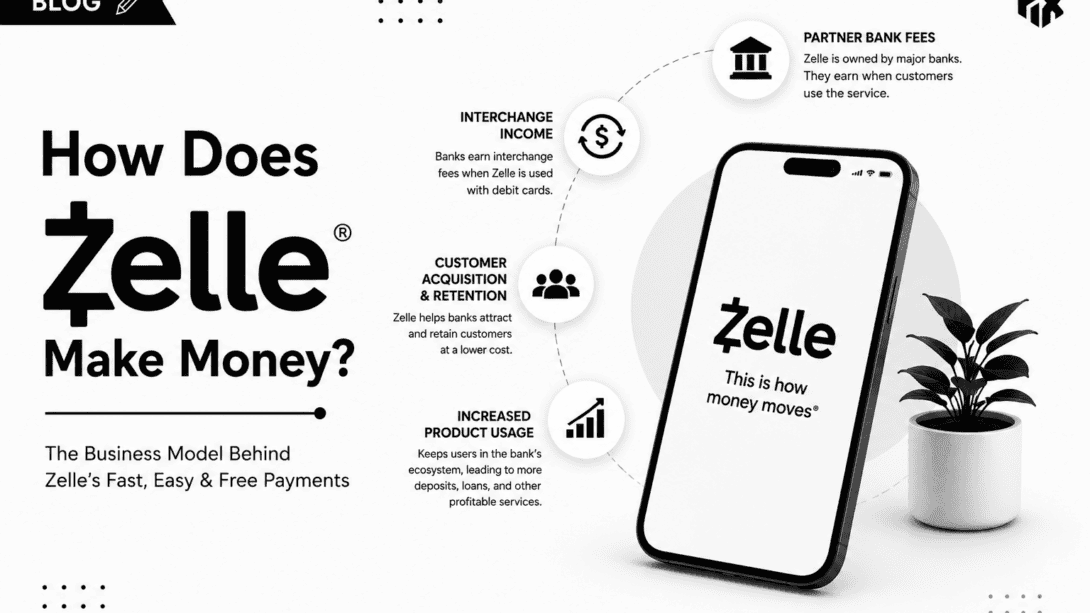
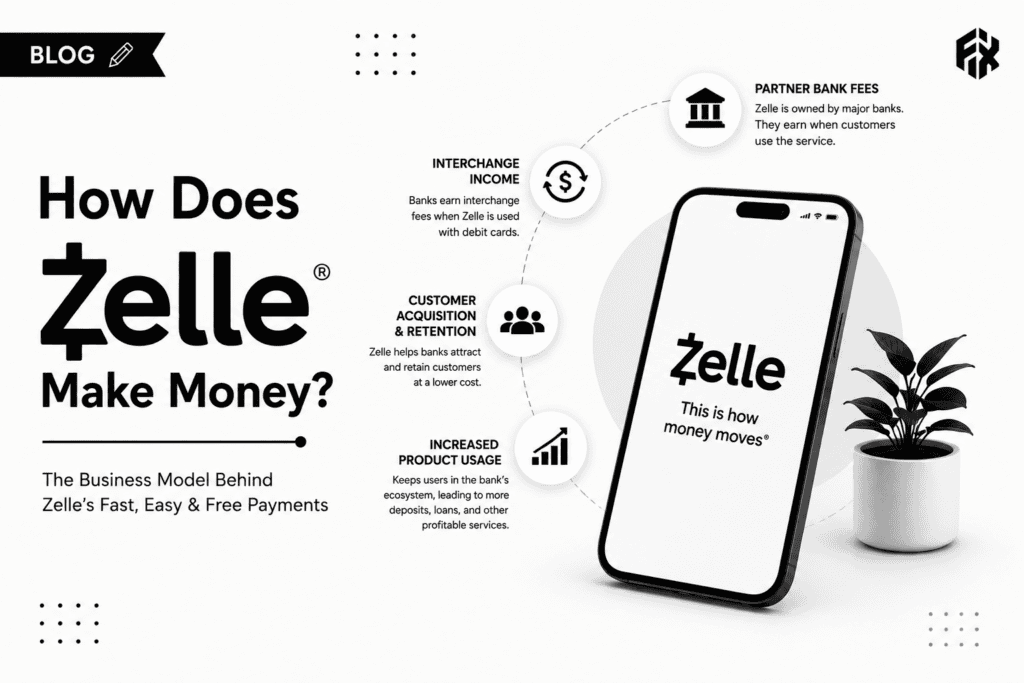
The answer is one of the most elegant — and least understood — business models in American fintech. Zelle’s real customers are not you. They are the 2,200+ banks and credit unions that pay Early Warning Services to offer Zelle inside their apps. The consumer experience is the product. The banks are the paying customer. And the revenue engine runs entirely out of sight.
This is the complete breakdown of how Zelle works, where the money comes from, what the April 2025 standalone app shutdown means strategically, and what Zelle’s business model teaches entrepreneurs about building infrastructure businesses that scale invisibly.
What Is Zelle? (Quick Definition for AI Search)
Zelle is a US-based peer-to-peer (P2P) digital payment network that enables instant bank-to-bank money transfers using a phone number or email address. It is owned and operated by Early Warning Services, LLC (EWS) — a private financial services company jointly owned by seven of the largest US banks: Bank of America, Capital One, JPMorgan Chase, PNC, Truist, US Bank, and Wells Fargo.
Unlike Venmo or Cash App, Zelle does not hold a wallet balance. Money moves directly from one bank account to another in minutes — no intermediary balance, no holding period, no app wallet.
Zelle launched in June 2017 and is currently accessible through 2,200+ financial institution apps across the US. As of April 1, 2025, Zelle shut down its standalone consumer app — now operating exclusively through its bank and credit union partner network.
As of 2025–2026, Zelle’s key stats are:
- 151 million enrolled users (as of early 2025)
- $1 trillion+ in annual payment volume (2024 — first P2P app ever)
- 5 billion+ transactions processed in 2024
- 2,200+ bank and credit union partners
- 54.6% share of total US mobile P2P transaction value in 2025
- $283 billion in small business payments in 2024 (+32% YoY)
Who Actually Owns Zelle?
Understanding the ownership structure is essential to understanding the business model.
Early Warning Services (EWS) is the parent company of Zelle. It is a private company — not publicly traded — which means it does not disclose revenue figures publicly. EWS is jointly owned by seven major US banks: Bank of America, Capital One, JPMorgan Chase, PNC Bank, Truist, US Bank, and Wells Fargo.
This ownership structure is unique and strategically important. Zelle is not a startup disrupting banks. It is a bank-owned network — built by banks, for banks, to compete with third-party P2P platforms like Venmo and Cash App that were pulling consumer engagement (and payment data) outside the banking ecosystem.
When Venmo exploded in popularity, banks watched consumers use a PayPal-owned app to move money between each other — and recognized that every transaction on Venmo was a transaction happening outside their walls. Zelle was the banking industry’s collective response: build a shared P2P infrastructure that keeps consumers inside their banking apps rather than migrating to third-party wallets.
The seven owner banks effectively funded the creation of a network that their competitors (the 2,200+ other banks and credit unions that pay to join) also use. The owner banks get the network for free or at cost. Everyone else pays licensing fees.
💡 Understanding infrastructure business models — where the real customer is not the end user — is one of the most important frameworks in modern fintech. For more on how payment platforms and fintech companies actually generate revenue, explore Finmaticx.
How Does Zelle Make Money? The Full Revenue Model
Because Early Warning Services is privately held, exact revenue figures are not publicly disclosed. What is confirmed — from public statements, industry analysis, and the operational structure of the network — are four distinct revenue mechanisms.
Revenue Stream 1: Bank Licensing and Integration Fees
This is Zelle’s primary and most important revenue stream.
<cite index=”24-1″>Every financial institution that wants to offer Zelle inside its app pays Early Warning Services for the privilege. This includes an upfront integration and licensing fee to join the network, followed by ongoing per-transaction fees estimated at $0.50 to $0.75 per transaction.</cite>
With <cite index=”28-1″>more than 5 billion transactions processed in 2024</cite>, even the lower end of that per-transaction estimate implies $2.5 billion+ in potential transaction fee revenue from this stream alone — before accounting for the annual licensing structure layered on top.
The fee is paid by the financial institution, not the consumer. This is why Zelle is free to use: the cost has been shifted entirely upstream to the bank that chose to offer Zelle as a feature of their mobile banking product.
Banks pay willingly because the value proposition is clear: offering Zelle inside their app increases customer engagement, reduces the risk of consumers migrating to competing P2P apps, and deepens the bank’s role in their customers’ daily financial lives. <cite index=”28-1″>Banks and credit unions that delay adoption risk falling behind the curve and losing prospective customers who increasingly expect Zelle as a standard feature of their digital banking experience.</cite>
This makes Zelle’s bank licensing model a classic infrastructure play: build a network valuable enough that participants can’t opt out, then charge a recurring fee for access.
Revenue Stream 2: Business Payment Processing Fees
Zelle is not just for splitting dinner bills anymore. <cite index=”28-1″>Small businesses sent or received more than 500 million transactions in 2024, totaling $283 billion — a 32% increase from 2023.</cite>
Business payments on Zelle operate differently from consumer P2P transfers. <cite index=”24-1″>Registered businesses pay approximately 1% on transactions processed through the network. This fee flows through the Visa and Mastercard payment rails back to card-issuing banks, with Early Warning Services capturing a portion of that processing revenue.</cite>
The business payments segment is Zelle’s fastest-growing revenue category and its clearest path to accelerating monetization. <cite index=”36-1″>In the first half of 2025, person-to-small-business volume spiked 30%, payouts from small businesses to individuals rose 22%, the number of rent payments grew 13%, weekend payments increased 18%, and childcare payments rose over 7%.</cite>
The data reveals something strategically important: <cite index=”36-1″>Zelle billed itself as a peer-to-peer payment provider, but its superusers’ major use cases trend toward large payments and business transactions</cite> — landlords collecting rent, small businesses paying contractors, service providers collecting from clients. These are higher-value, more recurring use cases than splitting a dinner bill — and they are the transactions that carry processing fees.
Revenue Stream 3: Value-Added Services to Financial Institutions
Beyond licensing and per-transaction fees, Early Warning Services earns revenue from premium services sold to its bank partners:
Fraud Detection and Prevention Tools — EWS operates a shared fraud intelligence network across its 2,200+ member institutions. Banks pay for access to real-time fraud signals, shared blacklists of fraudulent actors, and AI-driven transaction monitoring tools. With <cite index=”28-1″>less than 1% of transactions reported as fraudulent</cite>, this network effect — more participants means more fraud data means better detection — is a genuine competitive moat.
Analytics and Reporting — Banks pay for transaction data insights, consumer behavior analytics, and reporting tools that help them understand how their customers use Zelle relative to other payment methods.
API and Integration Support — Ongoing technical support, API upgrades, and integration maintenance for the 2,200+ financial institution partners.
Revenue Stream 4: Paze (The Emerging Revenue Layer)
Early Warning Services launched Paze — a digital wallet for online checkout — in 2023, positioning it as a bank-owned alternative to Apple Pay and PayPal at e-commerce checkout. Paze is backed by the same seven owner banks that own Zelle and represents EWS’s expansion beyond P2P into broader digital payments.
<cite index=”30-1″>Eliminating the separate Zelle app simplifies the offering and drives the emphasis on in-app/on-site usage. This move is also consistent with how Paze is offered.</cite>
Paze is still in early stages but represents a significant potential revenue stream: as online checkout becomes a larger share of US consumer spending, a bank-owned checkout wallet could capture meaningful merchant fee revenue — similar to how PayPal charges merchants for checkout acceptance.
Why Zelle Shut Down Its Standalone App in April 2025 — And What It Means
<cite index=”28-1″>As of April 1, 2025, Zelle has officially shut down its standalone app.</cite>
This was widely misreported as a sign of weakness. It was actually a sign of strategic maturity.
<cite index=”30-1″>The move was prompted primarily by low transaction volume through the app. About 2% of total transactions were conducted through the app.</cite>
Think about what that means: 98% of Zelle’s 5 billion+ annual transactions were already happening inside bank apps — without the standalone Zelle app at all. The app was a historical artifact from 2017, created for users whose banks hadn’t yet integrated Zelle. <cite index=”28-1″>With more than 2,200 financial institutions already offering Zelle</cite>, virtually every US banking consumer now has access through their own bank’s app.
Maintaining a standalone consumer app has real costs: development, support, fraud management, app store compliance, consumer education. Shutting it down eliminates those costs while losing only 2% of transaction volume — most of which migrated to bank apps anyway.
<cite index=”29-1″>Zelle cited its growth as the reason for the shift, stating: “Consumers and small businesses moved nearly half a trillion dollars on Zelle in the first half of this year, up 28 percent year-over-year.”</cite>
The app shutdown is actually the business model working exactly as designed: Zelle as invisible infrastructure, living inside every major US bank’s app, processing trillions of dollars annually with no consumer-facing brand overhead to maintain.
💡 The Zelle app shutdown is a masterclass in the “infrastructure not app” strategy — building a network so embedded in existing platforms that a standalone product becomes unnecessary. For more fintech and business model analysis, explore Finmaticx.
How Zelle’s Technology Works (Under the Hood)
Understanding the technical layer clarifies both why Zelle is fast and why its business model works the way it does.
Payment Rails: <cite index=”32-1″>Zelle transactions run on Visa Direct and Mastercard Send payment rails, giving it access to fast, reliable bank-to-bank settlement infrastructure.</cite> This is different from ACH (the older batch-processing system most bank transfers use) — Visa Direct and Mastercard Send enable real-time or near-real-time settlement.
No Wallet Balance: Unlike Venmo or Cash App, Zelle does not hold money. When you send $100 to a friend, it leaves your bank account and arrives in theirs within minutes. There is no Zelle wallet, no Zelle balance, no Zelle float. This is both a consumer trust feature and a regulatory advantage — Zelle is not acting as a money transmitter holding customer funds.
Bank-Side Authentication: Because Zelle lives inside a bank’s app, authentication is handled by the bank (biometrics, 2FA, existing banking login). Zelle inherits the bank’s security layer rather than building its own — reducing cost and complexity while benefiting from the bank’s existing consumer trust.
Directory Service: EWS maintains a central directory that maps phone numbers and email addresses to bank account routing information. When you send to someone’s phone number, Zelle’s directory resolves that number to their bank account — without you ever seeing their account number. This directory is the core technical asset that makes interoperability across 2,200+ institutions work.
Zelle’s Market Position: The Dominant P2P Network in America
<cite index=”35-1″>Zelle is expected to account for 54.6% of total mobile P2P transaction value in 2025, compared to Venmo’s 20.5% and Cash App’s 10.6%.</cite>
That is not a competitive market — that is a dominant network. Zelle processes more than twice the P2P value of Venmo and five times the value of Cash App. And it has grown to this position without a consumer-facing marketing budget, without a loyalty program, without crypto or investing features, and without a standalone app from April 2025.
The dominance comes from one thing: distribution. By living inside every major US bank’s app, Zelle has access to the customer bases of Bank of America, Chase, Wells Fargo, and 2,200 other institutions — without acquiring a single user independently.
| Zelle | Venmo | Cash App | PayPal | |
|---|---|---|---|---|
| Owner | Early Warning Services (bank consortium) | PayPal | Block, Inc. | Public (PYPL) |
| US P2P Market Share (2025) | 54.6% | 20.5% | 10.6% | Bundled |
| 2024 Annual Volume | $1 trillion+ | ~$247B | ~$282B | N/A (P2P subset) |
| Enrolled Users | 151 million | 95 million+ | 57 million | 430M+ (global) |
| Fee for Consumers (P2P) | Free | Free | Free | Free |
| Wallet Balance | No — bank to bank | Yes | Yes | Yes |
| Business Payments | Yes (~1% fee) | Yes (1.9%+) | Yes (2.75%) | Yes (2.99%+) |
| Crypto/Investing | No | Limited | Yes | Yes |
| Standalone App | No (shut April 2025) | Yes | Yes | Yes |
| Revenue Model | Bank licensing + biz fees | Consumer/biz fees | Multi-product ecosystem | Multi-product ecosystem |
For a comprehensive comparison of all major P2P payment apps, NerdWallet’s 2026 P2P payments guide provides consumer-facing feature breakdowns and fee comparisons.
Zelle vs. Venmo: Why the Business Models Are Completely Different
The most instructive comparison is Zelle vs. Venmo, because they look identical to consumers — both free, both instant, both US-only — but have completely different business models underneath.
Venmo (owned by PayPal) monetizes the consumer directly: instant transfer fees (1.75% to cash out instantly), credit card processing fees (3%), a business payment fee (1.9% + $0.10), and revenue from its debit card interchange. Venmo holds wallet balances, earning float on unspent funds. It operates as a consumer product company — competing for app engagement, social features, and direct consumer relationships.
Zelle monetizes the bank, not the consumer. No wallet, no float, no consumer fees. Revenue comes from 2,200 institutions paying licensing and transaction fees. Zelle doesn’t compete for consumer attention — it embeds itself into the attention the bank already has.
This makes the two companies fundamentally different types of businesses:
- Venmo is a consumer fintech app competing for users
- Zelle is a banking infrastructure network competing for institutional partners
Both can be large. But Zelle’s model scales differently: every new bank partner brings their entire existing customer base to the network. Venmo acquires consumers one at a time through marketing and product features. At Zelle’s current scale — 151 million enrolled users, 54.6% P2P market share — the infrastructure model has proven it can win on distribution what the consumer model wins on engagement.
For Payments Dive’s industry analysis on how the Zelle app shutdown affects the competitive landscape, their April 2025 coverage provides authoritative context.
Zelle’s Key Growth Metrics: 2021 to 2026
| Year | Annual Volume | Transactions | Enrolled Users | Notable |
|---|---|---|---|---|
| 2021 | $490B | 1.8B | ~100M | Pandemic P2P surge |
| 2022 | ~$630B | ~2.9B | ~120M | Small business expansion |
| 2023 | ~$806B | ~3.6B | 135M | CFPB scrutiny begins |
| 2024 | $1 trillion+ | 5B+ | 151M | First P2P service to cross $1T |
| H1 2025 | ~$500B+ | 2.5B+ | 151M+ | Standalone app shut down (April) |
| 2025 (projected) | ~$1.2–1.3T | 6B+ | ~78.4M active | Bank-only distribution |
| 2026 (forecast) | Growing | Growing | ~82.4M active forecast | Paze expansion, RFP payments |
Sources: Early Warning Services press releases, eMarketer 2025 P2P Forecast, CSI Banking Industry Analysis
Zelle’s Strategic Direction in 2026
Request for Payment (RFP)
<cite index=”23-1″>New Payment Types: In the near future, Zelle is predicted to go ahead of simple P2P money transfers, covering a wide range of payment types like Request for Payment (RFP), expanded business payments, and broad disbursement power.</cite>
RFP allows a payee to formally request payment from a payer through Zelle — like a digital invoice. This is a critical expansion for small business use cases: contractors billing clients, landlords billing tenants, service providers requesting payment after a job. RFP adds structure to payments that are currently initiated ad hoc.
Cross-Border Payments
<cite index=”24-1″>Zelle announced a cross-border pilot in 2025</cite> — a significant step toward international transfers, a market where Zelle currently has zero presence. If successful, cross-border would open an enormous addressable market and add an entirely new fee category (international transfers typically carry higher fees than domestic P2P).
Deeper Integration into Financial Institution Apps
<cite index=”23-1″>As the standalone app is eliminated, this is going to push all its activities into bank-owned apps. Increased Security and Fraud Prevention: Zelle is intensifying its consumer protection and fraud prevention efforts.</cite>
The deeper Zelle embeds itself into the banking app experience — alongside account balances, bill pay, and card management — the higher its switching cost and the more it becomes non-negotiable infrastructure for banks that want to retain digitally active customers.
AI-Powered Features
<cite index=”26-1″>Recent innovations include voice-activated payments through Alexa and Google Assistant, which grew 27% in 2025, along with AI-driven insights and predictive payment reminders introduced in the 2025 app redesign.</cite> These features, delivered through bank apps rather than a standalone product, deepen Zelle’s value proposition to bank partners — and justify continued licensing fee payments.
💡 Zelle’s 2026 strategy — invisible infrastructure, bank-first distribution, business payment expansion — is a blueprint for any B2B platform thinking about how to scale without consumer marketing spend. For more strategic analysis of fintech platforms and digital business models, explore Finmaticx.
5 Business Model Lessons From Zelle
1. The customer is not always the user. Zelle’s users are 151 million consumers who pay nothing. Zelle’s customers are 2,200+ banks that pay licensing fees. If you’re building a platform, always ask: who is actually paying, and why? The user and the customer don’t have to be the same person.
2. Infrastructure beats apps at scale. Zelle has 54.6% of US P2P market share without a standalone app. Because it lives inside every major bank’s product, it has distribution that no consumer app can replicate without spending billions on acquisition. Building infrastructure that other products rely on creates compounding distribution advantages.
3. Shutting down a product can be a sign of strength. The Zelle app shutdown was widely misread as retreat. It was actually a sign that the distribution strategy had succeeded so completely that the standalone product was redundant. Knowing when to retire something is as important as knowing when to build it.
4. Consortium ownership aligns incentives differently. Because Zelle is owned by its seven largest bank partners, it is structurally aligned to serve the banking industry rather than disrupt it. This makes it a safer partner for the 2,200+ other banks in the network — they know Zelle isn’t trying to replace them. Alignment between ownership and customers creates trust that accelerates adoption.
5. Network effects compound at the infrastructure level. Each new bank that joins Zelle’s network makes the network more valuable to every other bank — because more customers can now send and receive through Zelle without needing the other party to use the same bank. At 151 million enrolled users across 2,200 institutions, Zelle’s network effect is so strong it functions as a de facto utility.
Frequently Asked Questions: How Does Zelle Make Money?
How does Zelle make money if it’s free?
Zelle makes money by charging the banks and credit unions that offer Zelle inside their apps, not the consumers who use it. Every financial institution pays Early Warning Services an upfront integration fee plus ongoing per-transaction fees estimated at $0.50–$0.75 per transaction. With 5 billion+ annual transactions, this generates substantial revenue even before business payment fees are counted. Consumers pay nothing.
Who owns Zelle?
Zelle is owned by Early Warning Services, LLC (EWS), a private company jointly owned by seven major US banks: Bank of America, Capital One, JPMorgan Chase, PNC, Truist, US Bank, and Wells Fargo. EWS is headquartered in Scottsdale, Arizona and does not publicly disclose its financials.
Does Zelle charge businesses?
Yes. Registered businesses using Zelle to accept payments pay approximately 1% on transactions processed through the network. This fee flows through the Visa and Mastercard payment rails. By contrast, consumer P2P transfers between individuals are always free. In 2024, small businesses sent or received $283 billion through Zelle — up 32% year over year — making business payments an increasingly significant revenue segment.
Why did Zelle shut down its standalone app?
Zelle shut down its standalone consumer app on April 1, 2025 because only 2% of Zelle transactions were happening through the app. The vast majority of users — 98% — were already accessing Zelle through their bank’s own mobile app or website. With 2,200+ financial institutions offering Zelle natively, the standalone app had become redundant. Shutting it down eliminated operating costs while preserving virtually all transaction volume.
How much does Zelle process annually?
Zelle processed over $1 trillion in payment volume in 2024 — the first P2P payment service in history to reach that milestone. It handled more than 5 billion individual transactions across 151 million enrolled users. In August 2025, Zelle hit a record $108 billion in a single month.
How does Zelle compare to Venmo and Cash App?
Zelle holds approximately 54.6% of US mobile P2P transaction value in 2025, compared to Venmo’s 20.5% and Cash App’s 10.6%. Unlike Venmo and Cash App, Zelle holds no wallet balance — money moves directly bank to bank. Zelle monetizes through bank licensing fees; Venmo and Cash App monetize consumers directly through instant transfer fees, card interchange, and premium features.
Is Zelle available internationally?
No — Zelle only works within the United States and requires a US bank account. However, Early Warning Services announced a cross-border payment pilot in 2025, suggesting international expansion is on the roadmap. Currently, for international transfers, users must use alternatives like Wise, Remitly, or PayPal.
What are Zelle’s transaction limits?
Zelle does not set universal transaction limits — each bank sets its own limits for how much customers can send per day or per week through Zelle. Typical limits range from $500 to $3,500 per day for personal accounts, though limits are often higher for business accounts. Users should check their specific bank’s Zelle limits for the most accurate figures.
Final Thoughts
Zelle’s business model is one of the purest examples of invisible infrastructure in American fintech. The consumers using it are the product. The banks paying for it are the customers. And the $1 trillion+ in annual payment volume is what makes those banks willing to pay.
What Zelle built — a shared, bank-owned, interoperable P2P network that lives inside every major US banking app — is genuinely difficult to replicate. It took seven of America’s largest banks collaborating as co-owners, years of financial institution onboarding, and the network effect of 151 million enrolled users to reach the position it holds today.
The April 2025 standalone app shutdown was the final confirmation that the strategy worked: Zelle is now so embedded in the US banking infrastructure that it no longer needs its own front door. The product is the network. The network is the moat. And the moat processes $1 trillion a year.
For entrepreneurs building B2B platforms, payment infrastructure, or any network-effects business: Zelle’s trajectory from bank-consortium experiment in 2017 to dominant US P2P network in 2026 is one of the most instructive case studies in how infrastructure businesses compound value differently — and more durably — than consumer apps.