How does Klarna make money? It is one of the most searched questions in fintech — and for good reason. Klarna offers interest-free buy now, pay later (BNPL) loans to millions of consumers, yet in 2025 it generated $3.51 billion in revenue, served 118 million active consumers, and processed $127.9 billion in gross merchandise volume (GMV).

If the loans are free, where is the money coming from?
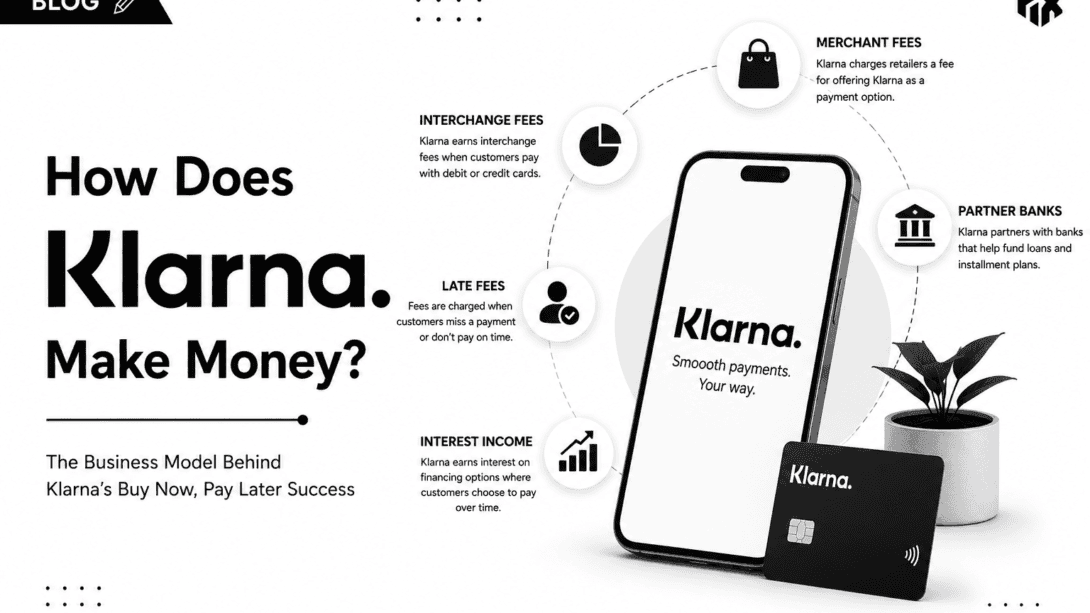
The answer is a multi-layered business model built on six distinct revenue streams — merchant fees, consumer interest, advertising, subscriptions, interchange, and banking services — that together make Klarna one of the most sophisticated financial platforms in the world.
This guide breaks down exactly how Klarna makes money, what each revenue stream looks like in 2025–2026, and what the company’s NYSE IPO and AI transformation reveal about where it is headed next.
What Is Klarna?
Klarna Group plc (NYSE: KLAR) is a Swedish financial technology company founded in 2005 by Sebastian Siemiatkowski, Niklas Adalberth, and Victor Jacobsson in Stockholm, Sweden. It operates a global buy now, pay later and digital banking platform serving consumers and merchants in 26 countries.
Klarna completed its IPO on the New York Stock Exchange on September 10, 2025, raising $1.37 billion at $40 per share with a final valuation of $15.1 billion — led by Goldman Sachs, JPMorgan, and Morgan Stanley.
As of Q1 2026, Klarna’s key stats are:
- $1.01 billion in quarterly revenue (Q1 2026 — first time ever crossing $1B in a single quarter)
- $3.51 billion in full-year 2025 revenue (+25% year over year)
- $127.9 billion in 2025 GMV (+21.8% year over year)
- 119 million active consumers as of Q1 2026
- 1 million+ merchant partners globally
- 43 million active users in the United States — Klarna’s largest single market
- AI assistant handling 69% of customer service chats with no drop in satisfaction
💡 Understanding how BNPL platforms like Klarna generate revenue is essential for anyone building or marketing a fintech product in 2026. Explore more fintech business model analysis at Finmaticx.
Klarna’s Business Model: The Core Concept
Klarna’s core business model rests on a deceptively simple three-sided value exchange:
- Consumers get interest-free payment flexibility at checkout — splitting purchases into installments with no extra cost on short-term plans.
- Merchants get higher conversion rates (+44%), larger average order values (+20–30%), and zero fraud or credit risk (Klarna assumes it all).
- Klarna earns fees from merchants for driving those outcomes — plus interest from consumers on longer-term financing, advertising revenue from its shopping app, and subscription income from premium features.
The short-term BNPL product (Pay in 4) is the acquisition engine. Every free loan Klarna offers to a consumer is an investment in a relationship that it then monetizes through higher-margin products: longer-term interest-bearing loans, advertising, subscriptions, and banking services.
How Does Klarna Make Money? 6 Revenue Streams Explained
Revenue Stream 1: Merchant Fees (The Core Engine)
Merchant fees are Klarna’s largest and most important revenue stream, accounting for roughly 57% of total revenue in 2024 — approximately $1.6 billion.
<cite index=”23-1″>Merchants pay Klarna transaction fees ranging from 3.29% to 5.99%, in addition to a fixed fee of $0.30 per transaction.</cite>
These fees are significantly higher than standard credit card processing rates (typically 1.5%–3%). So why do merchants pay them willingly?
Because Klarna delivers measurable commercial outcomes that justify the premium:
- <cite index=”24-1″>Merchants find the tradeoff worthwhile, as Klarna helps increase the average order value by 20–30% and boosts conversion rates by up to 44%.</cite>
- Klarna assumes all credit risk and fraud risk — the merchant receives payment in full regardless of whether the consumer repays Klarna.
- Klarna handles consumer credit underwriting, collections, and disputes — removing significant operational burden from the merchant.
When a consumer splits a $300 purchase into four installments, the merchant gets $300 immediately. Klarna earns its fee upfront and then manages the consumer repayment over time. The merchant has zero exposure to non-payment.
This risk transfer is why merchants accept Klarna’s premium pricing. A traditional payment processor offers payment rails. Klarna offers payment rails plus guaranteed revenue plus higher sales.
For the consumer, the short-term Pay in 4 product is always free. Klarna funds that consumer benefit entirely through the merchant fee.
Revenue Stream 2: Consumer Interest Income
Interest income is Klarna’s second-largest revenue stream, representing approximately 27% of 2025 revenue — around $937 million.
<cite index=”24-1″>Klarna generates interest income from its longer-term financing products, which range from 6 to 36 months and have Annual Percentage Rates (APRs) between 7.99% and 29.99%.</cite>
These are traditional installment loans — not the free Pay in 4 product — where consumers choose longer repayment terms and pay interest for the privilege. A consumer buying a $2,000 piece of furniture might choose 24 monthly payments at 14.99% APR. Klarna earns interest on that loan for two years.
<cite index=”24-1″>In 2025, interest income reached $937 million, about 27% of total revenue, up from $675 million (24%) in 2024. This reflects a shift from Klarna’s earlier focus on interest-free offerings to more profitable, interest-bearing credit products. The Walmart OnePay partnership, which offers loans from 3 to 36 months, exemplifies this strategic pivot.</cite>
This is an important strategic trend: Klarna is deliberately growing its interest-bearing loan book because it carries higher margins than fee-only BNPL. <cite index=”24-1″>Klarna now describes itself as a digital bank rather than a BNPL app, and its banking products are the fastest-growing part of the business.</cite>
The shift from BNPL label to digital bank label is not marketing — it reflects a genuine revenue mix evolution. Interest income growing from $675M to $937M in one year signals where Klarna sees its highest-margin future.
💡 The Klarna interest income model — transitioning from fee-based to interest-based revenue — mirrors how the most durable financial platforms are built. For analysis of fintech revenue models and digital strategy, explore Finmaticx.
Revenue Stream 3: Advertising Revenue (The Fastest-Growing Line)
<cite index=”29-1″>Klarna’s advertising revenue increased from $13 million in 2020 to $180 million in 2024</cite> — a 1,285% increase in four years. In 2025, advertising is on track to grow further as Klarna deepens its retail media capabilities.
<cite index=”28-1″>Klarna generates advertising revenue when a consumer clicks on an ad placed on the Klarna app or its website after their initial search, or purchases an item they have found through the Klarna app.</cite>
The Klarna shopping app — used by 33 million consumers monthly to track purchases, browse products, and access AI-powered shopping recommendations — has become a retail media platform. Merchants pay to appear in Klarna’s curated product feeds, sponsored search results, and personalized shopping recommendations.
This model is structurally similar to how Amazon and Google monetize search intent — but with a uniquely powerful signal. Klarna knows not just what consumers search for, but what they buy, how much they spend, when they pay, and which product categories they return to repeatedly.
<cite index=”29-1″>Klarna believes it is “uniquely positioned” to address the $475 billion global digital advertising market opportunity, excluding China.</cite>
Advertising is Klarna’s highest-margin revenue line. Unlike lending (which requires capital) or merchant processing (which requires risk management), advertising is essentially pure margin above the platform cost. With 119 million consumers and 1 million+ merchants, the advertising flywheel is just getting started.
Revenue Stream 4: Klarna Plus Subscription Revenue
Klarna Plus launched in early 2024 as a $7.99/month subscription in the United States, giving subscribers:
- Waived service fees on purchases
- Access to exclusive merchant discounts
- Premium customer support
- Additional perks and offers from Klarna’s merchant network
<cite index=”28-1″>Klarna generates consumer service revenue from its consumers using Klarna Plus, its subscription service that grants consumers access to a variety of features and offers, including special merchant deals.</cite>
Klarna Plus is strategically important for two reasons beyond its direct revenue. First, it creates recurring predictable income that smooths the transaction-volume volatility of merchant fees. Second, Plus subscribers become significantly more engaged — using Klarna more frequently, spending more per transaction, and churning far less than non-subscribers.
<cite index=”26-1″>Consumers who first used Klarna in 2022 generated $12 in annual revenue in year one. That same cohort now generates $52 a year.</cite>
This 333% revenue-per-user growth over a three-year cohort is extraordinary. It shows that Klarna’s subscription and cross-sell model is working: users who stay become dramatically more valuable over time.
Revenue Stream 5: Interchange Fees (Klarna Card)
The Klarna Card — a physical Visa credit card launched in 2022 — brings Klarna’s pay-later functionality into brick-and-mortar retail. <cite index=”20-1″>Nearly 80% of retail transactions still happened in physical stores</cite>, making the card a critical expansion beyond Klarna’s digital-first origins.
<cite index=”23-1″>The company gets interchange fees — usually 1–3% — when customers use their virtual card.</cite>
<cite index=”26-1″>The Klarna Card passed 5 million active users across 16 countries in 2025.</cite> Every card swipe earns Klarna interchange from the merchant’s bank — the same mechanism that makes debit and credit card networks profitable at scale.
Interchange is a passive, high-margin revenue stream. Once a consumer has the Klarna Card in their wallet, Klarna earns on every purchase — at Klarna-integrated merchants and at the 80% of retailers that aren’t Klarna partners but accept Visa. This dramatically expands Klarna’s addressable transaction market.
Revenue Stream 6: Banking Services and Consumer Deposits
<cite index=”29-1″>Klarna held $9.5 billion of consumer funds at the end of 2024</cite>, operating as a licensed bank in several European markets. This banking infrastructure generates revenue through:
- Interest on deposits — Klarna earns yield on the $9.5B in consumer funds it holds
- Savings accounts — Klarna offers interest-bearing savings accounts in select markets, earning a net interest margin between the rate paid to depositors and the rate earned on deployed capital
- Klarna Balance — launched in 2024, allowing consumers to hold and spend funds within the Klarna app without connecting a bank card
<cite index=”25-1″>In 2024, Klarna introduced Klarna Balance, which makes commerce even more effortless by allowing consumers to Pay in Full or Pay Later without connecting to a bank account or card.</cite>
The banking segment represents Klarna’s long-term strategic ambition. <cite index=”31-1″>Klarna CEO Sebastian Siemiatkowski says Klarna’s goal is to compete directly with retail banks such as JPMorgan Chase, Bank of America, Wells Fargo, and Citibank.</cite> Consumer deposits are the foundation of a retail banking business — and Klarna already has $9.5 billion of them.
Klarna’s Revenue Breakdown: 2022–2025
| Year | Total Revenue | GMV | Net Income | Key Driver |
|---|---|---|---|---|
| 2022 | $1.85B | ~$80B | -$1.0B loss | Post-pandemic reset |
| 2023 | $2.26B | ~$92B | -$244M loss | Cost restructuring, credit improvement |
| 2024 | $2.81B (+24%) | $105B | +$21M (first profit) | Merchant fees + US growth |
| 2025 | $3.51B (+25%) | $127.9B | Net loss (credit provisions) | Ad revenue, interest income scale |
| Q1 2026 | $1.01B (quarterly) | Growing | Profitable | Digital bank pivot |
Source: Klarna SEC F-1 Filing, Revenue Memo Klarna Analysis, Business of Apps Klarna Statistics
Note on 2025 net loss: Despite $3.51B revenue, Klarna booked a net loss in 2025 primarily due to $794 million in credit-loss provisions — money set aside against potential loan defaults as the loan book scaled rapidly. This is accounting provisioning, not operational failure. Adjusted operating income remained positive.
How Klarna’s AI Strategy Is Changing Its Business Model
Klarna’s AI transformation is not a marketing story — it is a structural change to the economics of the business.
<cite index=”27-1″>Klarna’s AI assistant has handled 69% of customer service chats in the last twelve months ended June 30, 2025, with no drop in consumer satisfaction levels.</cite>
<cite index=”27-1″>Average annual revenue per employee increased from approximately $344,000 in 2022 to approximately $972,000 in the twelve months ended June 30, 2025.</cite>
That is a 183% increase in revenue per employee in three years — achieved primarily through AI replacing headcount in customer service, underwriting, fraud detection, and code development. Klarna explicitly reduced its workforce via AI ahead of the IPO, cutting operating costs by nearly $500 million.
<cite index=”27-1″>Klarna has been an early and leading adopter of AI. Its network and AI capabilities are powered by a unique proprietary data set, built on SKU-level data points, including over 2.5 billion data points collected in 2024, and more than 5.7 billion transactions conducted through its network since founding.</cite>
This data moat — 5.7 billion historical transactions, SKU-level purchase data across 1M+ merchants — powers both the underwriting model (lower credit losses) and the advertising engine (better targeting). The more transactions Klarna processes, the more accurate its AI becomes, and the more valuable its advertising inventory becomes to merchants.
Klarna vs. Affirm vs. Afterpay: Business Model Comparison
| Klarna | Affirm | Afterpay (Block) | |
|---|---|---|---|
| Founded | 2005 (Sweden) | 2012 (USA) | 2014 (Australia) |
| Stock Exchange | NYSE: KLAR | NASDAQ: AFRM | Part of Block (NYSE: SQ) |
| 2025 GMV | $127.9B | $36.7B | Part of Block’s ecosystem |
| 2025 Revenue | $3.51B | ~$3.2B est. | N/A (Block consolidated) |
| Markets | 26 countries | USA + Canada | USA + Australia + UK |
| Merchant Fee Range | 3.29%–5.99% + $0.30 | Varies (higher for 0% APR) | ~4%–6% |
| Consumer Interest | 7.99%–29.99% APR | 0%–36% APR | 0% only |
| Late Fees | Yes ($2–$8 per missed payment) | Never | Yes |
| Advertising Revenue | $180M (2024) | Minimal | Minimal |
| Subscription Product | Klarna Plus ($7.99/mo) | None | None |
| Physical Card | Yes (5M+ users) | Yes (Affirm Card) | No |
| Banking/Deposits | Yes ($9.5B consumer funds) | No | No |
| AI Strategy | Deep (69% CS via AI) | Underwriting-focused | Limited |
Klarna’s competitive edge versus Affirm is product breadth and global scale. Klarna operates in 26 countries; Affirm is primarily US/Canada. Klarna has advertising revenue, a subscription tier, a physical card, and banking deposits — Affirm has none of these. The trade-off is that Affirm’s US underwriting and long-term loan capabilities (up to 60 months) are deeper than Klarna’s.
For a detailed comparison of BNPL providers from a consumer perspective, NerdWallet’s 2026 BNPL comparison guide provides authoritative feature-by-feature breakdowns.
Klarna’s Walmart Partnership: A Case Study in Scale
In March 2025, Walmart announced Klarna as its new exclusive BNPL provider — replacing Affirm. This partnership gave Klarna access to Walmart’s 240 million weekly US shoppers, both online and in-store.
The Walmart-Klarna product, offered through Walmart’s OnePay financial services app, includes:
- Short-term Pay in 4 at checkout
- Longer-term financing from 3 to 36 months (interest-bearing)
- In-store and online coverage across Walmart and Sam’s Club
This is the single most significant US distribution deal in Klarna’s history. Walmart’s customer base skews toward lower-to-middle-income American households — a demographic that is both underserved by traditional credit and particularly receptive to BNPL’s transparent, no-hidden-fees positioning.
The Walmart deal will substantially accelerate Klarna’s US GMV, US revenue (already $850M+ in 2024, +39% YoY), and — critically — its interest-bearing loan book, as longer-duration financing at Walmart scales.
For more on the Walmart-Klarna partnership details, Payments Dive’s coverage provides comprehensive industry context.
Klarna’s Credit Loss Management: The Underwriting Story
One of the most important — and least reported — aspects of Klarna’s business model is how well it manages credit losses.
<cite index=”19-1″>In Q2 2025, Klarna reported provision for credit losses of 0.56% as a percentage of GMV. Realized losses were 0.45% of GMV in Q2 2025, down from 0.48% in Q2 2024, and 0.44% of GMV in Q3 2025.</cite>
A credit loss rate of 0.44–0.56% of GMV is exceptionally low for a consumer lending platform. For context, US credit cards typically see charge-off rates of 3–5% of outstanding balances. Klarna’s AI-powered underwriting — trained on 5.7 billion transactions — has produced credit loss rates that rival the best-managed banks in the world.
<cite index=”22-1″>Better underwriting models reduced credit losses from 1.2% to 0.4% of Gross Merchandise Volume.</cite>
This improvement in credit quality is the foundation of Klarna’s profitability story. When credit losses fall, more of each merchant fee and interest payment drops to the bottom line. The path from $21M net profit in 2024 to sustained double-digit margins runs directly through continued underwriting accuracy.
Klarna’s 2026 Strategy: What Comes Next
Retail Banking at Scale
Klarna’s explicit goal — stated by CEO Sebastian Siemiatkowski — is to compete with JPMorgan Chase, Bank of America, and Wells Fargo. The Klarna Balance product (a digital wallet), $9.5B in consumer deposits, savings accounts in European markets, and the Walmart partnership’s longer-term loan products are all steps toward a full retail banking offering.
Advertising as a Third Revenue Pillar
Advertising grew from $13M in 2020 to $180M in 2024. At the current growth trajectory, it could reach $500M–$700M by 2028 — becoming a meaningful third revenue pillar alongside merchant fees and interest income. The $475B global digital advertising market Klarna is targeting represents a 100x opportunity from its 2024 revenue in this category.
AI Agent Commerce
<cite index=”25-1″>In 2023, Klarna developed an AI assistant powered by OpenAI, which meaningfully streamlines the commerce experience.</cite> In 2026, Klarna is actively building for the AI agent commerce era — where AI assistants like Claude, ChatGPT, and Gemini make purchases on behalf of users. Klarna is positioning its payment API and merchant network to be the default checkout infrastructure for AI-initiated transactions.
Expanding the Klarna Card
With 5 million active Klarna Card users across 16 countries, the card is tracking toward 10 million by 2027. Each new cardholder adds a passive interchange revenue stream and increases Klarna’s share of the consumer’s total spending — not just online BNPL spending.
💡 Klarna’s pivot from BNPL app to AI-powered digital bank is one of the most ambitious business model evolutions in modern fintech. For analysis of what this means for entrepreneurs and marketers, explore Finmaticx.
5 Business Model Lessons From Klarna
1. Use a free product as an acquisition engine, not a revenue engine. Klarna’s Pay in 4 is always free to consumers. It exists to acquire users and build relationships — not to make money directly. The revenue comes from the next product (interest-bearing loans), the next service (advertising), the next tier (Klarna Plus). Design your free product around what it enables, not what it earns.
2. Taking on risk is a business model. Klarna assumes all credit and fraud risk from merchants. This is not charity — it is a product feature that commands a premium merchant fee. If you can take a risk that your customer wants to avoid, and manage it better than they can, you have a business.
3. Data compounds into advertising. Klarna grew advertising revenue 1,285% in four years without building an advertising company. It built a payments company that generated unique purchase data — and then monetized that data through retail media. If your platform generates behaviorally rich data, advertising is often your highest-margin future revenue stream.
4. AI is a margin expansion story, not just a cost story. Klarna’s AI handling 69% of customer service is not just a cost reduction. It is a margin expansion that allows revenue to scale without proportional headcount growth — driving revenue per employee from $344K to $972K. AI is Klarna’s operating leverage engine.
5. Profitability enables strategic ambition. Klarna’s $21M net profit in 2024 — modest in absolute terms — unlocked the IPO, the Walmart partnership, and the banking expansion strategy. Being profitable, even marginally, is a different strategic position than burning cash. It determines what partnerships you can sign, what investors back you, and what bets you can make.
Frequently Asked Questions: How Does Klarna Make Money?
How does Klarna make money on free BNPL loans? Klarna makes money on its free Pay in 4 product through merchant fees. Merchants pay Klarna between 3.29% and 5.99% plus a $0.30 flat fee per transaction in exchange for Klarna handling the financing, assuming credit risk, and driving higher conversion rates and average order values. The consumer pays nothing extra on short-term BNPL; the merchant funds the entire cost.
What are Klarna’s revenue streams? Klarna has six main revenue streams: merchant transaction fees (57% of 2024 revenue), consumer interest income from longer-term financing at 7.99%–29.99% APR (27% of 2025 revenue), advertising revenue from its shopping app ($180M in 2024), Klarna Plus subscription fees ($7.99/month), Visa interchange fees from the Klarna Card, and banking services including interest on $9.5 billion in consumer deposits.
Is Klarna profitable? Klarna posted its first net profit of $21 million in 2024 after years of losses. In 2025, it reported a net loss primarily due to $794 million in credit-loss provisions as its loan book scaled rapidly — not due to operational losses. Revenue grew 25% to $3.51 billion in 2025, and Q1 2026 hit $1.01 billion in quarterly revenue for the first time. Adjusted operating income remains positive.
What is Klarna’s revenue in 2025? Klarna generated $3.51 billion in total revenue for full-year 2025, a 25% increase year over year from $2.81 billion in 2024. In Q1 2026, Klarna reported $1.01 billion in quarterly revenue — the first time it crossed $1 billion in a single quarter. Its 2025 gross merchandise volume was $127.9 billion.
What is Klarna Plus? Klarna Plus is a $7.99/month subscription service in the United States that gives subscribers waived service fees on purchases, exclusive merchant discounts, premium customer support, and additional perks. It launched in early 2024 and creates recurring subscription revenue for Klarna alongside higher engagement and spending from subscribers.
How does the Klarna Card make money? The Klarna Card is a physical Visa card that earns Klarna interchange fees — typically 1–3% of transaction value — every time it is used. The card had over 5 million active users across 16 countries as of 2025. It extends Klarna’s revenue beyond integrated online merchants to any Visa-accepting retailer, including physical stores.
How does Klarna compare to Affirm? Klarna processes significantly more GMV ($127.9B vs. $36.7B for Affirm in 2025) and operates in 26 countries versus Affirm’s primary US/Canada focus. Klarna has additional revenue streams that Affirm lacks — advertising ($180M), a subscription tier (Klarna Plus), a physical card (5M+ users), and banking deposits ($9.5B). Affirm differentiates on longer loan terms (up to 60 months) and a strict no-late-fees policy. Both charge merchant fees, earn consumer interest, and have proprietary AI underwriting models.
When did Klarna IPO and what is its valuation? Klarna completed its IPO on the New York Stock Exchange (NYSE) on September 10, 2025, under the ticker symbol KLAR. It raised $1.37 billion, pricing 34.3 million shares at $40 each — above the expected range of $35–$37. The IPO valued Klarna at $15.1 billion, significantly below its 2021 peak valuation of $45.6 billion but well above its 2022 low of $6.7 billion.
Final Thoughts
So — how does Klarna make money? Not by charging consumers for free BNPL loans. It makes money the same way the best two-sided marketplaces always have: by charging the merchant for guaranteed access to an engaged consumer, and then building a richer relationship with that consumer over time that unlocks progressively higher-margin revenue.
Merchant fees fund the free experience. Interest income deepens the lending relationship. Advertising monetizes attention and purchase intent. Subscriptions create recurring revenue from the most engaged users. The Klarna Card captures in-store spending. Banking deposits fund a long-term financial services ambition.
<cite index=”26-1″>Consumers who first used Klarna in 2022 generated $12 in annual revenue in year one. That same cohort now generates $52 a year.</cite>
That single metric — 333% revenue growth per user over three years, without acquiring new users — is Klarna’s business model in one number. The free loan is not the business. The free loan is the introduction. The business is everything that follows.
💡 For more fintech business model breakdowns, AI tool analysis, and digital strategy content, explore Finmaticx — built for entrepreneurs and marketers navigating the AI era.
Published on Finmaticx.com | Updated July 2026 Tags: how does Klarna make money, Klarna business model, Klarna revenue 2025 2026, Klarna BNPL, Klarna IPO, buy now pay later business model, Klarna vs Affirm, Klarna merchant fees