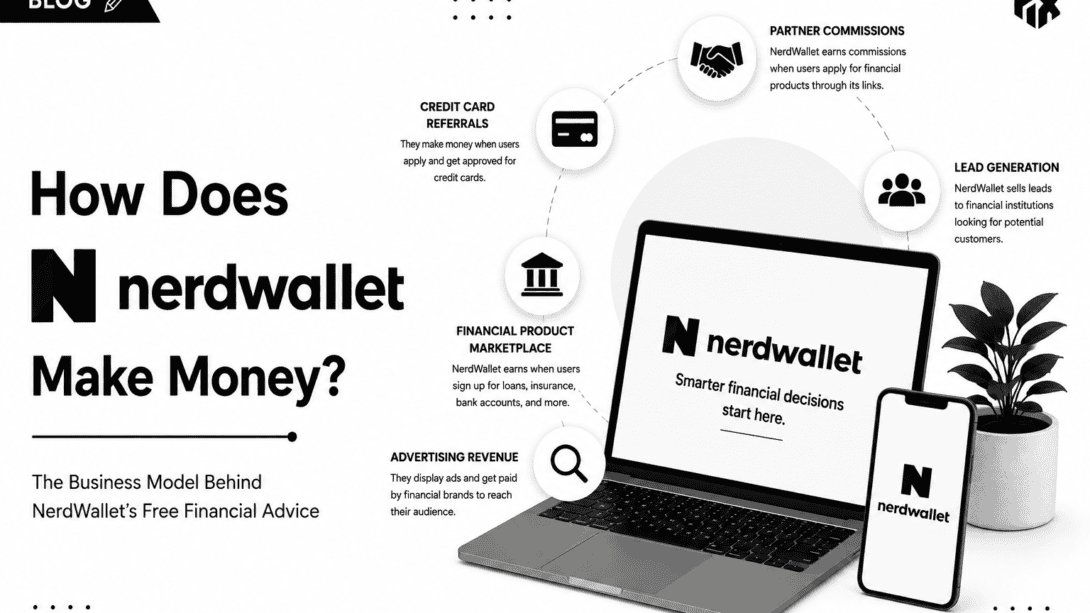
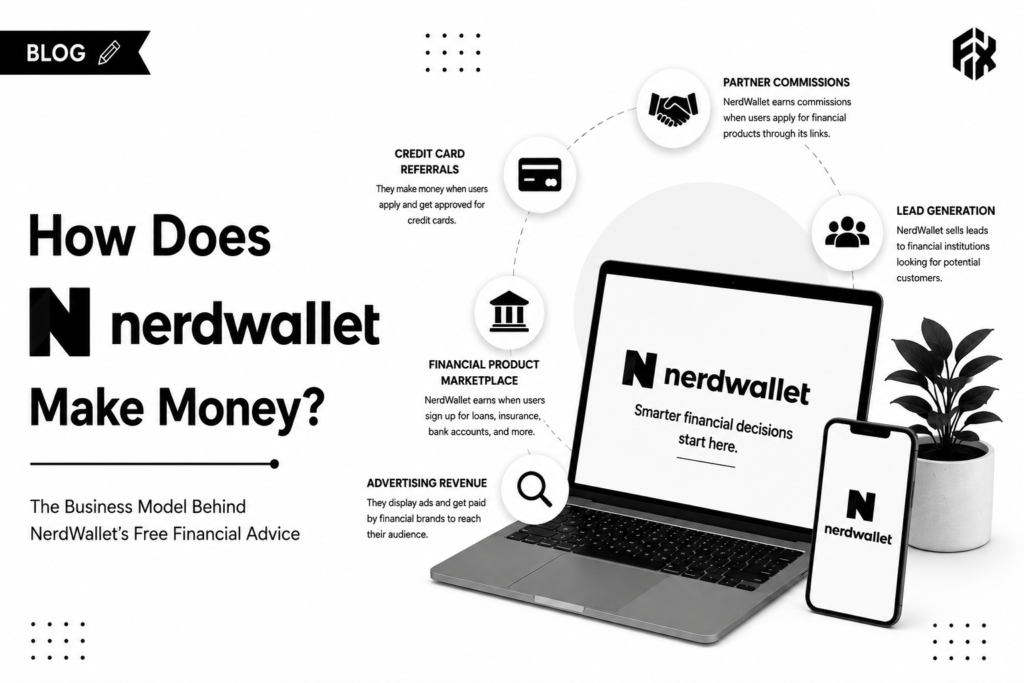
How does NerdWallet make money? In one line: NerdWallet makes money by earning referral fees and commissions from banks, card issuers, insurers, and lenders whenever a reader clicks through and applies for one of their products — not by charging users anything.
That single fact explains almost everything about how the site is built, why certain products get featured, and why “free financial advice” isn’t quite the same thing as “advice with no strings attached.” Below, we’ll break down exactly how does NerdWallet make money, dollar by dollar, using the company’s own 2025 financial filings.
What Is NerdWallet?
NerdWallet is a U.S. personal finance platform that helps people compare credit cards, loans, insurance, banking products, and investing options. Tim Chen and Jacob Gibson started NerdWallet in 2009, originally as a simple tool for comparing credit cards, and it has since grown into a full financial media and marketplace company serving both consumers and small and mid-sized businesses (SMBs).
NerdWallet went public on the Nasdaq on November 4, 2021, under the ticker symbol NRDS, pricing shares at $18 apiece. The company now operates in the United States, Canada, and the United Kingdom, with roughly 650 employees.
How Does NerdWallet Make Money? The Short Answer
Every article, comparison chart, and calculator on NerdWallet is free to read. Revenue appears when a reader clicks through to a financial partner — a card issuer, lender, insurer, or bank — and completes a qualifying action such as applying for a product, requesting a quote, or opening an account.
If that action leads to an approved application, a funded loan, an issued policy, or a similar qualifying event, the partner pays NerdWallet a referral fee, lead-generation fee, or commission. NerdWallet generates revenue from referral fees, lead-generation arrangements, partner marketing programs, and related compensation models across its marketplace categories.
In short, this is a performance marketing model wrapped in editorial content. The content earns the traffic and the trust; the marketplace behind it converts that trust into paid referrals.
How Does NerdWallet Make Money: 5 Revenue Streams
NerdWallet’s own financial reporting breaks its revenue into five distinct product lines. Here’s how does NerdWallet make money across each one, based on FY2025 results.
| Revenue Stream | What It Covers | FY2025 Trend |
|---|---|---|
| Insurance | Auto, life, and pet insurance referrals and quote comparisons | Grew roughly 47% year-over-year |
| Loans | Personal loans and mortgage loans | Grew roughly 58% year-over-year |
| Emerging Verticals | Banking, investing, and international products | Grew roughly 51% year-over-year |
| Credit Cards | Consumer credit card referrals | Declined roughly 24% year-over-year |
| SMB Products | Loans, credit cards, and other services for small and mid-sized businesses | Declined roughly 9% year-over-year |
1. Credit Card Marketplace
This is where NerdWallet built its name. The Credit Card Marketplace offers comparison tools, pre-qualification workflows, and introductions to issuing partners. When someone applies for a card through NerdWallet and gets approved, the issuing bank pays a commission.
This segment has been under pressure recently. Credit cards revenue decreased 24% year-over-year, primarily due to continued headwinds in organic search traffic.
2. Personal Loan and Mortgage Marketplace
NerdWallet’s Personal Loan Marketplace provides comparison, rate-shopping tools, and introductions to lending partners, covering both personal loans and mortgages. Loans revenue was up 141% year-over-year in Q4 2025, primarily driven by growth in personal loans, as well as mortgage loans, aided by NerdWallet’s acquisition of mortgage brokerage Next Door Lending.
3. Insurance Marketplace
The Insurance Marketplace, run through NerdWallet Insurance Services, Inc., provides quote comparisons for auto, life, and pet insurance. In 2025, NerdWallet also established NerdWallet Insurance Experts, LLC, a licensed property-and-casualty brokerage. Insurance carriers pay NerdWallet for these referrals, and insurance revenue saw a significant increase of 47% in 2025, driven by auto insurance products.
4. Banking Marketplace
NerdWallet’s Banking Marketplace enables users to discover deposit products, high-yield savings accounts, certificates of deposit, and other banking solutions, earning referral fees from partner banks when users open accounts. This sits under the “Emerging Verticals” line in NerdWallet’s reporting.
5. Small Business Financing Marketplace (Fundera)
Through Fundera, NerdWallet assists small and mid-sized businesses with lender matching, product comparisons, intake support, and introductions to financing partners. NerdWallet earns fees when SMB owners are connected with financing partners, though this segment has softened recently alongside credit cards.
NerdWallet’s 2025 Financial Results
NerdWallet reported Q4 2025 revenue of $225 million, up 23% year-over-year, contributing to full-year revenue of $837 million, up 22% year-over-year. Full-year net income reached $48.7 million, with GAAP income from operations of $65.2 million.
CEO Tim Chen noted that strength in performance marketing, direct, and non-search referral channels more than offset organic search headwinds, as consumers turned to AI overviews and large language models over traditional search. That single sentence from leadership tells you almost everything about where this business is headed next.
Why “Free Content” Is the Whole Strategy
NerdWallet’s business only works because its content ranks well and earns trust. Every product review, every “best credit cards for X” roundup, and every calculator exists to attract an audience that’s actively shopping for a financial decision — one of the most valuable audience types advertisers will pay for.
That’s also the source of a fair criticism of the model. Since NerdWallet earns more when readers click through and apply, there’s a built-in incentive to feature partners that pay commissions. NerdWallet states publicly that some of the financial institutions with products on its site may compensate the company, and it shares how it makes money in the spirit of transparency. Whether or not you take that at face value, it’s worth comparing more than one source before you apply for anything.
The AI Search Problem NerdWallet Is Racing to Solve
One of the more candid admissions in NerdWallet’s 2025 earnings commentary is that organic search traffic is shrinking as people increasingly turn to AI Overviews and chatbots instead of clicking through search results. That’s a real structural risk for a company whose original growth engine was SEO-driven content.
In response, NerdWallet is investing heavily in proprietary AI, having launched “NerdAI” in 2025 to deliver conversational, real-time guidance and reduce dependence on external search. It’s a useful case study in how even a company built entirely on search traffic has to adapt once AI search engines start answering questions before anyone clicks a link — a shift Finmaticx tracks closely across its coverage of AI tools reshaping content discovery.
NerdWallet vs. Credit Karma vs. Bankrate
| Platform | Primary Revenue Model | Core Focus |
|---|---|---|
| NerdWallet | Referral/commission fees across credit cards, loans, insurance, banking, SMB | Broad personal finance + SMB comparisons |
| Credit Karma | Referral fees, primarily tied to credit monitoring and card/loan matching | Free credit scores plus product matching |
| Bankrate | Referral and advertising fees, rate table placements | Mortgage rates, banking, and loan comparisons |
The underlying model across this whole category — get paid by financial institutions for qualified referrals — is the same. NerdWallet’s differentiator has been the depth of its editorial content and its diversification into insurance, banking, and SMB lending as credit card revenue slowed.
FAQ: How Does NerdWallet Make Money
Is NerdWallet actually free to use? Yes. Reading articles, using calculators, and comparing products on NerdWallet costs nothing. Revenue comes from financial partners paying for referrals, not from user fees.
How does NerdWallet make money if users never pay? NerdWallet makes money entirely from the financial-institution side of the transaction — referral fees, lead-generation fees, and commissions paid by partners when users apply for or open a product.
Does NerdWallet get paid even if my application is rejected? It depends on the partner arrangement. Some deals pay for a completed application or lead, while others pay only when an account is opened, a loan is funded, or a card is approved.
Does paying NerdWallet influence which products it recommends? NerdWallet states that partner compensation doesn’t affect its editorial ratings or reviews. Since NerdWallet only earns revenue from partnered products, it’s still worth double-checking offers against independent sources.
What is NerdWallet’s biggest revenue source in 2025? Insurance and loans were the fastest-growing categories in 2025, while credit cards — historically NerdWallet’s core business — declined due to weaker organic search traffic.
Is NerdWallet profitable? Yes. NerdWallet reported net income of $48.7 million for full-year 2025, alongside $836.6 million in total revenue.
When did NerdWallet go public? NerdWallet listed on the Nasdaq on November 4, 2021, under the ticker symbol NRDS.
Where can I read NerdWallet’s own explanation of how it makes money? NerdWallet publishes its own disclosure on how it makes money directly in its help center, and its quarterly results are available through its investor relations site.
The Bottom Line
So, how does NerdWallet make money? Through referral fees and commissions earned when its content turns into an application, a policy, a funded loan, or a new account with one of its financial partners — across five pillars: insurance, loans, banking, credit cards, and small-business financing. Insurance and loans are currently driving most of the growth, while credit cards and SMB products face organic search headwinds.
It’s a useful reminder for anyone reading financial advice online, including here on Finmaticx: understand who’s paying whom before deciding whose recommendation to trust. If you’re curious how AI-powered platforms are changing how financial content gets discovered and monetized in the first place, our breakdown of Finmaticx GPT digs into exactly that shift.