So how does Discord make money when most of what happens on it looks like teenagers arguing about Minecraft skins for free? You join a server to ask one question about a game glitch. Three hours later you’re in a voice channel with six strangers, a bot is tracking everyone’s stats, someone just boosted the server so it gets a fancier banner, and you never once saw a banner ad.
That absence of ads isn’t an accident — it’s the whole personality of the company. For most of its life, Discord built a business almost entirely on people voluntarily paying for a better version of something they’d already use for free. That’s a strange, slow, and surprisingly durable way to make money, and it’s exactly why understanding how Discord makes money looks so different from understanding how Instagram or Reddit does.
How Does Discord Make Money? The Short Answer
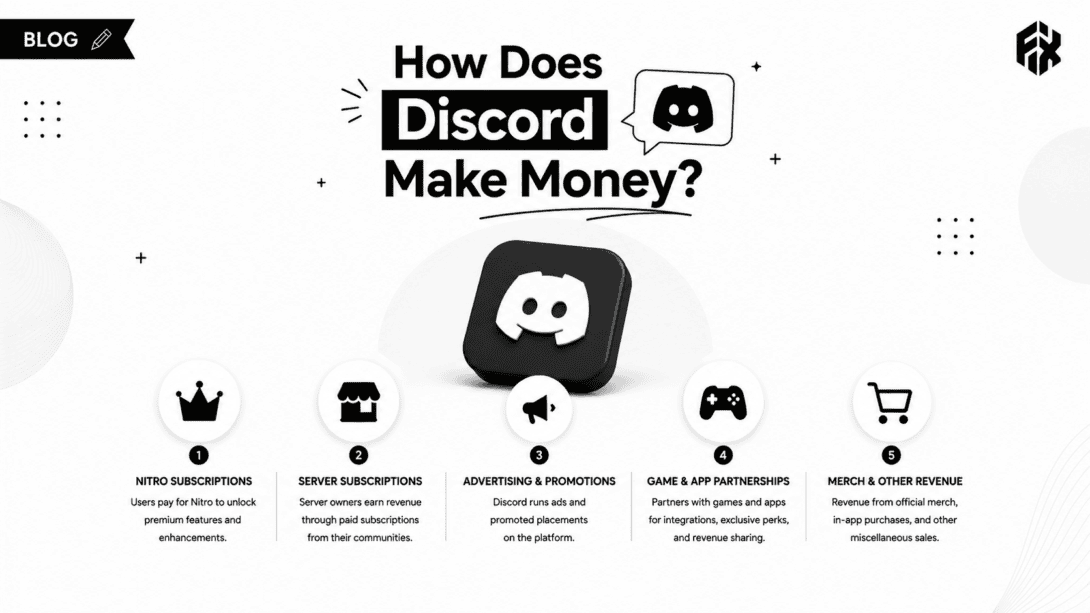
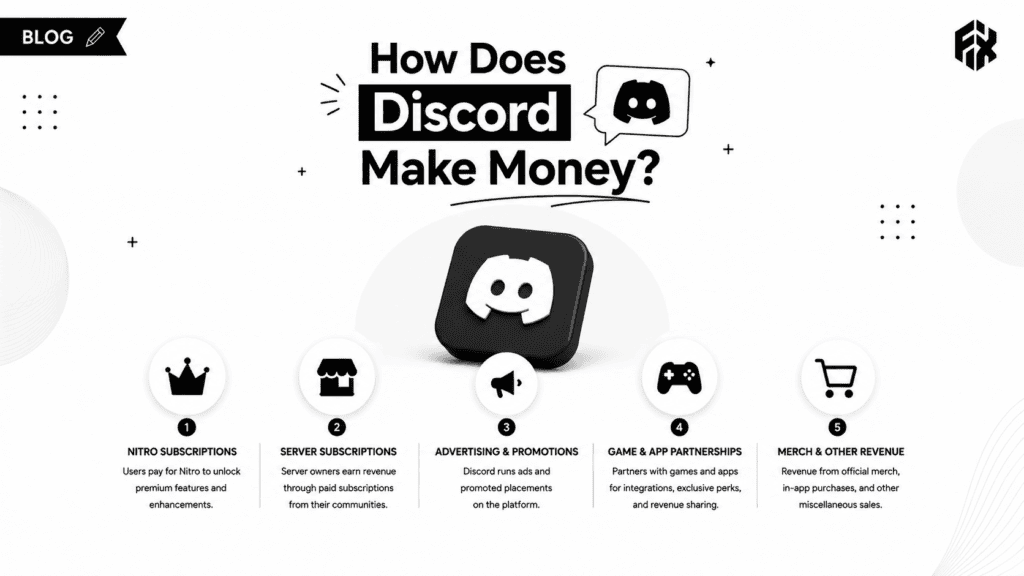
Discord makes money primarily through Discord Nitro, its premium subscription, which still accounts for roughly half of total revenue. The rest comes from Server Boosts, the Discord Shop’s cosmetic items and its Orbs virtual currency, and a newer advertising layer built around “Quests” — sponsored, gameplay-based promotions rather than traditional banner ads. Discord has confidentially filed paperwork for a US initial public offering, and third-party estimates put its 2025 revenue somewhere between roughly $560 million and $880 million, depending on the source, since Discord is still privately held and hasn’t published audited financials the way a public company would.
That range is wide because nobody outside Discord has the real number yet — but every credible estimate agrees on the shape of the business: subscriptions first, community-driven spending second, advertising a fast-growing but still-junior third.
Where It All Started: A Chat App Gamers Actually Wanted
Discord launched in 2015 to solve a genuinely annoying problem: voice chat for gaming was fragmented, laggy, and clunky. Skype dropped calls, TeamSpeak required a server you had to configure yourself, and in-game voice chat was usually an afterthought bolted onto whatever engine the game shipped with. Discord built something that just worked — low-latency voice, persistent text channels, and servers anyone could spin up for free in minutes.
It grew the way most great community products grow: quietly, then suddenly. By December 2020, Discord had roughly 140 million active users and a $7 billion valuation. In 2020 it also rebranded from “Chat for Gamers” to “Your Place to Talk,” a small tagline change that signaled a much bigger ambition — Discord wanted to be the default hangout space for any interest group, not just gamers. Today, more than half of Discord’s active communities have nothing to do with gaming at all — book clubs, study groups, crypto communities, fandoms, and creator spaces now make up the majority of servers.
That expansion matters to the revenue story, because it means Discord’s monetization tools have had to work across a much broader base than just people buying game-related perks.
It also explains a strategic patience most companies its size don’t have the luxury of showing. Discord spent roughly its first four years focused almost entirely on making the product good enough that people would want to pay for extras — not on maximizing revenue per user as fast as possible. Nitro didn’t launch until 2017, two years after the app itself, and even then it started small: better emoji, bigger uploads, a handful of quality-of-life perks. There was no grand monetization roadmap unveiled at launch. Revenue followed usage, not the other way around, and that sequencing is a big part of why the eventual business ended up feeling durable rather than forced.
Compare that to a lot of venture-backed consumer apps that bolt monetization on early, before the product has earned genuine habitual use — those often see subscribers churn the moment a cheaper or free alternative appears. Discord’s Nitro base has stuck around specifically because people were already spending hours a day in the app before anyone ever asked them to pay for anything.
Nitro: The Subscription That Built the Company
For most of Discord’s life, Nitro was essentially the entire business. It’s a straightforward premium subscription — $9.99 a month or $99.99 a year for the full tier, with a cheaper “Nitro Basic” option around $2.99 a month for a lighter feature set. Subscribers get bigger file upload limits, higher-resolution screen sharing and streaming, animated avatars and custom emoji usable across any server, and a personal Server Boost allowance to gift to communities they care about.
Nitro’s growth tells the story of Discord’s monetization maturing. It generated an estimated $173 million in 2021, grew to roughly $207 million by 2023 — about 36% of total revenue that year — and has climbed further since, with some estimates putting it near $280 to $300 million annually as of 2025, off a base of roughly 7.3 million paying subscribers, up about 17% year over year. The average Nitro subscriber reportedly spends close to $47 a year across subscription and shop purchases combined.
What makes Nitro such an efficient business isn’t the subscriber count — it’s the margin. Once Discord has built the feature, the incremental cost of serving one more Nitro subscriber is close to nothing beyond payment processing and infrastructure. That’s a very different cost structure from, say, an ad business that needs a sales team chasing every new advertiser relationship.
It’s also worth noting that Nitro pricing isn’t flat everywhere. Like most global subscription products, Discord adjusts pricing by region to reflect local purchasing power — a Nitro subscription in India or Brazil costs meaningfully less than the US price, in local currency terms. This is standard practice across the subscription economy, but it’s an important piece of how Discord makes money at true global scale: a uniform $9.99 price tag would price out huge swaths of its non-gaming, non-US userbase, particularly given how much of Discord’s newer growth is coming from outside North America and Western Europe.
Suggested image: side-by-side comparison graphic of Discord free tier vs Nitro tier features. Filename: how-discord-makes-money-nitro-comparison.webp. Alt text: “How Discord makes money — Nitro subscription features compared to the free tier.” Caption: “Nitro remains Discord’s single largest revenue source.”
Server Boosts: Turning Fandom Into a Monetization Tool
Server Boosts are one of the cleverer pieces of how Discord makes money, because they turn a personal purchase into a community flex. When someone boosts a server — either by buying Boosts directly or gifting the ones bundled into their Nitro subscription — that server collectively unlocks perks: higher audio quality, more emoji slots, custom invite backgrounds, and vanity URLs.
The genius of this mechanic is incentive alignment. A single generous member boosting their favorite server benefits every single person in that server, which creates social pressure and status around boosting that a purely individual subscription feature never could. It’s part subscription, part tip jar, part bragging right — and it quietly nudges non-paying members toward eventually buying Nitro themselves, since Boosts are the easiest way to get a taste of premium perks without committing to a full subscription up front.
The Discord Shop and Orbs: Gamifying Spending
Discord launched its own in-app Shop in late 2023, selling cosmetic digital goods — avatar decorations, profile effects, and themed items — separate from the core Nitro subscription. It’s a familiar model to anyone who’s played a free-to-play game: cosmetics that don’t change functionality but let people express identity and status.
The more interesting recent addition is Orbs, a virtual currency Discord rolled out globally in July 2025. Users earn Orbs by completing Quests (more on those in a moment) and can redeem them for Nitro credits or Shop cosmetics. During a seven-week pilot, Orbs reportedly drove a 16x increase in first-time Shop purchasers, and 79% of the people buying during that window were completely new to the Shop. That’s a meaningful signal — Orbs function as a low-friction on-ramp that gets non-paying users transacting for the first time, which then makes them more likely to become recurring Shop or Nitro customers later.
This is the flywheel Discord is clearly building toward: Quests get users to engage with sponsored content, engagement earns Orbs, Orbs get spent in the Shop, and Shop habits eventually convert into Nitro subscriptions. Every piece feeds the next one.
Quests: How Discord Finally Started Running Ads
For a decade, Discord’s leadership was famously allergic to traditional advertising — no banner ads, no interruptive pre-roll video, nothing that would make the app feel like it was selling your attention rather than hosting your conversation. That started to change with Quests.
Quests are Discord’s answer to the “how do we run ads without looking like ads” problem. Instead of a banner, a Quest might ask a user to play a specific game for a set amount of time, or engage with sponsored content inside a voice or video channel, in exchange for a reward — usually Orbs, sometimes an in-game item from the sponsoring publisher. Discord has expanded this into several formats: Sponsored Quests, Video Quests built for mobile, and Arena Quests that span PC, console, and mobile simultaneously.
This ad business is still young, but it’s growing fast and is widely seen as the second engine Discord needs if it wants to justify a public-market valuation built on more than subscription revenue alone. Advertising and expanded monetization features helped push Discord’s estimated annual recurring revenue from around $660 million in August 2024 to roughly $725 million by the end of that year — a jump largely credited to Quests scaling up.
What makes Quests worth watching closely is who they’re designed for. A banner ad on a scrolling feed works on almost anyone passively browsing. A Quest only works on someone already inclined to spend fifteen minutes inside a game — which happens to be exactly the audience game publishers most want to reach and are willing to pay the most to reach. Discord isn’t trying to compete with Meta or Google for generic ad dollars; it’s trying to own a specific, high-intent sliver of the gaming and entertainment ad market where its userbase has a natural home-field advantage.
Suggested image: mockup of a Sponsored Quest banner inside a Discord server. Filename: discord-sponsored-quest-ad-format.webp. Alt text: “How Discord makes money through Sponsored Quests advertising.” Caption: “Quests reward users for engaging with sponsored content instead of interrupting them with banner ads.”
The Developer Ecosystem: Bots, Apps, and Platform Fees
There’s a quieter piece of how Discord makes money that rarely gets top billing: its developer ecosystem. Discord’s App Directory hosts thousands of bots and third-party apps — moderation tools, music bots, game-stat trackers, level-up systems, ticketing bots for support servers. Most of these are free or run on their own external subscription models that Discord doesn’t take a direct cut of.
But Discord has been steadily building the infrastructure to change that. App monetization features let developers sell premium app subscriptions or one-time unlocks directly inside Discord, with the platform positioned to take a standard platform fee — the same basic mechanic Apple and Google use with their app stores, just at a much earlier and smaller scale. It’s not a major revenue line today, and Discord hasn’t broken out platform fee revenue separately in any of the estimates analysts have published. But it’s a strategically important one, because it’s the piece that could let Discord monetize the parts of its ecosystem it doesn’t directly build — bots, community tools, and mini-games created by outside developers — without having to build every feature in-house.
Think of it as optionality. If Nitro growth flattens and Quests advertising hits a ceiling advertisers are comfortable with, a mature developer platform fee business is the kind of thing that could become a real fourth leg of revenue a few years down the line.
Why People Actually Pay for Nitro — The Psychology Behind It
It’s worth pausing on why Nitro works as well as it does, because the psychology is a little different from most subscription products. Nobody strictly needs animated emoji or a bigger upload limit — Discord functions perfectly well on the free tier. So what’s actually being purchased?
Mostly, it’s identity and belonging. A custom animated avatar or a rare profile badge is a small, visible signal inside a community you care about — not unlike a concert T-shirt or a fandom pin. Server Boosting takes that further: it’s a purchase that benefits an entire group of people you already have a relationship with, which taps into something closer to communal generosity than personal utility. That’s a very different purchase trigger than paying for extra cloud storage or an ad-free podcast feed, and it’s a large part of why Discord has been able to grow Nitro revenue for years without heavy discounting or aggressive upsell tactics.
This also explains why Discord has been so cautious about advertising. A subscription bought out of genuine affection for a community is fragile — if users start to feel like the platform is squeezing them for ad revenue on top of what they’ve already paid for Nitro, that goodwill can evaporate fast. Quests were designed with that fragility in mind, framed as rewarding engagement rather than interrupting it.
Discord’s Revenue, Year by Year
Because Discord is privately held, none of these figures are audited public numbers — they’re a mix of company-disclosed milestones and third-party analyst estimates, and different research firms land on somewhat different totals. Even with that caveat, the trend line is consistent:
| Year | Estimated Annual Revenue | Primary Driver |
|---|---|---|
| 2019 | ~$45 million | Early Nitro adoption |
| 2021 | ~$130–175 million | Nitro growth during pandemic-era gaming boom |
| 2023 | ~$575–600 million | Nitro maturity, early Shop launch |
| Late 2024 | ~$725 million | Quests advertising scaling up |
| 2025 | ~$561–879 million (estimates vary) | Nitro (~54%), Shop/Orbs, Quests advertising |
| 2026 (projected) | ~$750–800 million+ | Continued ad expansion, Nitro growth |
Alongside that revenue growth, Discord has reportedly posted positive adjusted EBITDA for several consecutive quarters as of 2025 — a genuinely rare trait for a consumer social company at this stage, and one of the strongest arguments its bankers can make to public-market investors that this isn’t a business burning cash indefinitely to buy growth.
The Microsoft Deal It Walked Away From
No conversation about how Discord makes money is complete without its most famous non-transaction. In April 2021, Discord walked away from acquisition talks with Microsoft that reportedly valued the company at around $10 to $12 billion, choosing instead to stay independent and aim for its own public listing down the line. Other companies, including Twitter and Amazon, had also floated interest around that time, with some conversations reportedly valuing Discord as high as $15 to $18 billion.
Five years later, that decision looks more complicated than it did in the moment. Discord’s most recent secondary-market valuation sits around $8 to $8.5 billion — below the $12 billion Microsoft once offered. That doesn’t necessarily make the decision wrong; staying independent let Discord build Nitro, the Shop, Orbs, and Quests entirely on its own terms, without folding into Xbox or Microsoft Teams. But it does mean the company now has to prove, through an actual IPO, that independence was worth more than the number it turned down.
Discord confidentially filed for a US IPO with a January 2026 S-1 filing, after previously engaging Goldman Sachs and JPMorgan as advisors. Humam Sakhnini, a gaming-industry veteran who previously served as Vice Chairman at Activision Blizzard and President of King Digital Entertainment, took over as CEO in April 2025, replacing co-founder Jason Citron — a fairly clear signal that Discord specifically wanted public-market experience steering it toward listing day.
Why Discord’s ARPU Is So Much Lower Than Its Rivals
Here’s where Discord’s ad-averse history shows up starkly in the numbers. Average revenue per user (ARPU) is one of the clearest ways to compare how efficiently different platforms monetize their audiences, and Discord trails nearly every comparable consumer platform by a wide margin:
| Platform | Approximate Annual ARPU |
|---|---|
| X (formerly Twitter) | ~$35 |
| Snap | ~$10 |
| ~$8 | |
| ~$6 | |
| Discord | ~$2 |
With roughly 200 to 260 million monthly active users (estimates vary by source and date) generating somewhere between $561 million and $879 million a year, Discord’s ARPU lands around $2 to $3.50 per user annually — a fraction of what ad-first platforms extract from a comparable audience. That gap is the direct cost of avoiding traditional advertising for a decade. It protected user trust and kept the platform feeling like a place to talk rather than a feed to scroll through, but it also means Discord enters public-market conversations with far more room — and far more pressure — to grow revenue per user than its peers.
Discord vs Slack: Two Very Different Monetization Playbooks
It’s worth briefly contrasting Discord with the platform it gets compared to most: Slack. Both are persistent chat apps built around servers and channels, both grew out of solving a communication problem nobody else had solved well. But their monetization paths diverge almost completely.
Slack sells seats — a per-user, per-month fee charged directly to the businesses using it, with pricing that scales cleanly with headcount. It’s a B2B SaaS model through and through, and it made Slack straightforward enough to value that Salesforce acquired it for close to $27.7 billion in 2021.
Discord sells almost the opposite: a mostly free consumer product where a minority of highly engaged users voluntarily pay for cosmetic and quality-of-life upgrades, monetized at the level of individuals and communities rather than corporate seats. That’s a slower, messier model to build — there’s no per-seat contract to sign, no procurement department to negotiate with — but it’s also one that scales globally to hundreds of millions of casual users without needing a single enterprise sales rep. The tradeoff shows up exactly where you’d expect: Slack’s ARPU dwarfs Discord’s, but Discord’s total addressable audience is far larger and more diverse than Slack’s workplace-only user base.
The Road to an IPO
Discord’s IPO story has been a long one, marked by delays rather than a single clean announcement. After years of “will they, won’t they” speculation and a confidential S-1 filing in January 2026, the listing has reportedly been pushed back further amid a rockier market for tech valuations generally — secondary-market pricing for growth companies has cooled well below 2024 peaks, and Discord’s own valuation has moved accordingly.
None of that changes the underlying thesis, though: subscriptions built a durable, high-margin base, and advertising through Quests is the piece that’s supposed to convince public investors Discord can grow revenue per user meaningfully from here rather than plateauing. Whether that thesis holds is likely to be the single biggest question hanging over the eventual roadshow.
What Could Threaten This Model
Every part of how Discord makes money carries a version of the same underlying tension — growth versus the trust that got it here.
- Nitro growth may be approaching saturation. Subscription revenue showed signs of plateauing between 2022 and 2023 before Orbs and Shop cosmetics gave it a fresh boost — a pattern that could repeat.
- Advertising risks the exact trust that built the platform. Discord’s community-first reputation was built specifically on not running ads. Pushing Quests too aggressively, or eventually introducing more traditional ad formats, risks alienating the users who chose Discord because it wasn’t ad-supported.
- ARPU pressure from public markets. Once Discord is a public company, investors will expect ARPU to climb toward peer levels — a push that could force faster, less user-friendly monetization decisions than Discord has made historically.
- Valuation compression. A $12 billion offer once looked conservative; today’s ~$8.5 billion secondary pricing suggests the market isn’t yet convinced Discord’s growth story justifies its historical peak valuation, which puts real pressure on IPO pricing and timing.
- Developer and moderation costs scale with growth. As Discord expands past gaming into education, crypto, and general communities, so does the cost of trust-and-safety tooling and platform moderation across a much broader range of content types.
- Competition for the same users’ attention and wallets. TikTok, Instagram, and Reddit are all fighting for the same discretionary spending and time budget, and any one of them borrowing Discord-style community mechanics could dilute Discord’s differentiation.
- A crowded IPO calendar. Timing a public listing during a period of tech-market caution means Discord could be forced to accept a lower valuation than its fundamentals would justify in a stronger market, simply because of when it’s forced to list.
None of these risks are unique to Discord — they’re the standard tension every subscription-and-ads hybrid business faces as it scales. What makes Discord’s version notable is how long it delayed facing that tension at all, by simply not running ads for the better part of a decade.
What This Means If You’re a Brand or Creator on Discord
Understanding how Discord makes money isn’t just trivia if you’re a creator, community manager, or marketer trying to decide where to invest attention. A few practical takeaways fall out of everything above.
For creators and community owners, Server Boosts are worth treating as a genuine engagement lever, not an afterthought. Communities that actively encourage boosting — through recognition, small in-community perks, or simply explaining what boosting unlocks — tend to build a stronger sense of shared ownership than communities that never mention it. It’s a low-cost way to give your most invested members something concrete to do with their enthusiasm.
For brands, Quests represent a genuinely different kind of ad buy than a typical social platform. Because Quests require real engagement — actual gameplay time, actual interaction — the audience reached tends to be smaller than a comparable impression-based ad buy elsewhere, but noticeably higher-intent. That trade-off makes sense for game publishers, entertainment brands, and consumer tech companies with products that reward hands-on engagement; it’s a weaker fit for brands whose message works better as a passive, high-frequency impression.
For anyone building a product with its own Discord community — SaaS tools, indie games, newsletters, online courses — the App Directory and developer monetization tools are worth watching. As Discord builds out first-party support for selling app subscriptions inside the platform, community-embedded products may get a meaningfully easier path to monetization than building a separate payment flow from scratch.
The Bigger Picture: A Slow-Money Business in a Fast-Money Industry
Step back from the individual revenue lines and there’s a pattern worth naming directly. Almost every major consumer tech company that reached Discord’s scale did it by monetizing attention immediately and aggressively — ads from day one, or close to it. Discord took the opposite path on purpose, and it’s genuinely rare for a company to hold that line for the better part of a decade while still growing into the hundreds of millions of monthly users.
That patience came at a real cost, visible in the ARPU gap covered earlier in this piece. But it also built something a lot of ad-first platforms struggle to replicate afterward: a userbase that mostly trusts the platform isn’t optimizing every screen for extraction. As Discord adds Quests and leans harder into advertising ahead of its IPO, the real test isn’t whether the ads work — early results on Sponsored Quests suggest they do — it’s whether Discord can keep growing that second revenue engine without spending down the trust the first one was built on.
That tension is, in a lot of ways, the most interesting open question in the entire “how does Discord make money” conversation right now. Subscriptions proved people will pay for community. Advertising is proving people will tolerate sponsorship, if it’s built the right way. Whether both can keep growing together, at the scale a public company needs, is the thing this IPO story will ultimately answer.
FAQs
Does Discord run traditional banner ads? No, not in the conventional sense. Discord has historically avoided banner and pre-roll ads, opting instead for Quests — sponsored, engagement-based promotions that reward users with Orbs or in-game items rather than interrupting the app experience.
What percentage of Discord’s revenue comes from Nitro? Roughly half. Some estimates put Nitro at around 54% of total revenue as of 2025, with the rest split between Server Boosts, Shop/Orbs spending, and advertising through Quests.
Is Discord profitable? Discord has reportedly posted positive adjusted EBITDA for several consecutive quarters as of 2025, though as a private company it hasn’t published audited GAAP financials, so full profitability details aren’t public yet.
Why did Discord turn down Microsoft’s acquisition offer? In April 2021, Discord walked away from reported acquisition talks valuing it at roughly $10 to $12 billion, choosing to remain independent and pursue an eventual public listing on its own terms instead.
How much is Discord worth right now? Estimates place Discord’s most recent secondary-market valuation at roughly $8 to $8.5 billion, below both its 2021 peak funding valuation (~$14.7–15 billion) and the offer it turned down from Microsoft.
What are Discord Orbs? Orbs are a virtual currency Discord launched globally in July 2025. Users earn Orbs by completing Quests and can redeem them for Nitro credits or cosmetic items in the Discord Shop.
Is Discord going public? Discord confidentially filed IPO paperwork (an S-1) in January 2026 after engaging Goldman Sachs and JPMorgan as advisors, though the listing timeline has reportedly faced delays amid broader tech-market conditions.
Does Discord charge businesses to advertise? Yes, through Sponsored Quests, Video Quests, and Arena Quests, which let brands and game publishers pay to reward users with Orbs or in-game items for engaging with sponsored content, rather than running traditional display ads.
How is Discord different from Slack’s business model? Slack charges businesses a per-seat subscription fee for workplace use. Discord monetizes individual consumers directly through Nitro, Server Boosts, Shop purchases, and advertising, with no per-seat enterprise pricing model.
Final Word
How does Discord make money? Mostly by asking its most engaged users nicely, for a very long time, before it ever asked anyone to look at an ad. Nitro subscriptions and Server Boosts built a genuinely profitable business on voluntary spending alone — something almost no consumer platform its size has managed. Quests and Orbs are the newer bet: proof that Discord can add an advertising engine without breaking the trust that got 200-plus million people talking there in the first place. Whether that balance holds through an IPO and beyond is the story still being written.
There’s also a broader lesson in here for anyone building a product community of their own, gaming-related or not: monetization doesn’t have to mean advertising, and it doesn’t have to arrive on day one. Discord waited until people were already spending real time in the app before it asked for a single dollar, and it built its first monetization tool around things people wanted to buy rather than things advertisers wanted to sell them. That sequencing — usage first, revenue second — is a genuinely reusable idea well outside the chat-app category.
If you’re studying monetization models like this one for your own product or content strategy, Finmaticx’s AI Prompt Generator and Finmaticx GPT tools can help you structure research and content faster. You’ll find more platform revenue breakdowns like this one in the Finmaticx blog, and you can learn more about what we cover on our About Us page.