So how does Canva make money when literally anyone can open the app, design a full Instagram carousel, and export it for free? A small business owner making her first logo. A student building a slide deck at 1 AM. A marketing team churning out fifty social posts a week. All three can use Canva without ever paying a cent — and yet Canva closed 2025 with $4 billion in annual recurring revenue and a $42 billion valuation.
That’s not a contradiction. It’s the freemium playbook executed about as well as it’s ever been executed in software — give away a genuinely great free product, then make the paid version so useful that a meaningful slice of your enormous free userbase upgrades anyway. Understanding how Canva makes money means understanding exactly where that line between free and paid sits, and why it keeps moving in Canva’s favor.
How Does Canva Make Money? The Short Answer
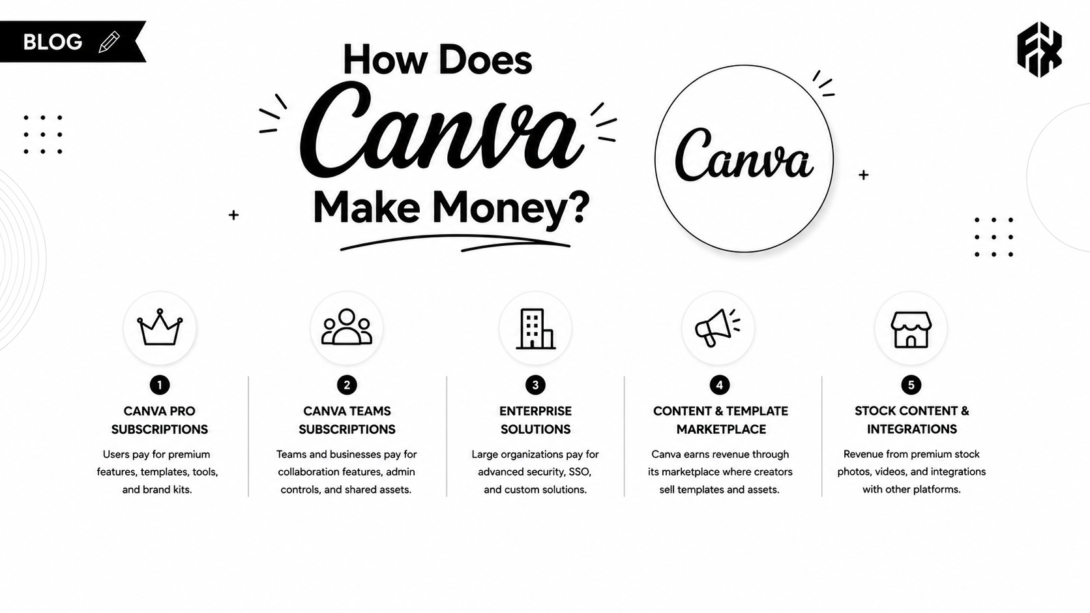
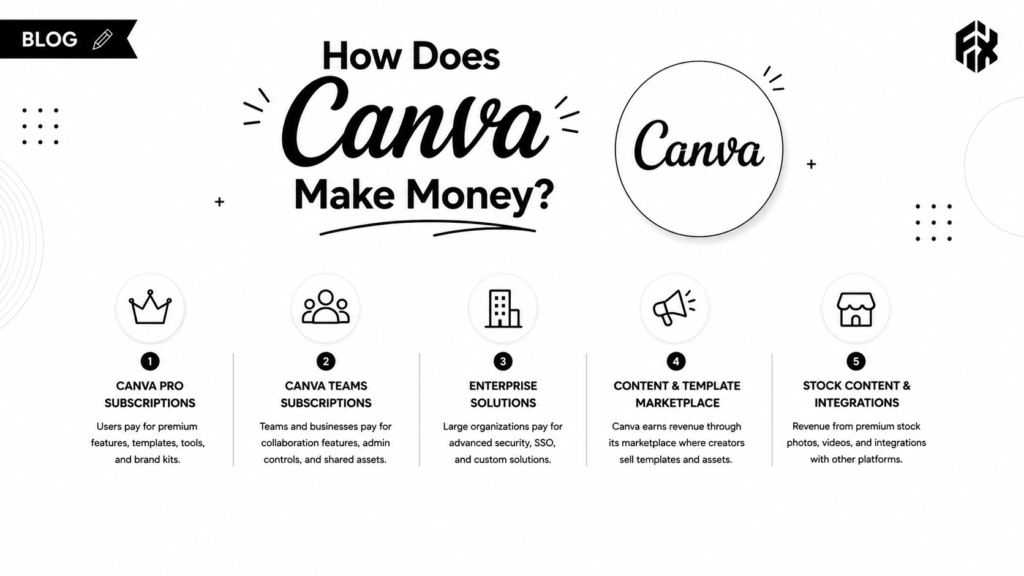
Canva makes money mainly through subscriptions — Canva Pro for individuals and small teams, and Canva for Teams and Enterprise for larger organizations — plus a smaller but growing set of adjacent revenue streams: Canva Print (physical products made from designs), a Creators marketplace where template designers earn royalties, and an Affiliates program. According to Canva co-founder and COO Cliff Obrecht, speaking to TechCrunch, the company’s annual recurring revenue hit $4 billion by the end of 2025, up from roughly $2.8 billion the year before, on the back of more than 265 million monthly active users and over 31 million paying subscribers.
The core mechanic is simple to describe and hard to execute: the free tier has to be good enough that hundreds of millions of people genuinely use it, while still leaving enough obviously valuable features locked behind Pro that a meaningful percentage eventually pays. Canva has spent over a decade tuning exactly where that line sits.
The Problem Canva Actually Solved
Canva launched in 2013, founded by Melanie Perkins, Cliff Obrecht, and Cameron Adams out of Perth, Australia. The founding insight was almost embarrassingly simple in hindsight: professional design software like Photoshop and InDesign was built for trained designers, priced for agencies, and came with a learning curve steep enough to keep most small business owners and marketers out entirely. Canva’s bet was that the actual market for “making things look good” was vastly larger than the market for “people who know how to use Photoshop” — and that a drag-and-drop, template-first tool could unlock all the people that professional software had left behind.
That bet paid off at a scale even its founders likely didn’t expect. Canva now serves more than 265 million monthly active users across 190-plus countries, with a template library exceeding 4.5 million designs and more than 30 billion total designs created on the platform since launch. The company has also been profitable for eight consecutive years — a genuinely rare feat for a venture-backed software company still growing this fast, and one that gives Canva far more control over its own timeline toward a public listing than most companies its size have.
That scale matters directly to the revenue story. A freemium business only works if the free tier is popular enough to generate a massive base to convert from. Canva didn’t design its free tier as a stripped-down demo — it designed it as a genuinely complete product, and that generosity is precisely what built the audience Canva Pro now converts from.
It’s also worth remembering how unlikely that outcome looked at the start. Perkins and Obrecht spent roughly three years pitching the idea to Silicon Valley investors before finding backers who believed a browser-based design tool could work at scale — the two reportedly met with well over a hundred investors before their first funding round closed. That long, unglamorous fundraising slog matters to the eventual business model, because it meant Canva built its product with an unusually strong focus on reaching profitability early rather than burning cash indefinitely on the assumption that funding would always be there. That discipline is arguably why Canva has managed eight straight years in the black while still growing revenue at a pace most profitable software companies never attempt.
Canva Pro: The Subscription That Funds Everything
Canva Pro is the individual and small-team subscription, and it’s still the single largest driver of how Canva makes money. It unlocks access to Canva’s full stock library of more than 100 million photos, videos, audio tracks, and graphics, along with tools like the background remover, Magic Resize (which reformats one design across dozens of size templates instantly), custom Brand Kits for consistent colors and fonts, and priority customer support.
With more than 31 million paying subscribers across Canva Pro, Teams, and Enterprise plans combined, and Canva Pro alone estimated to generate upward of $600 million in annual recurring revenue, this is the tier doing the heavy lifting of turning Canva’s enormous free audience into cash flow. Roughly 11 to 12% of Canva’s monthly active users pay for some tier of subscription — a notably strong conversion rate for a freemium consumer product, where 2 to 5% is a more typical benchmark.
That conversion rate isn’t an accident. Canva’s free tier deliberately lets people build real, finished designs — which means the moment of “wanting to pay” usually arrives right when someone is already invested in a design they like, needing one more stock photo or a slightly better export option, rather than being blocked from starting at all. Friction shows up late in the workflow, not early, which is a meaningfully gentler upgrade trigger than a hard paywall at signup.
Pricing also flexes by market in a way that matters enormously for a platform with users across 190-plus countries. Canva Pro’s list price in the US sits well above what the same subscription costs in markets like India, Indonesia, or Brazil — three of Canva’s largest user bases by traffic outside North America. That regional pricing strategy is a big part of why Canva’s user growth has stayed so strong internationally even as its most lucrative revenue continues to concentrate in North American and European markets, where the majority of Canva’s paid revenue still originates today.
Suggested image: side-by-side comparison of Canva’s free tier and Canva Pro feature set. Filename: how-canva-makes-money-pro-features.webp. Alt text: “How Canva makes money — Canva Pro subscription features compared to the free tier.” Caption: “Canva Pro unlocks premium stock, brand tools, and advanced export options.”
Canva for Teams and Enterprise: Where the Real Money Is
If Canva Pro built the base, Canva for Teams and Enterprise is where the growth story is happening right now. This tier targets companies rather than individuals, layering in brand management across an entire organization, approval workflows, shared template libraries, and admin controls that let a marketing department keep every employee’s output on-brand without a single designer reviewing every slide.
The B2B segment — companies with 25 or more seats — has been Canva’s fastest-growing business by a wide margin. It reached roughly $500 million in annual recurring revenue by the end of 2025, doubling year over year, and now represents somewhere around 12 to 20% of Canva’s total revenue depending on how the segment is measured. Canva has also pushed pricing here meaningfully: the standard Canva Teams subscription price rose from around $300 to $500 per year, lifting average contract value by an estimated 66% in the process.
This tier is also where Canva is most directly chasing Adobe’s traditional enterprise customer base. More than 85% of Fortune 500 companies reportedly have some paid Canva presence today — a remarkable foothold for a company that started as a template tool for people who’d never touched design software professionally.
Canva Print: Turning Designs Into Physical Products
Beyond subscriptions, Canva also monetizes through Canva Print, which lets users order physical products directly from their designs — business cards, posters, mugs, apparel, and other printed goods — without leaving the platform. This turns Canva into something closer to a print-on-demand storefront layered on top of a design tool: a user builds a business card in the same editor they use for social graphics, then checks out and has physical copies shipped, with Canva handling production and fulfillment through its print partners.
Print revenue isn’t broken out separately in any of Canva’s public disclosures, so it’s best understood as a supporting revenue stream rather than a primary one — but strategically, it matters for a reason beyond the direct sales: it keeps users inside Canva’s ecosystem for tasks that would otherwise send them to a completely separate print shop or template site, reducing the number of reasons anyone ever needs to leave the platform.
The Creators and Affiliates Program
Canva also runs a Creators marketplace, where independent template designers, photographers, and illustrators contribute content to Canva’s library and earn royalties based on how often their work is used by paying subscribers. This is a meaningful piece of how Canva makes money indirectly — it lets Canva keep expanding its enormous content library (the same 100-million-plus stock library that helps sell Canva Pro) without having to produce every asset in-house, while giving thousands of independent creators a real income stream tied to a platform with hundreds of millions of users.
Alongside this sits Canva’s Affiliates program, which pays creators, educators, and bloggers a commission for referring new paying subscribers. Between the two programs, Canva has effectively built a distributed sales and content-production force that costs it a percentage of revenue rather than a fixed salary bill — a structure that scales far more cheaply than hiring an equivalent in-house team would.
AI as a Growth Engine, Not a Separate Product
Unlike a lot of software companies bolting AI features onto an existing product as an upsell, Canva has largely folded AI into the core experience rather than charging for it as a standalone add-on — and used it primarily as a growth and retention lever instead. Magic Studio, Canva’s suite of AI design tools, logged more than 24 billion uses over the past year, with monthly AI tool usage climbing to roughly 800 million uses — up about 700% year over year.
In April 2025, Canva launched Visual Suite 2.0 at its Canva Create event, repositioning the platform from a design tool into what the company calls a “Creative Operating System” — a broader suite spanning documents, websites, presentations, and even simple app-building, powered heavily by AI generation underneath. An AI tool for building small websites and mini-apps inside Canva has already reportedly crossed 10 million monthly users on its own.
There’s also a subtler AI-driven growth channel worth naming: referral traffic from large language models themselves. Canva has reported that conversations referencing Canva inside tools like ChatGPT now number in the tens of millions, and traffic arriving via LLM referrals represents a growing double-digit share of new user acquisition. In effect, Canva is being recommended by AI assistants the way it might once have been recommended by a friend or a Google search result — a distribution channel that essentially didn’t exist three years ago and is now large enough that Canva tracks it as a distinct growth driver.
Suggested image: dashboard mockup showing Magic Studio’s AI design tools inside the Canva editor. Filename: canva-magic-studio-ai-tools.webp. Alt text: “How Canva makes money — AI-powered Magic Studio tools inside the design editor.” Caption: “AI tool usage inside Canva grew roughly 700% year over year.”
Canva’s Revenue, Year by Year
Because Canva remains privately held, these figures come from a mix of the company’s own disclosures (often shared directly with press like TechCrunch) and third-party analyst estimates, and different sources occasionally report slightly different numbers depending on whether they’re measuring ARR or recognized revenue. Here’s the trend as reported:
| Year | Reported Revenue / ARR | Notes |
|---|---|---|
| 2020 | — | Valuation reaches $8.5 billion following pandemic-driven collaboration boom |
| 2023 | ~$1.7 billion | Early scaling phase, Magic Design AI features introduced |
| End of 2024 | ~$2.7–2.8 billion ARR | Continued Pro and Teams growth |
| End of 2025 | ~$4 billion ARR (per Canva/TechCrunch); ~$3.5 billion recognized revenue | 20% MAU growth, B2B ARR doubles to $500M, AI usage up ~700% |
The gap between the reported $4 billion ARR figure and the roughly $3.5 billion in recognized revenue for 2025 reflects a common SaaS accounting nuance: ARR measures the annualized run-rate of current subscriptions, while recognized revenue reflects what’s actually been booked during the year — the two figures diverge more as a company sells more multi-year enterprise contracts, which Canva has been doing increasingly through its Teams and Enterprise push.
From $8.5B to $42B: Canva’s Valuation Story
Canva’s valuation history is a useful proxy for how quickly investor confidence in this business model has grown. The company was valued at around $8.5 billion in 2020, as the pandemic pushed remote teams toward collaborative design and presentation tools almost overnight. By 2021, following a funding round backed by investors including T. Rowe Price and Blackbird Ventures, that valuation had climbed to roughly $40 billion.
An August 2025 employee share sale then pushed Canva’s valuation to approximately $42 billion — meaning the company has, remarkably, held roughly flat on valuation for several years even while ARR nearly doubled, a sign the market had already priced in aggressive growth expectations well ahead of time. At that valuation, Canva trades at somewhere in the range of 10 to 13 times its ARR, a multiple worth watching against Figma’s post-IPO trading multiple, since Canva is widely expected to pursue its own public listing within the next couple of years.
Why Canva’s Paid-Conversion Rate Is Unusually High
It’s worth pausing on that 11 to 12% free-to-paid conversion rate, because it’s genuinely unusual for a freemium consumer product at this scale. Spotify converts free users to Premium at roughly similar rates after years of optimization; plenty of freemium apps struggle to break 3 to 5%.
Part of the explanation is who’s actually using Canva. Unlike a game or entertainment app, where the free tier and paid tier deliver roughly the same experience with different levels of polish, Canva’s free and paid tiers serve genuinely different use cases. A student making a single poster rarely needs Canva Pro. A small business owner producing branded content every week for a dozen different channels very quickly runs into the limits of the free stock library and generic export options — and by that point, they’ve already built real workflows inside Canva, making a competitor switch far more painful than simply upgrading. Canva effectively lets the free tier serve as a multi-year onboarding funnel rather than a time-limited trial, and it converts users at the moment their actual usage outgrows what’s free.
Canva vs Adobe vs Figma: Three Different Monetization Bets
It’s worth situating Canva against the two companies it gets compared to most often, because all three represent genuinely different monetization philosophies inside the same broad “creative software” category.
Adobe built its business on professional-grade tools — Photoshop, Illustrator, Premiere — sold at prices that assumed a working designer or agency was footing the bill, historically through perpetual licenses and now through the Creative Cloud subscription bundle. It’s a high-ARPU, lower-volume model built for people who already consider themselves designers.
Figma, by contrast, built its earliest monetization around collaborative product design specifically — UI and UX work for software teams — charging per-seat, per-editor pricing that assumes a company, not an individual, is paying. It IPO’d in 2025 at a valuation multiple analysts have cited as high as roughly 68 times revenue, reflecting how richly the market currently prices collaborative, workflow-embedded software.
Canva sits in between, deliberately: broader and cheaper than Adobe’s professional tools, aimed at non-designers rather than design teams, but increasingly pushing into Figma’s enterprise and collaboration territory through Canva for Teams and Visual Suite 2.0. The strategic bet is that Canva’s enormous non-designer user base — the people Adobe never successfully served — is a bigger long-term market than the narrower professional-designer segment Adobe and Figma compete over.
| Company | Core Audience | Primary Revenue Model | Approx. Scale |
|---|---|---|---|
| Canva | Non-designers, marketers, small teams | Freemium subscription (Pro, Teams, Enterprise) | 265M+ MAU, ~$4B ARR |
| Adobe | Professional designers, agencies | Bundled subscription (Creative Cloud) | Tens of millions of paid seats, ~$20B+ revenue |
| Figma | Product design teams, UI/UX | Per-seat, per-editor subscription | Tens of millions of users, public since 2025 |
Laid out this way, it’s easier to see why none of the three treat each other as an existential threat despite constant comparisons — each is optimized for a different buyer with a different willingness to pay, and Canva’s whole growth story has been built on serving the buyer the other two mostly ignored.
What Could Threaten This Model
Even with eight years of profitability behind it, Canva’s business carries real risks worth naming honestly.
- Free-to-paid conversion could plateau. An 11 to 12% conversion rate is strong today, but as Canva’s free userbase grows increasingly casual and non-professional, maintaining that rate at a much larger scale isn’t guaranteed.
- AI could commoditize Canva’s core value proposition. If general-purpose AI tools become good enough at instant design generation on their own, some of what currently makes Canva Pro worth paying for could erode — a risk Canva is clearly aware of, given how aggressively it’s built AI into the core product rather than treating it as a paid add-on.
- Enterprise competition is intensifying. Adobe has its own AI-driven design push (Firefly and Express), and Figma continues expanding beyond pure UI design into broader creative and marketing use cases — both narrowing the gap Canva has exploited for years.
- Valuation has outpaced multiple funding rounds without a liquidity event. Employees and early investors have been waiting years for an IPO; continued delay risks talent retention issues if equity can’t be converted to cash through some route.
- LLM referral traffic is a double-edged growth channel. Being recommended by AI assistants is a genuine acquisition win today, but it also means a meaningful and growing slice of new user discovery now runs through platforms Canva doesn’t control.
- Currency and regional pricing exposure. With a large share of users outside North America paying discounted regional prices, currency fluctuations and local economic conditions carry more weight in Canva’s total revenue than they would for a company monetizing a smaller, wealthier user base alone.
- Template fatigue. With more than 30 billion designs created from a shared library of 4.5 million templates, a genuine brand risk for Canva is that its outputs start to look homogenous across the internet — a real tension for a design tool whose entire pitch is helping people look distinctive and professional.
None of these risks have slowed Canva’s growth so far, but they’re the reason the company keeps pushing so hard into enterprise, AI, and adjacent products like Print rather than resting on subscription revenue from individuals alone.
The Bigger Picture: Freemium Done Patiently
Step back from the individual revenue lines, and Canva’s story is really a case study in freemium done with unusual patience. Plenty of software companies try the “give it away free, convert a slice to paid” playbook. Very few manage to stay profitable while doing it, and fewer still manage to keep the free tier genuinely excellent for over a decade instead of slowly degrading it to force upgrades — a temptation that eventually undermines user trust at companies that give in to it.
Canva’s answer to that temptation has been to keep adding new places to spend money — Teams, Print, Creators royalties, AI-powered tools — rather than making the free tier worse. That’s a meaningfully harder path than tightening the free tier’s limits, but it’s also the reason Canva’s 265 million monthly users still trust the platform enough to keep coming back daily, which is ultimately the asset the entire $42 billion valuation is priced against. The real test ahead — through an eventual IPO and beyond — is whether Canva can keep expanding its enterprise and AI revenue without ever making its free product feel like bait.
What This Means If You’re a Small Business or Marketing Team
Understanding how Canva makes money is more than trivia if you’re actually deciding whether to pay for it. A few practical implications fall out of everything above.
If your design needs are occasional — a one-off flyer, a single social post, a resume — the free tier genuinely covers most of that without friction, and there’s no strong financial reason to upgrade. Canva built it that way on purpose; the free tier isn’t a bait-and-switch trial with an expiration date.
If you’re producing branded content weekly or managing multiple contributors, Canva Pro’s brand kit and stock library tend to pay for themselves quickly in time saved alone, since the alternative is usually piecing together stock assets from several paid sources anyway. And if you’re a growing team where more than one person touches brand assets, Canva for Teams is worth evaluating specifically for the approval workflows and shared libraries — the price increase to $500 a year reflects real added functionality, not just inflation, since it now includes collaboration tooling the older $300 tier didn’t.
For template designers, illustrators, and photographers, the Creators program is a legitimate secondary income stream worth understanding on its own terms — royalties scale with how often your specific assets get used by paying subscribers, meaning a handful of genuinely popular templates can generate meaningfully more than a large volume of rarely-used ones.
FAQs
Is Canva free to use? Yes. Canva’s core design tool, most templates, and a large portion of its stock library are free to use. Canva Pro, Teams, and Enterprise are optional paid tiers that unlock additional stock, brand tools, and collaboration features.
How much revenue does Canva make? Canva reported annual recurring revenue of roughly $4 billion by the end of 2025, according to co-founder Cliff Obrecht, with approximately $3.5 billion in recognized revenue for the year.
What percentage of Canva users pay for a subscription? Roughly 11 to 12% of Canva’s 265 million-plus monthly active users are paying subscribers — around 31 million people across Canva Pro, Teams, and Enterprise combined.
Is Canva profitable? Yes. Canva has been profitable every year since 2017, a rare accomplishment for a venture-backed software company growing this quickly.
What is Canva’s valuation? Canva was valued at approximately $42 billion following an employee share sale in August 2025, up from around $40 billion in 2021 and $8.5 billion in 2020.
Does Canva make money from printing physical products? Yes, through Canva Print, which lets users order physical items like business cards, posters, and apparel made from their designs, though this revenue isn’t broken out separately from Canva’s overall subscription figures.
Is Canva going public? Canva hasn’t confirmed a specific IPO date, but a public listing is widely expected within the next couple of years given its scale, profitability, and the retail investor interest that followed comparable design-adjacent IPOs like Figma’s.
How is Canva different from Adobe’s business model? Adobe monetizes professional designers through tools like Photoshop and Illustrator, typically at higher price points aimed at agencies and trained creatives. Canva monetizes a much broader, largely non-designer audience through a freemium model with a lower price point and simpler tools.
Does Canva charge for its AI features separately? No. Canva has largely built AI tools like Magic Studio into its existing Free, Pro, and Teams tiers rather than charging for AI as a standalone add-on, using it primarily to drive engagement and subscription conversion instead.
Final Word
How does Canva make money? By giving away a product good enough that hundreds of millions of people build real habits around it, then charging the slice of users — individuals scaling up their output, and companies needing brand control at scale — who genuinely outgrow the free tier. Canva Pro built the base. Canva for Teams and Enterprise, now growing faster than any other part of the business, is proving that freemium consumer products can climb successfully into serious B2B revenue without abandoning the free tier that built their audience in the first place.
If you’re studying business models like this one for your own product, content, or marketing strategy, Finmaticx’s AI Prompt Generator and Finmaticx GPT tools can help you move faster on research and content creation. You’ll find more platform revenue breakdowns like this one in the Finmaticx blog, and you can learn more about what we cover on our About Us page.