So how does PhonePe make money when the transaction you use it for most — sending ₹200 to a friend over UPI — literally costs PhonePe nothing to charge you for, because Indian regulation makes basic UPI transfers free by law? You split a dinner bill, scan a QR code at a tea stall, pay your electricity bill, and never once see a processing fee. And yet PhonePe closed its most recent full financial year with revenue of over ₹7,100 crore — roughly $850 million — and is preparing for one of India’s biggest fintech IPOs.
That’s the puzzle at the center of how PhonePe makes money. It built the country’s single largest payments app on top of a product that, by design, can’t directly charge the people using it most. Everything interesting about PhonePe’s business model exists because of how it worked around that constraint.
How Does PhonePe Make Money? The Short Answer
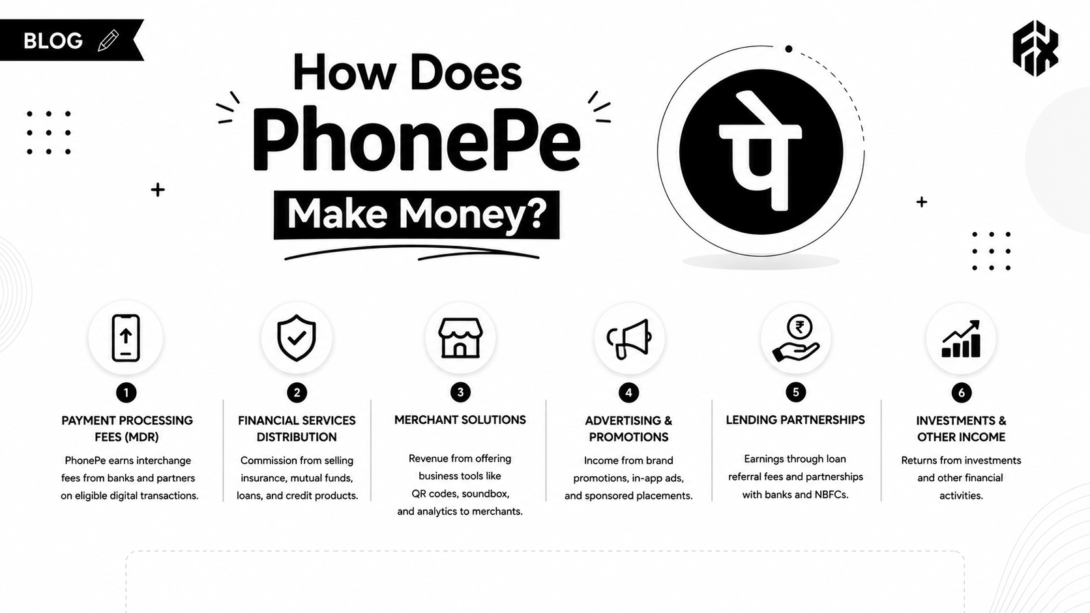
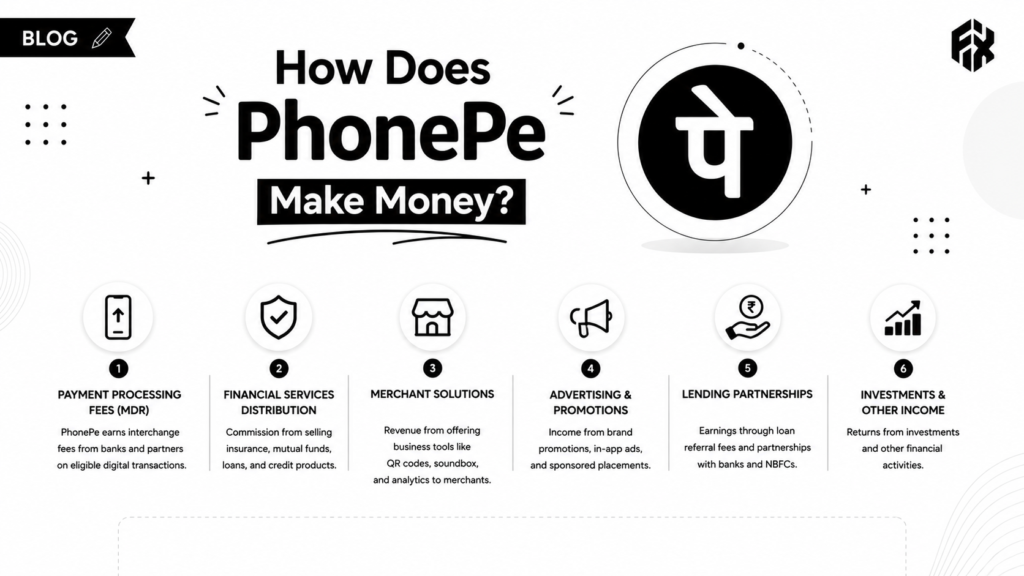
PhonePe makes money through a mix of payment-adjacent services — advertisement fees, platform and subscription fees, transaction charges on non-UPI-regulated services like bill payments and travel booking, and increasingly, merchant payment processing — plus a fast-growing financial services distribution business spanning insurance, lending, mutual funds, and stockbroking. In FY25 (the year ending March 2025), payment services accounted for roughly 88.55% of PhonePe’s ₹7,114.9 crore in revenue from operations, with insurance and lending contributing about 7.8%, and newer businesses like stockbroking and marketplace services making up the rest.
Revenue grew 40% year over year in FY25, and the company narrowed its net loss to ₹1,727.4 crore from ₹1,996.1 crore the year before — while, on an adjusted basis excluding stock-based compensation, PhonePe actually turned profitable, posting an adjusted profit after tax of ₹630 crore. That distinction between statutory loss and adjusted profit is one of the more important things to understand about how PhonePe makes money right now, and it’s covered in more detail further down.
PhonePe was founded in December 2015 by Sameer Nigam, Rahul Chari, and Burzin Engineer, three former colleagues who had previously worked together at Flipkart, India’s largest homegrown e-commerce company. Their founding bet was that India was on the verge of a genuine leapfrog moment in digital payments — skipping past the card-heavy infrastructure that Western markets had built over decades and going straight to instant, phone-number-linked bank transfers. That bet was validated almost immediately by external events: within a year of PhonePe’s founding, India’s National Payments Corporation launched UPI itself, in 2016, and PhonePe became one of the earliest and most aggressive apps built specifically around it. Flipkart acquired PhonePe in 2016, and when Walmart acquired a majority stake in Flipkart in 2018, Walmart became PhonePe’s majority owner by extension — a relationship that has defined PhonePe’s capital structure, and its path toward an eventual IPO, ever since.
The Catch: UPI Itself Is Free to Use
To understand PhonePe’s business, you first need to understand what it can’t charge for. India’s Unified Payments Interface (UPI), the instant bank-to-bank transfer system PhonePe is built on top of, operates under a zero-merchant-discount-rate mandate for the vast majority of transactions — meaning neither PhonePe nor any other UPI app can charge users or most merchants a fee simply for moving money through UPI. This was a deliberate government policy choice, designed to drive UPI adoption as a public digital infrastructure layer rather than a for-profit payment rail.
That’s a genuinely unusual constraint for a payments company holding roughly 45 to 46% of India’s UPI transaction volume as of late 2025 — larger than any Western payments company’s typical market share in its home market — and it means PhonePe had to build almost its entire monetization strategy around the edges of its core product, rather than on the core transaction itself. Every other part of this article is essentially the story of how PhonePe answered that constraint.
Suggested image: infographic showing India’s UPI zero-MDR policy and where PhonePe actually earns revenue around it. Filename: how-phonepe-makes-money-upi-zero-mdr.webp. Alt text: “How PhonePe makes money despite UPI transfers being free under India’s zero-MDR policy.” Caption: “PhonePe monetizes around UPI’s free core transaction, not the transaction itself.”
Advertisement and Platform Fees: The Quiet Core Business
Within that 88.55% “payment services” revenue bucket sits a mix most users never think about as PhonePe’s actual business model: advertisement fees from brands paying for visibility inside the app (on recharge screens, deal sections, and promotional banners), platform fees for using certain app features, subscription-style setup charges for hardware like PhonePe’s smart speaker devices used by merchants to get audio payment confirmations, and transaction processing fees on services that fall outside UPI’s zero-MDR rule — things like bill payments, digital gold purchases, and travel bookings, where PhonePe can and does charge a small convenience fee or take a commission.
This is the layer that turns hundreds of millions of daily UPI transactions — individually unmonetizable — into a functioning business. Every time someone opens the app to check their balance or send money, they’re also a few taps away from a bill payment, a gold purchase, or a travel booking that does carry a small fee, or an ad placement PhonePe got paid to show them. Scale, in this case, is doing work that a per-transaction fee can’t.
Merchant Payments: The Fastest-Growing Slice of Revenue
If advertisement and platform fees are the quiet, steady base, merchant payments are where PhonePe’s growth story is accelerating fastest. Merchant payments — offline QR-code transactions at shops, restaurants, and other point-of-sale locations — grew from contributing just 14.75% of total revenue two years ago to nearly 31% of the topline by the first half of FY26, according to PhonePe’s own financial disclosures.
A major driver of that acceleration: in September 2025, the Reserve Bank of India granted PhonePe final approval to operate as a payment aggregator, a license that lets the company process merchant payments through cards, net banking, and wallets — channels where, unlike UPI, merchant discount rate fees are legally permitted. That’s a meaningful unlock. It means PhonePe’s 45-million-plus merchant network isn’t limited to UPI QR codes anymore; the company can now capture fee revenue on a much broader slice of the payment methods those merchants already accept, without needing every single one of those merchants to switch to a new payment method.
Suggested image: growth chart showing merchant payments as a share of PhonePe’s total revenue, 2023 to 2026. Filename: phonepe-merchant-payments-revenue-growth.webp. Alt text: “How PhonePe makes money — merchant payments revenue share growth chart.” Caption: “Merchant payments more than doubled as a share of PhonePe’s revenue in two years.”
Insurance and Lending: Distribution, Not Risk-Taking
Beyond payments, PhonePe has built a genuinely fast-growing financial services distribution business. It sells insurance products — motor, health, and life policies — acting as a broker and earning commission from insurance companies for every policy sold through the app, rather than underwriting the risk itself. Similarly, its lending business primarily distributes loans from partner banks and non-banking financial companies, earning a referral or distribution fee, rather than holding most of that loan book on its own balance sheet.
This “distribution, not balance sheet” structure is deliberate and capital-efficient: PhonePe doesn’t need to raise or hold enormous reserves of lending capital to participate in India’s booming digital credit market, since the actual underwriting risk sits with its partner lenders and insurers. The payoff has been dramatic — insurance and lending’s combined share of PhonePe’s revenue climbed from a negligible 0.96% in FY23 to roughly 11.55% by the first half of FY26, making it one of the fastest-growing pieces of the entire business, and notably higher-margin than the core payments segment.
The strategic logic here mirrors what plenty of consumer platforms with large, trusted user bases eventually discover: the hardest and most expensive part of selling financial products is usually customer acquisition, not the product itself. Insurers and lenders spend heavily to reach potential customers through call centers, agent networks, and advertising. PhonePe already has 650-plus million registered users opening the app multiple times a week for payments — a distribution advantage no traditional insurer or NBFC can replicate on their own. That’s precisely why PhonePe can offer partners access to this user base in exchange for a commission, rather than needing to become an insurer or lender itself, taking on regulatory capital requirements and underwriting risk it has no particular expertise in managing.
Wealth: Stockbroking and Mutual Fund Distribution
PhonePe has also pushed into wealth management, primarily through Share.Market, its stockbroking platform, alongside mutual fund distribution where it earns trail commissions for every rupee invested through the app. This segment remains small in absolute terms — stockbroking, mutual funds, and marketplace services combined contributed only about ₹57.2 crore, under 1% of FY25 revenue — but it represents the same underlying strategy as insurance and lending: using PhonePe’s existing base of 650-plus million registered users as a distribution channel for financial products it doesn’t need to manufacture itself, only sell.
Pincode and Indus Appstore: The Strategic Side Bets
Two other ventures round out PhonePe’s broader ecosystem, though neither is a meaningful revenue contributor yet. Pincode is PhonePe’s hyperlocal e-commerce platform, initially focused on medicine delivery and expanding into broader quick commerce, competing in a category already crowded with well-funded players like Blinkit and Zepto. Indus Appstore is an Android app marketplace positioned as an alternative to Google Play, aimed at giving Indian developers a distribution channel that doesn’t route entirely through Google’s ecosystem and fee structure.
Both are best understood as strategic rather than financial bets today. Pincode extends PhonePe’s relationship with users beyond payments into everyday commerce, while Indus Appstore is a bet on India’s regulatory and developer appetite for platform alternatives to Google — a long game, not a near-term revenue driver, and one that hasn’t shown up as a material line item in PhonePe’s disclosed financials yet.
PhonePe’s Revenue, Year by Year
Here’s the trajectory, based on PhonePe’s own consolidated filings with India’s Registrar of Companies and its IPO prospectus:
| Fiscal Year (ending March) | Revenue from Operations | YoY Growth | Net Loss |
|---|---|---|---|
| FY21 | ₹690 crore | +85% | — |
| FY23 | ₹2,914.3 crore | — | ₹738 crore (adjusted) |
| FY24 | ₹5,064.1 crore | +74% | ₹1,996.1 crore |
| FY25 | ₹7,114.9 crore | +40% | ₹1,727.4 crore |
| H1 FY26 (6 months) | ₹3,918.5 crore | — | ₹1,444 crore |
Revenue from operations grew at a compound annual growth rate of roughly 56% between FY23 and FY25 — a pace few payments companies anywhere sustain at PhonePe’s scale. Just as notable: FY25 marked the year PhonePe achieved positive adjusted EBIT (earnings before interest and tax, excluding stock-based compensation) for the first time, and the company also reported generating positive free cash flow during the year — meaning it could fund its own growth without leaning as heavily on external capital, a meaningful milestone heading into an IPO.
The Billion-Dollar Move Back to India
One of the more unusual chapters in how PhonePe makes money — or rather, in how it’s structured to make money — happened off the balance sheet entirely. PhonePe was originally domiciled in Singapore, a common structure for Indian startups seeking a more IPO-friendly jurisdiction and easier access to global capital. In December 2022, PhonePe completed a full redomiciliation, shifting its parent entity back to India ahead of a planned Indian stock exchange listing — a move that reportedly cost the company and its shareholders close to $1 billion in taxes, since shifting a company’s domicile between countries triggers a taxable event on the underlying value being moved.
That’s an extraordinary price to pay for a change that doesn’t directly generate revenue, and it tells you how seriously PhonePe’s leadership and its majority owner, Walmart, were taking the eventual goal of a listing on Indian exchanges rather than a US or Singapore listing. The same year, PhonePe formally demerged from Flipkart, becoming a standalone entity majority-owned by Walmart, with Flipkart’s other shareholders retaining smaller stakes — clearing the path for PhonePe to pursue its own independent IPO timeline rather than being valued as part of Flipkart’s broader e-commerce business.
The logic behind absorbing that tax bill becomes clearer once you consider what an Indian listing actually offers a company like PhonePe that a foreign listing wouldn’t. A domestic IPO lets Indian retail investors — who make up a meaningful share of PhonePe’s own user base — actually buy shares in the company they use every day, a dynamic that’s proven to generate strong demand for other India-focused consumer tech listings. It also avoids the cross-border regulatory friction that a foreign-domiciled company would face trying to list a business this deeply embedded in India’s payments infrastructure, given how central data localization and financial-sector oversight are to Indian fintech regulation. Paying roughly $1 billion upfront to remove that friction was, in effect, a bet that a clean domestic listing structure would be worth more in eventual IPO proceeds and long-term investor access than the one-time tax cost.
The Road to an IPO — and Why the Valuation Keeps Changing
PhonePe converted from a private limited company to a public limited company in April 2025, a structural prerequisite for listing on Indian exchanges, and filed a confidential draft red herring prospectus (DRHP) with India’s securities regulator, SEBI, in September 2025. As of its updated DRHP in January 2026, the IPO was structured as a pure offer-for-sale — meaning no fresh capital would be raised, with existing shareholders selling roughly ₹12,000 crore ($1.5 billion) worth of shares. Walmart’s holding entity, WM Digital Commerce, planned to sell about 9% of its 71.77% stake, while Tiger Global and Microsoft planned to exit their positions entirely.
That January 2026 filing initially targeted a valuation of roughly $14.5 to $15 billion — up from the $12 billion valuation PhonePe achieved in a 2023 funding round. But by March 2026, reports indicated the IPO had been paused and the target valuation revised sharply downward, to somewhere between $9 billion and $10.5 billion, with the listing timeline pushed back citing broader market tensions, including instability linked to the Middle East conflict from late February 2026 onward. As of this writing, no revised listing timeline has been announced, and the final valuation will ultimately be set by market conditions whenever the process resumes.
That kind of swing — nearly a 35% valuation cut in a matter of weeks — is a useful reminder that even a company with genuinely strong, fast-growing fundamentals can see its IPO pricing whipsawed by macro conditions entirely outside its control.
Suggested image: timeline graphic of PhonePe’s IPO valuation targets from 2023 funding round through the March 2026 pause. Filename: phonepe-ipo-valuation-timeline.webp. Alt text: “How PhonePe’s IPO valuation target has shifted from $12 billion to $15 billion to $9-10.5 billion.” Caption: “PhonePe’s targeted IPO valuation has moved significantly based on market conditions alone.”
The 30% Cap Hanging Over the Entire Business
There’s a regulatory risk specific to PhonePe’s business that’s worth understanding on its own, because it’s unusual and genuinely significant: India’s National Payments Corporation of India (NPCI), which oversees UPI, has a rule capping any single UPI app at 30% of total transaction volume, intended to prevent excessive concentration in the payments ecosystem. PhonePe’s actual UPI market share has sat well above that threshold for years — around 45 to 46% as of late 2025, more than 50% above the theoretical cap.
NPCI has repeatedly delayed enforcement of this rule, most recently extending compliance deadlines rather than forcing PhonePe (or Google Pay, the only other player near the threshold) to actively shed transaction volume. But the rule technically remains on the books, and any future decision to actually enforce it — rather than extend it again — would represent a genuine structural risk to PhonePe’s core payments business, since it would mean deliberately capping growth in the exact product category that still generates the large majority of its revenue.
What Could Threaten This Model
Even with 56% revenue CAGR and a clear path toward sustained profitability, PhonePe’s business carries real, well-documented risks.
- The NPCI 30% cap remains unresolved. Continued delays in enforcement don’t eliminate the risk — they just postpone a decision that could eventually force PhonePe to actively limit its own UPI transaction volume growth.
- Payments still dominates revenue despite diversification efforts. At 88.55% of FY25 revenue, PhonePe remains heavily exposed to a single, regulator-constrained product category, even as insurance, lending, and merchant payments grow faster in percentage terms.
- IPO valuation volatility signals broader market sensitivity. A roughly 35% valuation cut within months shows how exposed PhonePe’s eventual listing proceeds are to macro conditions entirely outside the company’s operating performance.
- Competition remains intense. Google Pay holds a meaningful UPI market share of its own (~35%), and India’s fintech landscape includes well-capitalized competitors like Paytm and Amazon Pay, all competing for the same merchant and consumer relationships.
- Accumulated losses are still substantial. With ₹14,860 crore in accumulated net losses by the end of FY25, PhonePe’s path to sustained statutory (not just adjusted) profitability is still a work in progress, even as the underlying trend is clearly improving.
None of these risks have stopped PhonePe’s growth so far — revenue nearly doubled between FY23 and FY25 — but they’re the reason the company has pushed so hard into merchant payments, insurance, and lending rather than resting on UPI transaction volume alone, given that volume itself can’t be directly monetized and carries real regulatory uncertainty.
PhonePe vs Google Pay vs Paytm: Three Approaches to the Same Constraint
It’s worth briefly comparing PhonePe against its two closest UPI competitors, because all three face the identical zero-MDR constraint on core transactions and have responded to it somewhat differently.
Google Pay, PhonePe’s largest rival at roughly 35% UPI market share, monetizes far less aggressively around its Indian payments product than PhonePe does — it doesn’t run the same breadth of insurance, lending, and stockbroking distribution business, largely because Google’s broader global revenue doesn’t depend on Google Pay India turning a profit on its own. That gives Google Pay more patience to simply hold market share without needing every user interaction to eventually justify itself financially.
Paytm, by contrast, pursued a strategy closer to PhonePe’s own — diversifying aggressively into lending, wealth management, and merchant services — but ran into serious regulatory trouble in 2024 when the Reserve Bank of India restricted its associated payments bank over compliance concerns, a setback that significantly dented its UPI market share and consumer trust. PhonePe’s own RBI payment aggregator approval in September 2025, obtained without the kind of regulatory friction Paytm experienced, stands in useful contrast — a reminder that in India’s tightly regulated fintech environment, staying on the right side of RBI compliance isn’t optional politeness, it’s a genuine competitive advantage.
What This Means If You’re a Merchant or User in India
Understanding how PhonePe makes money is also practically useful if you’re deciding how to use the platform. For everyday users, the core lesson is straightforward: basic UPI transfers will very likely remain free indefinitely, since that’s a matter of national policy rather than PhonePe’s own discretion — there’s no looming subscription fee coming for splitting a dinner bill with friends.
For merchants, the calculus is a little different now that PhonePe holds a payment aggregator license. Accepting UPI payments through PhonePe remains free of merchant discount rate fees, but if you also want to accept cards, net banking, or wallet payments through the same PhonePe merchant account, those channels do carry processing fees — worth comparing against dedicated payment gateway providers before committing to consolidate everything under one PhonePe merchant relationship. And if you’re a small business owner who’s used PhonePe primarily for UPI collections, it’s worth knowing the same account can now plug you into insurance and lending distribution products PhonePe offers merchants directly — often a faster underwriting process than a traditional bank, precisely because PhonePe already has visibility into your real transaction history.
FAQs
Does PhonePe charge fees on UPI transactions? No. Under India’s zero-MDR (merchant discount rate) policy, PhonePe cannot charge users or most merchants a fee for standard UPI transactions. Revenue instead comes from advertising, platform fees, non-UPI transaction fees, merchant payment processing, and financial services distribution.
How much revenue does PhonePe make? PhonePe reported ₹7,114.9 crore (roughly $850 million) in revenue from operations for FY25 (the year ending March 2025), up 40% from ₹5,064.1 crore in FY24.
Is PhonePe profitable? On a statutory basis, PhonePe reported a net loss of ₹1,727.4 crore in FY25. On an adjusted basis, excluding stock-based compensation, it posted a profit of ₹630 crore and achieved positive adjusted EBIT and positive free cash flow for the first time.
What percentage of PhonePe’s revenue comes from payments? Roughly 88.55% of FY25 revenue came from payment services (transaction fees on non-UPI services, platform fees, subscription fees, and advertisement fees), with insurance and lending contributing about 7.8%, and other businesses making up the remainder.
Who owns PhonePe? Walmart, through its subsidiary WM Digital Commerce Holdings, owns approximately 71.77% of PhonePe. Other shareholders include General Atlantic (8.89%), Headstand Pte. Ltd. (5.73%), and co-founders Sameer Nigam and Rahul Chari (2.55% each).
Is PhonePe going public? PhonePe filed a confidential draft red herring prospectus with India’s securities regulator in September 2025, targeting a roughly $15 billion valuation. As of March 2026, the IPO process was paused amid broader market conditions, with the target valuation revised down to $9–10.5 billion and no new listing timeline announced.
What is the NPCI 30% cap and does it affect PhonePe? It’s a rule limiting any single UPI app to 30% of transaction volume. PhonePe’s actual share sits around 45–46%, well above that threshold. NPCI has repeatedly delayed enforcement, but the rule remains a genuine long-term regulatory risk for PhonePe’s core business.
Final Word
How does PhonePe make money? By building an entire business around the edges of a product it’s legally barred from charging for directly. Advertising, platform fees, and non-UPI transaction charges built the early revenue base; merchant payments and financial services distribution — insurance, lending, wealth — are now the fastest-growing pieces of a business preparing for one of India’s largest fintech IPOs. Whether that IPO lands at $15 billion or closer to $9 billion will depend far more on global market conditions in the coming months than on anything happening inside PhonePe’s own operations.
If you’re studying fintech and platform business models like this one for your own research or content strategy, Finmaticx’s AI Prompt Generator and Finmaticx GPT tools can help you move faster. You’ll find more platform revenue breakdowns like this one in the Finmaticx blog, and you can learn more about what we cover on our About Us page.