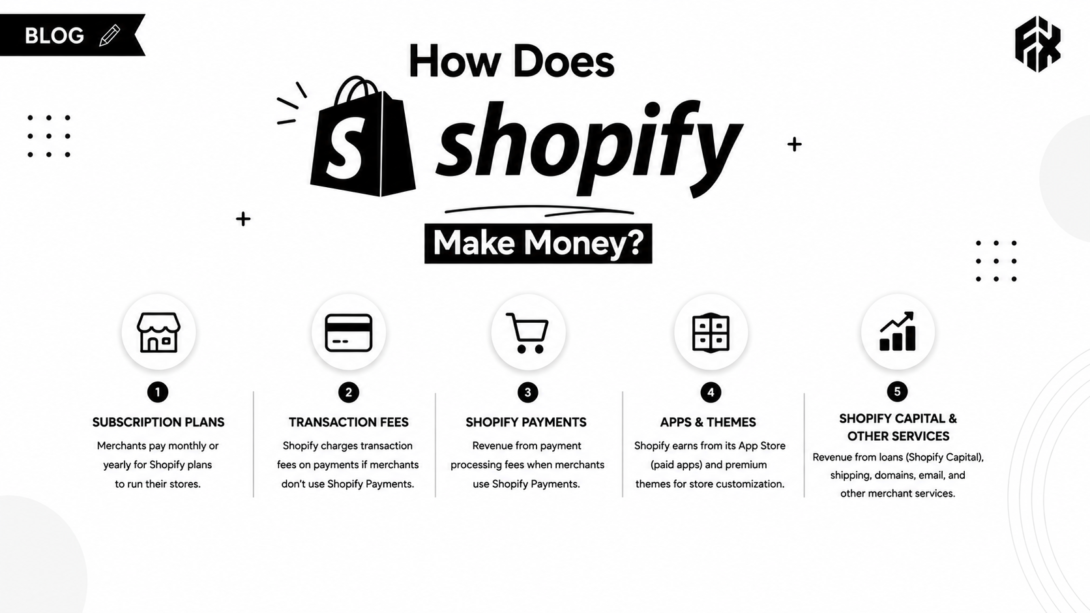
So how does Shopify make money when it doesn’t own a single product you’ve ever bought through it? You click “Add to Cart” on a small skincare brand’s website, check out, and get a confirmation email with that brand’s logo on it — not Shopify’s. You may never even notice the words “Powered by Shopify” in the tiny footer text. And yet that one purchase, split across a subscription fee the merchant already pays and a small transaction cut Shopify takes automatically, is a small piece of what turned Shopify into an $11.5 billion-revenue company in 2025.
That invisibility is the whole point. Shopify isn’t trying to be the store you shop at — it’s trying to be the infrastructure every other store runs on, collecting a fee every time commerce happens on top of it rather than competing with the merchants themselves for your attention. Understanding how Shopify makes money means understanding that quiet, infrastructure-first bet, and why it’s paid off at a scale few e-commerce companies have matched.
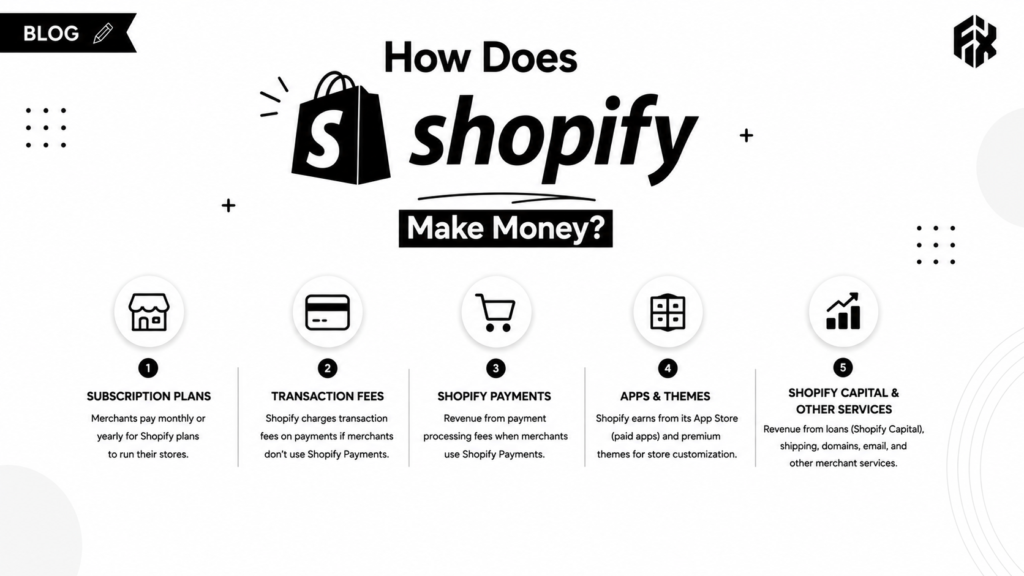
How Does Shopify Make Money? The Short Answer
Shopify makes money through two revenue streams: Subscription Solutions, the recurring monthly fee merchants pay to run a store on the platform, and Merchant Solutions, a success-based bucket that includes payment processing fees, shipping, lending through Shopify Capital, and point-of-sale hardware. In 2025, Merchant Solutions made up roughly 73% of Shopify’s total revenue, with Subscription Solutions accounting for the remaining 27% — a split that’s shifted meaningfully over time, since Merchant Solutions revenue was closer to a 2.3-to-1 ratio against subscriptions back in 2020, compared with roughly 3.7-to-1 by the end of 2025.
Total 2025 revenue reached $11.5 billion, up 30% year over year, on gross merchandise volume (GMV) of $378.4 billion flowing through the platform — a figure roughly three times what Shopify processed just five years earlier. That growth in Merchant Solutions relative to Subscription Solutions is the single clearest signal of Shopify’s strategic direction: it increasingly earns money alongside its merchants’ success, not just from the flat monthly fee for existing.
The Snowboard Shop That Became a $100 Billion Platform
Shopify’s origin story is one of the more genuinely accidental founding stories in tech. In 2004, Tobias Lütke, Daniel Weinand, and Scott Lake tried to launch an online snowboard shop called Snowdevil in Ottawa, Canada. Unable to find e-commerce software that didn’t feel clunky and outdated, Lütke — a trained programmer — built his own. The snowboard business itself never took off in any meaningful way, but the software underneath it clearly had a much bigger market than snowboards alone, and the founders pivoted entirely to selling the platform itself.
That pivot from “sell one specific product” to “sell the infrastructure that lets anyone sell anything” is the thread running through every part of how Shopify makes money today. Shopify went public in 2015 on both the NYSE and TSX, and by the end of 2025 its platform had crossed $378 billion in annual GMV — commerce happening through independent merchants who chose Shopify specifically because it let them own their own storefront, their own customer data, and their own brand, rather than renting a listing inside someone else’s marketplace.
It’s a useful reminder that some of the most durable software businesses weren’t built by someone setting out to build software at all — they were built by someone trying to solve one specific, narrow problem for themselves, discovering the tool they built was more valuable than the original goal, and having the discipline to abandon the original plan entirely. Lütke has said in interviews that had a decent e-commerce platform already existed in 2004, Shopify likely never would have been built — the entire company exists because of a gap the founders only found by trying to build something else first.
Subscription Solutions: The Storefront Fee
The most straightforward piece of how Shopify makes money is Subscription Solutions — the recurring fee merchants pay simply to have a functioning store. This covers Shopify’s tiered plans (commonly Basic, Shopify, and Advanced, alongside enterprise-grade Shopify Plus), the POS Pro offering for merchants selling in physical retail locations, plus revenue from app sales, theme purchases, and domain name registration through the platform.
Subscription Solutions revenue reached $777 million in Q4 2025 alone, up 17% year over year — solid, steady growth, but notably slower than the growth Shopify is seeing elsewhere in the business. Much of that growth is coming less from raw merchant-count expansion and more from a mix shift toward higher-priced plans like Shopify Plus, along with the variable component of certain subscription contracts that scales with a merchant’s GMV. In other words, Shopify is increasingly making more from each existing merchant rather than relying purely on signing up new ones — a maturing-platform pattern common to most SaaS businesses once their addressable market of brand-new customers starts to level off relative to the size of their existing base.
Suggested image: comparison graphic of Shopify’s Basic, Shopify, Advanced, and Plus subscription tiers. Filename: how-shopify-makes-money-subscription-tiers.webp. Alt text: “How Shopify makes money — comparison of Basic, Shopify, Advanced, and Plus subscription plans.” Caption: “Subscription Solutions revenue grows both from new merchants and from existing merchants trading up to higher tiers.”
Merchant Solutions: Where the Real Growth Is
If Subscription Solutions is the steady baseline, Merchant Solutions is where Shopify’s growth story actually lives. This bucket includes Shopify Payments (payment processing and currency conversion fees), Shopify Shipping, Shopify Capital (merchant lending), Shop Pay, point-of-sale hardware sales, and transaction fees charged when merchants use a non-Shopify-Payments gateway instead.
Merchant Solutions revenue hit $2.90 billion in Q4 2025 alone, up 35% year over year — more than double the growth rate of Subscription Solutions in the same quarter. The reason this segment has become Shopify’s dominant revenue driver is structural: unlike a flat subscription fee, Merchant Solutions revenue scales directly with GMV. As merchants sell more, Shopify earns more automatically, without needing to sign a single new customer or negotiate a single new contract. That alignment is deliberate — Shopify’s own success-based fees mean the company’s incentives point in the same direction as its merchants’ incentives, which is a meaningfully different relationship than a landlord collecting flat rent regardless of how a tenant’s business performs.
Shopify Payments: The Engine Inside the Engine
Within Merchant Solutions, Shopify Payments is the single largest component, and it’s worth understanding on its own. Rather than requiring merchants to set up a separate payment processor, Shopify offers built-in payment processing, taking a percentage-based fee on transactions plus currency conversion fees on cross-border sales. Shopify Payments generated $518 million in revenue in Q3 2025 alone from processing and conversion fees.
The real story is in the penetration rate — the percentage of total GMV flowing through Shopify’s own payment system rather than a third-party processor. That penetration rate climbed from 62% in Q3 2024 to 65% in Q3 2025, and Shopify processed $84 billion of Q4 2025’s total GMV through Shopify Payments alone, representing 68% penetration for the quarter. Every percentage point of additional penetration compounds directly into revenue, since Shopify earns meaningfully more from a transaction processed through its own payment rails than from one processed through an outside gateway that only pays Shopify a smaller transaction fee. At current GMV scale, analysts estimate that each additional percentage point of Shopify Payments penetration is worth roughly $1 billion in incremental annual payment volume — which is a large part of why Shopify has invested so heavily in making its own checkout and payments experience (branded as Shop Pay) faster and more trusted than the third-party alternatives merchants might otherwise choose.
Suggested image: chart showing Shopify Payments penetration rate climbing from 2024 to 2026. Filename: shopify-payments-penetration-rate-growth.webp. Alt text: “How Shopify makes money — Shopify Payments penetration rate growth chart.” Caption: “Shopify Payments penetration climbed from 62% to 68% of total GMV in a year.”
Shopify Capital: Becoming a Lender to Its Own Merchants
One of the less obvious ways Shopify makes money is through Shopify Capital, which offers merchants loans and merchant cash advances — essentially, upfront funding repaid as a percentage of future sales, rather than a fixed monthly payment. It’s a natural extension of Shopify’s core data advantage: because Shopify already sees a merchant’s real-time sales performance, it can underwrite lending decisions with a level of insight a traditional bank simply doesn’t have access to.
This business has grown fast — Shopify’s loans and merchant cash advances balance climbed from $1.22 billion to $1.78 billion over the course of 2025, a 46% increase. It’s also a genuine source of financial risk worth naming honestly: transaction and loan losses reached $114 million in Q4 2025, down somewhat from an elevated Q3 but still roughly 50% higher year over year. Shopify’s own management has acknowledged some of that increase reflects deliberate testing and experimentation with merchant onboarding criteria — a signal that Shopify is actively tuning how aggressively it extends credit, aware that Capital’s growth needs to stay disciplined rather than becoming a hidden liability on an otherwise fast-growing balance sheet.
Why GMV Matters More Than Any Other Number Shopify Reports
If you read anything about Shopify’s earnings, you’ll see gross merchandise volume, or GMV, mentioned constantly — arguably more than revenue itself. GMV represents the total dollar value of all orders processed through Shopify’s platform, net of refunds, including shipping and taxes. It’s not revenue Shopify actually keeps; it’s the total size of the economic activity happening on top of Shopify’s infrastructure.
GMV matters because it’s the leading indicator for nearly every other number in Shopify’s business. Higher GMV means more Shopify Payments processing fees, more Shopify Capital repayment volume, more variable subscription fees from Plus merchants whose contracts scale with sales, and generally more of everything Merchant Solutions captures. Shopify crossed $100 billion in quarterly GMV for the first time in Q4 2025, at $123.8 billion, and followed that with a second consecutive $100 billion-plus quarter in Q1 2026 — a pattern management has explicitly framed as evidence that $100 billion in quarterly GMV is now a structural floor for the business rather than a seasonal peak driven by holiday shopping alone.
It’s worth drawing out why GMV, rather than revenue, gets top billing in Shopify’s own earnings materials and investor conversations. Revenue tells you how much Shopify itself earned. GMV tells you how much economic activity Shopify’s merchants collectively generated — a number that’s inherently larger and, for a platform business, arguably more predictive of long-term revenue potential than current revenue alone. A platform growing GMV faster than revenue is, in effect, signaling untapped monetization headroom: more transaction volume that could eventually convert to Shopify Payments, more merchants who could eventually qualify for Shopify Capital, more GMV that could eventually cross into higher-priced Plus contracts. That’s part of why analysts watch GMV growth as closely as revenue growth when assessing whether Shopify’s momentum is likely to continue.
Shopify’s Revenue, Year by Year
Here’s the growth trajectory, based on Shopify’s own SEC filings and quarterly shareholder materials:
| Period | Revenue | YoY Growth | GMV |
|---|---|---|---|
| Q4 2024 | $2.81 billion | +31% | ~$95 billion |
| Q1 2025 | $2.4 billion | +27% | $74.8 billion |
| Q4 2025 | $3.67 billion | +30.6% | $123.8 billion |
| FY2025 (full year) | $11.5 billion | +30% | $378.4 billion |
| Q1 2026 | $3.17 billion | +34% | $100.7 billion |
Free cash flow for full-year 2025 exceeded $2 billion, a 17% margin — a meaningful data point for a company whose scale might otherwise suggest it’s still prioritizing growth over discipline. Q1 2026’s 34% revenue growth rate was Shopify’s fastest quarterly growth in more than four years, suggesting the business’s growth trajectory, rather than slowing as it scales, has actually been reaccelerating.
Shopify Plus and the Enterprise Push
Shopify Plus, the company’s enterprise-tier subscription, is a meaningful part of why Subscription Solutions revenue keeps growing even as overall merchant count growth naturally slows. Plus targets larger, high-GMV merchants and B2B operations, offering higher transaction limits, dedicated support, and deeper customization than the standard tiers.
Shopify’s B2B segment specifically has been one of the fastest-growing parts of the entire business — B2B GMV grew 84% in Q4 2025 alone and 96% for the full year, meaning wholesale and business-to-business commerce on Shopify’s platform is now growing roughly three times faster than the company’s overall GMV growth rate. That’s a strategically important trend, because B2B merchants tend to generate significantly higher GMV per account than typical direct-to-consumer stores, meaning each new B2B relationship contributes disproportionately more to both Subscription and Merchant Solutions revenue than an average new merchant would.
This B2B push also represents a meaningful expansion of who Shopify actually competes against. Direct-to-consumer commerce software competes mainly with other storefront builders. B2B commerce software competes with legacy enterprise resource planning systems and dedicated wholesale ordering platforms — a category with historically higher contract values and stickier, harder-to-switch relationships once a business has built its ordering workflows around a specific system. Shopify’s early success pulling B2B GMV growth well ahead of its overall growth rate suggests the company sees this as a genuine long-term expansion opportunity, not just a side feature bolted onto its consumer-facing product.
Betting on Agentic Commerce: The Google Partnership
Shopify’s newest strategic push is aimed at a shift most e-commerce companies are only starting to take seriously: AI agents making purchases on behalf of users, rather than a human clicking through a checkout flow themselves. In partnership with Google, Shopify launched the Universal Commerce Protocol (UCP), described as a new standard meant to let AI assistants and shopping agents interact directly and reliably with merchant storefronts.
The strategic logic here mirrors Shopify’s entire history: rather than trying to become the AI shopping agent itself, Shopify is positioning its platform as the infrastructure layer that any AI agent — Google’s, OpenAI’s, or otherwise — would need to interact with to actually complete a purchase on a Shopify-powered store. If a meaningful share of online shopping does eventually shift toward AI-agent-initiated purchases, owning the protocol merchants and AI platforms both rely on would let Shopify capture value from that shift regardless of which AI assistant ultimately wins the most usage — the same infrastructure-first instinct that turned a failed snowboard shop into a $100-billion-GMV platform in the first place.
Suggested image: simple diagram showing an AI shopping agent interacting with a Shopify store through the Universal Commerce Protocol. Filename: shopify-universal-commerce-protocol-ai-agents.webp. Alt text: “How Shopify makes money — Universal Commerce Protocol enabling AI shopping agents.” Caption: “Shopify’s UCP partnership with Google is a bet on AI agents becoming a new checkout channel.”
Shopify vs Amazon vs WooCommerce: Three Different Bets on Who Owns the Store
It’s worth placing Shopify against the two platforms it gets compared to most, because each represents a fundamentally different answer to the same question: who should own the relationship with the shopper?
Amazon operates a marketplace model — sellers list products inside Amazon’s own storefront, competing for visibility on Amazon’s search results and paying Amazon a referral fee plus optional advertising costs. Amazon owns the customer relationship, the checkout experience, and the brand the shopper actually trusts; the seller is largely invisible.
WooCommerce, by contrast, is free, open-source software that plugs into WordPress, monetized mainly through paid extensions and hosting partnerships rather than a unified subscription — a lower-cost, more technical, more do-it-yourself alternative that puts almost all setup and maintenance responsibility on the merchant.
Shopify sits deliberately in between: merchants own their own branded storefront and customer relationship, the way WooCommerce allows, but with the polish, reliability, and integrated payments-and-fulfillment infrastructure closer to what a company as large as Amazon can offer. That combination — brand ownership without the technical burden — is precisely the gap Shopify built its entire business inside, and it’s why so many brands that could technically sell on Amazon choose to build their primary storefront on Shopify instead, treating Amazon as one additional sales channel rather than their main one.
| Platform | Who Owns the Customer | Primary Revenue Model | Best Fit For |
|---|---|---|---|
| Shopify | The merchant | Subscription + success-based Merchant Solutions | Brands wanting their own storefront with less technical overhead |
| Amazon Marketplace | Amazon | Referral fees + advertising | Sellers prioritizing discovery over brand ownership |
| WooCommerce | The merchant | Paid extensions + hosting partnerships | Technical merchants wanting maximum customization at low cost |
This is also why so many merchants use more than one of these at once rather than treating the choice as exclusive. A common pattern among growing brands is running a primary storefront on Shopify for brand control and customer data ownership, while also listing select products on Amazon purely for discovery — capturing shoppers who start their search on Amazon without ceding the entire customer relationship to it.
What Could Threaten This Model
Even at $11.5 billion in annual revenue and accelerating growth, Shopify’s business carries real risks worth naming honestly.
- Shopify Capital’s credit risk is growing faster than its loss provisions suggest comfort. A 46% increase in loans and merchant cash advances outstanding, alongside loan losses up 50% year over year, is a trend worth monitoring closely — lending businesses that grow faster than their risk management can be recalibrated have a long history of causing problems years after the fact, not immediately.
- Merchant Solutions growth depends on continued GMV strength. Because so much of Shopify’s newer revenue scales directly with transaction volume rather than flat fees, any broad pullback in consumer spending or a slowdown among Shopify’s largest merchants would hit revenue growth more directly than it would have a decade ago, when subscription fees made up a larger share of the mix.
- Competition for payment processing penetration isn’t guaranteed to keep climbing. Shopify Payments’ rising penetration rate has been a major growth driver, but larger, higher-GMV merchants sometimes negotiate to keep using existing payment relationships elsewhere, which could cap how high penetration realistically climbs.
- Agentic commerce is a genuine bet, not a certainty. The Universal Commerce Protocol assumes AI-agent-initiated shopping becomes meaningfully common. If that shift happens slower than expected, or if a competing standard gains more traction, Shopify’s early investment here may take years to show a return.
- Tariffs and trade policy affect merchants directly, and merchants affect Shopify. Management has explicitly flagged tariffs and geopolitical trade uncertainty as headwinds merchants are navigating — and since Shopify’s revenue is tied so closely to merchant sales volume, anything that squeezes merchant margins or cross-border commerce flows through to Shopify’s own growth eventually.
None of these risks have slowed Shopify’s momentum so far — Q1 2026’s 34% revenue growth was actually its fastest in four years — but they’re worth understanding for anyone evaluating the business rather than just admiring its growth chart.
What This Means If You’re a Merchant Choosing a Platform
Understanding how Shopify makes money is also genuinely useful if you’re deciding whether to build a store on it. A few practical implications fall directly out of the model above.
Because Merchant Solutions revenue scales with your sales, Shopify’s own financial incentives are aligned with helping you sell more — the company genuinely benefits when your GMV grows, not just when you renew a subscription. That’s different from platforms monetized purely through flat fees or advertising placement, where the platform’s revenue doesn’t necessarily rise and fall with an individual merchant’s actual sales performance.
The Shopify Payments penetration story also has a direct, practical implication: using Shopify’s own payment processing instead of a third-party gateway typically comes with lower blended transaction fees, since Shopify charges an additional fee specifically to merchants who route payments elsewhere. For most small and mid-sized merchants without a pre-existing payment processor relationship, that makes Shopify Payments the more cost-effective default rather than a mere convenience.
And if you’re a fast-growing merchant considering Shopify Capital for working capital, it’s worth going in with clear eyes about the mechanics: repayment as a percentage of sales means the cost scales with your revenue rather than sitting at a fixed interest rate, which can be genuinely merchant-friendly during slow months but also means total repayment cost is worth comparing carefully against a traditional small-business loan before committing.
Shopify’s Approach to Moderation and Platform Trust
Shopify’s infrastructure-first model also means it occasionally has to make visible, sometimes controversial calls about which merchants can use its platform at all — a responsibility that comes with owning so much of the infrastructure behind independent online retail. The company has taken action against high-profile stores in the past when merchant conduct violated its acceptable use policies, a reminder that even an infrastructure-focused platform can’t fully separate itself from the content and conduct of the businesses running on top of it. These decisions rarely move the needle financially given Shopify’s scale, but they matter to the broader trust equation that keeps millions of merchants comfortable building their primary online presence on Shopify’s infrastructure rather than a competitor’s.
FAQs
Does Shopify take a cut of every sale? Yes, indirectly. Merchants pay a percentage-based transaction fee, which is lower if they use Shopify Payments and higher if they use an external payment gateway. This falls under Merchant Solutions revenue.
How much revenue does Shopify make? Shopify reported $11.5 billion in total revenue for full-year 2025, up 30% year over year, on $378.4 billion in gross merchandise volume (GMV) processed through the platform.
What’s the difference between Subscription Solutions and Merchant Solutions? Subscription Solutions is the recurring monthly fee merchants pay for their store, plans, and add-ons like themes or apps. Merchant Solutions is a success-based revenue bucket including payment processing, shipping, lending, and point-of-sale hardware, which scales directly with how much merchants actually sell.
What is Shopify Capital? Shopify Capital is Shopify’s merchant lending arm, offering loans and cash advances repaid as a percentage of future sales, underwritten using Shopify’s own visibility into a merchant’s real-time sales data.
Is Shopify profitable? Yes. Shopify generated more than $2 billion in free cash flow in 2025, a 17% free cash flow margin, alongside 30% revenue growth for the year.
Who founded Shopify and why? Shopify was founded in 2004 by Tobias Lütke, Daniel Weinand, and Scott Lake, originally to sell snowboards online. Unable to find good e-commerce software, they built their own, then pivoted to sell that software as the actual business.
How is Shopify different from Amazon? Amazon operates a marketplace where it owns the customer relationship and storefront. Shopify lets merchants own their own branded storefront and customer data, functioning as infrastructure rather than a competing retail destination.
Final Word
How does Shopify make money? By staying invisible on purpose — collecting a subscription fee for the storefront, then earning alongside every merchant’s actual sales through payments, shipping, and lending. That shift toward success-based Merchant Solutions revenue, now nearly three-quarters of the business, is the clearest sign of where Shopify’s growth is actually coming from, and its bet on agentic commerce through the Universal Commerce Protocol suggests the same infrastructure-first instinct that built the company is still steering its next move.
If you’re studying platform business models like this one for your own e-commerce or content strategy, Finmaticx’s AI Prompt Generator and Finmaticx GPT tools can help you move faster on research and content creation. You’ll find more platform revenue breakdowns like this one in the Finmaticx blog, and you can learn more about what we cover on our About Us page.