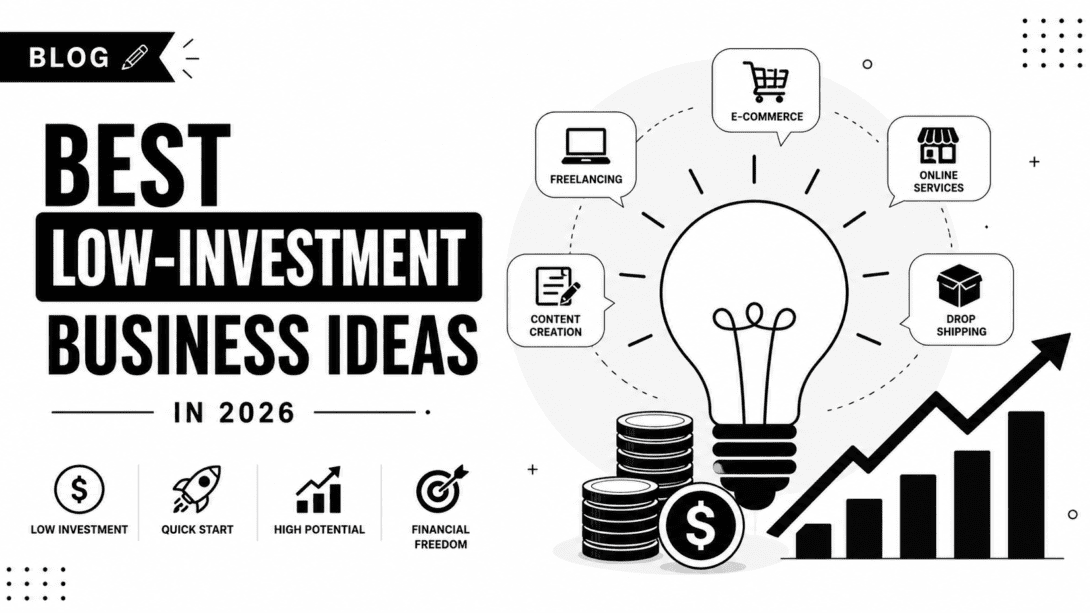
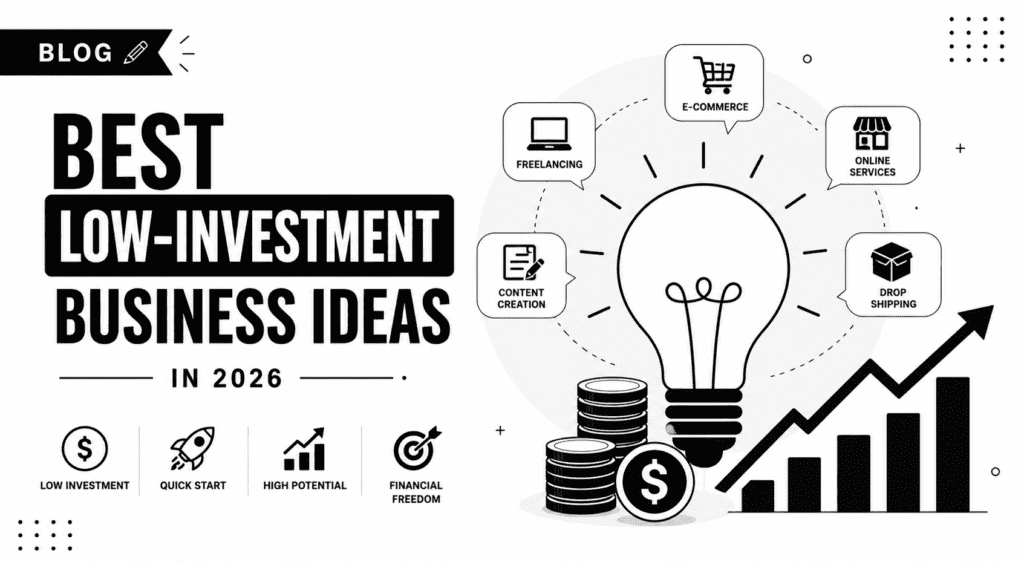
You don’t need a huge bank balance to start a profitable business. In 2026, some of the fastest-growing businesses in the United States were launched with less than $500 — sometimes zero.
The shift is real: AI tools have dramatically lowered the cost of starting a service business, digital platforms have eliminated the need for physical storefronts, and remote-first culture means your market is no longer limited to your zip code.
This guide breaks down 15 of the best low-investment business ideas you can start right now — with realistic startup costs, how fast you can earn your first dollar, and what’s working in today’s US market.
What Makes a Business “Low Investment”?
A low-investment business typically requires less than $1,000 to launch — often much less. The common traits:
- No physical inventory (or minimal stock)
- Relies on skills, not capital — your time and expertise are the product
- Can be run from home — no rent, no office
- Scalable without proportional cost increases — you can grow revenue without hiring fast
- Digital delivery or local service model — both work with near-zero overhead
Service businesses and digital businesses dominate this category. According to the US Chamber of Commerce, service businesses typically need far lower startup capital than product businesses, which can require $50,000–$150,000 in upfront inventory and logistics costs.
15 Best Low-Investment Business Ideas in 2026
1. Freelance Writing & Content Creation
Startup Cost: $0–$50 | Time to First Revenue: 1–2 weeks
If you can write, you can earn. Businesses in every industry need blog posts, case studies, email newsletters, website copy, and social media content — and most don’t have in-house writers to produce it.
The highest-paying niches in 2026 are SaaS, finance, healthcare, and B2B tech, where specialized writers earn $0.20–$0.50 per word on retainer. You don’t need to be a generalist — domain expertise raises your rates faster than writing ability alone.
How to start: Build a portfolio of 3–5 sample pieces (even unpublished work for made-up clients counts). Create a profile on LinkedIn and Contra, pitch 5 potential clients per week, and specialize in one niche fast.
💡 Content strategy and AI tools are reshaping how writers work in 2026. See how smart marketers are using AI to produce better content faster at Finmaticx.
2. AI-Powered Virtual Assistant Services
Startup Cost: $0–$100 | Time to First Revenue: 1–3 weeks
Virtual assistant (VA) services have been transformed by AI in 2026. A VA in today’s market isn’t doing $15/hr data entry — they’re delivering AI-augmented research, inbox management, content repurposing, and operations support that used to cost clients $3,000–$5,000/month at agencies.
The secret is using AI tools to handle the repetitive work while you focus on judgment calls and client communication. This lets a solo VA productively serve 3–5 clients simultaneously.
How to start: Define 3 specific workflows you’ll handle (e.g., email triage, social scheduling, CRM updates). Price as a monthly retainer ($500–$1,500/month per client). Find clients on LinkedIn by targeting founders and small business owners.
3. Online Bookkeeping & Accounting
Startup Cost: $100–$300 | Time to First Revenue: 2–4 weeks
Every business needs bookkeeping. Most small businesses can’t afford a full-time accountant. That gap is your opportunity.
With tools like QuickBooks Online, Wave, and Xero, you can serve 5–10 small business clients from a laptop. The winning move in 2026 is to specialize by industry — e-commerce bookkeeping, agency accounting, or healthcare practice finances — and price as a monthly subscription ($300–$800/month per client).
A client paying $400/month is $4,800/year. Ten clients = $48,000/year, part-time.
How to start: Get a QuickBooks ProAdvisor certification (free). Find your first clients in local Facebook groups, small business forums, or through referrals.
4. Digital Marketing Consulting
Startup Cost: $0–$200 | Time to First Revenue: 2–4 weeks
Small businesses spend heavily on digital marketing but often lack the expertise to run it efficiently. If you understand SEO, Google Ads, Meta Ads, or email marketing, you can charge $1,500–$5,000/month as a consultant or fractional marketing manager.
This is one of the highest-earning low-investment businesses available to someone with marketing experience. The barrier to entry is knowledge, not capital.
How to start: Pick one channel you know deeply. Document 2–3 case studies (your own site’s results count). Reach out to 10 local businesses in your area offering a free 30-minute audit.
💡 Performance marketing and AI tools are changing how digital consultants operate. Learn the latest strategies at Finmaticx — we cover everything from paid search to AI-powered campaign optimization.
5. Dropshipping (Niche-Focused)
Startup Cost: $100–$500 | Time to First Revenue: 2–8 weeks
Dropshipping lets you sell physical products online without ever holding inventory. When a customer orders, your supplier ships directly to them. Your margin is the difference between retail price and supplier cost.
The generic “trending product” Shopify store model is largely dead in 2026. What works is vertical dropshipping — picking one obsessive niche, using branded packaging, offering real customer support, and building a repeat-purchase relationship.
Profitable niche directions in the US market right now: pet accessories, eco-friendly household goods, hyper-specific hobby equipment, and personalized gifting.
How to start: Sign up for Shopify ($1 trial), find a supplier on AutoDS or Spocket, and run $50–$100 in test ads on Meta to validate demand before investing more.
6. Print-on-Demand (POD) Store
Startup Cost: $0–$100 | Time to First Revenue: 1–4 weeks
Print-on-demand lets you design products — t-shirts, mugs, tote bags, posters — and sell them online without upfront inventory. Your supplier (Printful, Printify, or Gelato) prints and ships each item when ordered.
The US market in 2026 rewards hyper-specific designs: niche humor apparel, location-based gifts, pet portrait products, and profession-specific merchandise. Competing on generic designs is hard; competing in a niche most stores ignore is far easier.
How to start: Create designs using free tools like Canva or Adobe Express. List them on Etsy (low barrier, built-in traffic) or your own Shopify store. Market through a matching TikTok or Instagram account in the same niche.
7. Online Tutoring & Education
Startup Cost: $0–$150 | Time to First Revenue: 1–2 weeks
Academic tutoring, test prep (SAT, GMAT, LSAT), language learning, and professional skill training are all in demand. US parents and professionals pay $40–$150/hour for the right expertise.
The best tutoring niches aren’t just school subjects. In 2026, Excel/data skills training, AI tools training, coding bootcamp prep, and professional certification coaching are growing fast — because employers are demanding skills faster than formal education can deliver them.
How to start: List yourself on Wyzant, Tutor.com, or Preply for fast client acquisition. Build your own website and packages for higher margins over time. One-hour sessions, sold as monthly packages, create predictable income.
8. Affiliate Marketing / Niche Content Sites
Startup Cost: $50–$200 | Time to First Revenue: 4–16 weeks
Affiliate marketing means earning a commission when someone purchases a product through your referral link. You create content (a blog, YouTube channel, newsletter, or TikTok) that attracts an audience in a specific niche, then monetize with affiliate partnerships.
The key in 2026 is the combination: content + community + affiliate. A niche newsletter or a focused TikTok channel that recommends the right products to the right audience consistently outperforms generic comparison sites.
Commission rates range from 5% (Amazon) to 50% (digital products and SaaS). SaaS and finance affiliate programs often pay $50–$500 per converted referral.
💡 Interested in building a content-driven business in the finance and tech niche? Finmaticx covers AI tools, marketing strategies, and money topics for exactly this audience. Explore our content here.
9. Social Media Management
Startup Cost: $0–$100 | Time to First Revenue: 1–3 weeks
Small businesses know they need to be on social media — but most don’t have the time or skill to manage it. A social media manager handles content creation, scheduling, engagement, and growth strategy for $500–$2,500/month per client.
AI tools in 2026 have made solo social media managers significantly more productive. Tools like Buffer, Later, and AI content assistants let one person manage 5–8 clients’ accounts simultaneously without burning out.
How to start: Grow one social account in a niche you understand (your own or a friend’s business). Document the results. Use that case study to pitch your first paying client.
10. Residential Cleaning Services
Startup Cost: $100–$400 | Time to First Revenue: 1–2 weeks
Of every idea on this list, residential cleaning consistently shows the highest small business survival rate. Demand is constant, the path to repeat customers is reliable, and referrals happen naturally when you do good work.
A single residential client at $150–$200 per clean, every two weeks, is worth $3,900–$5,200 per year. Fifteen clients = a six-figure business. Niche specializations — Airbnb turnover cleaning, post-construction cleanup, or eco-friendly products — command 30–60% pricing premiums over generic services.
How to start: Get supplies ($80–$150 for your first kit), create a Google Business Profile, list on TaskRabbit and Nextdoor, and ask your first 5 clients for a Google review.
11. Graphic Design Services
Startup Cost: $0–$100 | Time to First Revenue: 1–3 weeks
Businesses always need visual assets — logos, social media graphics, pitch deck designs, ad creatives, packaging, and brand identity work. Skilled graphic designers charge $50–$150/hour or sell project packages at $300–$3,000+ depending on scope.
Canva Pro ($13/month) gives aspiring designers a powerful toolkit. For more advanced work, Adobe Creative Cloud starts at $55/month. Neither is a major barrier to entry.
How to start: Build a portfolio of 5–10 sample projects on Behance. Set up a Fiverr and 99designs profile for initial client acquisition, then transition to direct clients through LinkedIn for higher margins.
12. AI Consulting for Small Businesses
Startup Cost: $0–$200 | Time to First Revenue: 2–4 weeks
This is one of the highest-growth low-investment opportunities in 2026. Most small businesses know they need to adopt AI but have no idea where to start. If you understand ChatGPT, Claude, AI automation, or tools like Zapier AI, you can charge $150–$300/hour to help businesses implement AI workflows.
According to multiple industry reports, over 54% of CEOs surveyed in 2025 were hiring for roles that didn’t exist a year earlier — much of that driven by AI adoption. The consulting window is wide open right now.
How to start: Get hands-on with 5–10 AI tools across different categories (writing, automation, analytics, customer service). Document 3 workflows you can implement for a business. Pitch local small businesses with a “free AI audit” offer.
💡 Stay current on AI tools, strategies, and business applications at Finmaticx — we track what’s working for marketers and entrepreneurs using AI in 2026.
13. Pet Services (Sitting, Walking, Grooming)
Startup Cost: $50–$200 | Time to First Revenue: 1–2 weeks
Pet ownership in the US has surged post-pandemic, and spending on pet services has followed. Dog walking, pet sitting, mobile grooming, and pet boarding are all high-demand, repeat-revenue services in most American cities.
Apps like Rover and Wag let you build a client base with zero upfront marketing cost. Verified reviews on these platforms compound over time, making the business self-sustaining.
How to start: Sign up on Rover. Set your rates ($20–$40/walk, $50–$80/overnight sit). Your first 5 clients plus their reviews will drive the next 50.
14. Selling Digital Products
Startup Cost: $0–$100 | Time to First Revenue: 1–4 weeks
Digital products — templates, spreadsheets, ebooks, notion dashboards, Canva templates, mini-courses, and swipe files — are unique because you create them once and sell them infinitely with zero marginal cost.
High-selling digital products in the US right now: budget templates, resume templates, social media content calendars, business plan templates, and AI prompt packs. The key is packaging a solution to a specific, painful problem.
How to start: Create one product that solves a problem you’ve already solved for yourself. List it on Gumroad (free) or Etsy. Market it through Pinterest, TikTok, or a small email list.
15. Niche Newsletter / Email Business
Startup Cost: $0–$100/year | Time to First Revenue: 4–12 weeks
A focused newsletter on a niche topic — personal finance for millennials, AI tools for small businesses, real estate investing for beginners — can become both a content asset and a business in itself.
Revenue comes through sponsorships ($200–$5,000 per edition depending on list size), affiliate commissions, premium subscription tiers, and digital product sales to your audience.
The content + community + monetization loop is one of the most durable low-investment business models available in 2026. Costs are under $100/year (Beehiiv or Substack free tiers work to start).
How to start: Pick a niche you’d write about for free. Commit to one email per week for 8 weeks. Promote each issue on LinkedIn, Twitter/X, and Reddit threads in your niche. Monetize once you hit 500 subscribers.
How to Choose the Right Low-Investment Business for You
With so many options, the right framework matters more than the right list. Ask yourself:
1. What do I already know? Businesses built on existing expertise launch faster and earn sooner. A marketer starting a digital marketing consultancy has a head start of years over someone starting from zero.
2. Do I want active or passive income? Services (cleaning, consulting, VA) produce income immediately but require ongoing time. Digital products and affiliate content take longer to build but earn while you sleep.
3. Do I want to work with people directly? Tutoring, consulting, and pet services involve direct client relationships. Dropshipping, print-on-demand, and newsletter businesses are largely remote and asynchronous.
4. What’s my timeline? If you need revenue in weeks, choose service businesses (freelancing, cleaning, tutoring). If you can invest 3–6 months before seeing returns, content and product businesses offer more scale.
The Role of AI in Low-Investment Businesses in 2026
AI has fundamentally changed the economics of low-investment businesses in two ways:
It collapsed the cost of starting. Tasks that once required hiring a designer, copywriter, or developer — building a website, writing product descriptions, creating social graphics — now take minutes with AI tools. This brings startup costs close to zero for digital businesses.
It multiplied what one person can do. A solo freelance writer using AI can produce 3x the content in the same time. A single virtual assistant can serve 5 clients simultaneously with AI-powered workflows. A one-person social media manager can handle 8 accounts. The leverage is real.
The businesses winning in 2026 aren’t replacing human judgment with AI — they’re using AI to remove the repetitive work so they can focus on strategy, relationships, and creativity.
💡 Want to learn exactly which AI tools are worth using in your business? Check out the Finmaticx AI tools section — we test and cover the tools that actually move the needle for small business owners and marketers.
Frequently Asked Questions: Low-Investment Business Ideas
What is the best low-investment business to start in 2026?
The best low-investment business depends on your skills. For someone with marketing experience, digital marketing consulting offers the highest earning potential with near-zero startup cost. For someone without specific professional skills, residential cleaning and pet services have the highest survival rates and fastest path to consistent income. AI consulting is the fastest-growing new opportunity for anyone willing to learn AI tools quickly.
What businesses can you start with under $500?
Freelance writing, virtual assistant services, online tutoring, social media management, graphic design, affiliate marketing, print-on-demand, and niche newsletters can all be started for under $500 — and often for free. Service-based businesses are the leanest because your skills, not capital, are the product.
What is the most profitable low-investment business?
Digital marketing consulting, AI consulting, and online bookkeeping offer the highest profit margins among low-investment businesses — often 80–90% margins since overhead is minimal. Among physical services, niche cleaning (Airbnb turnover, post-construction) and pet services offer strong margins with repeat customers.
Can I start a low-investment business with no experience?
Yes. Residential cleaning, pet sitting, and print-on-demand require minimal prior experience. Even skill-based businesses like freelance writing can be started by learning on the job — many successful freelancers started with no professional writing background. Starting small, getting your first client, and learning from real projects is far more effective than waiting until you feel “ready.”
How much can I realistically earn from a low-investment business?
Earnings vary widely by business type and effort. Service businesses like consulting and bookkeeping can generate $50,000–$100,000/year with 10–15 clients. Digital businesses like affiliate marketing and print-on-demand typically take 6–12 months to reach significant income but can scale without proportional time investment. Pet services and cleaning businesses can generate $40,000–$80,000/year with a full client roster.
Are low-investment businesses risky?
Compared to traditional businesses requiring significant capital, low-investment businesses carry far less financial risk. You’re not taking out loans or investing life savings. The main risk is opportunity cost — your time. Validating your idea quickly (getting a paying client before building extensively) minimizes this risk significantly.
What low-investment businesses are best for passive income?
Affiliate marketing, print-on-demand, digital product sales, and niche newsletters have the strongest passive income potential. They require upfront time investment to build but generate revenue with minimal ongoing effort once established.
Final Thoughts
The barriers to starting a business in 2026 have never been lower. AI tools, digital platforms, and the global shift to remote-first services mean you can launch something real this week — not after months of planning and capital raising.
The entrepreneurs winning right now aren’t the ones with the biggest budgets. They’re the ones who started fast, validated early, and iterated based on what actual customers told them.
Pick one idea from this list that matches your skills and schedule. Get your first client. Learn from that. Then build from there.
💡 For more guides on building and growing AI-powered businesses, marketing smarter, and staying ahead of the curve — explore Finmaticx. We publish actionable content for entrepreneurs and marketers navigating the AI era.