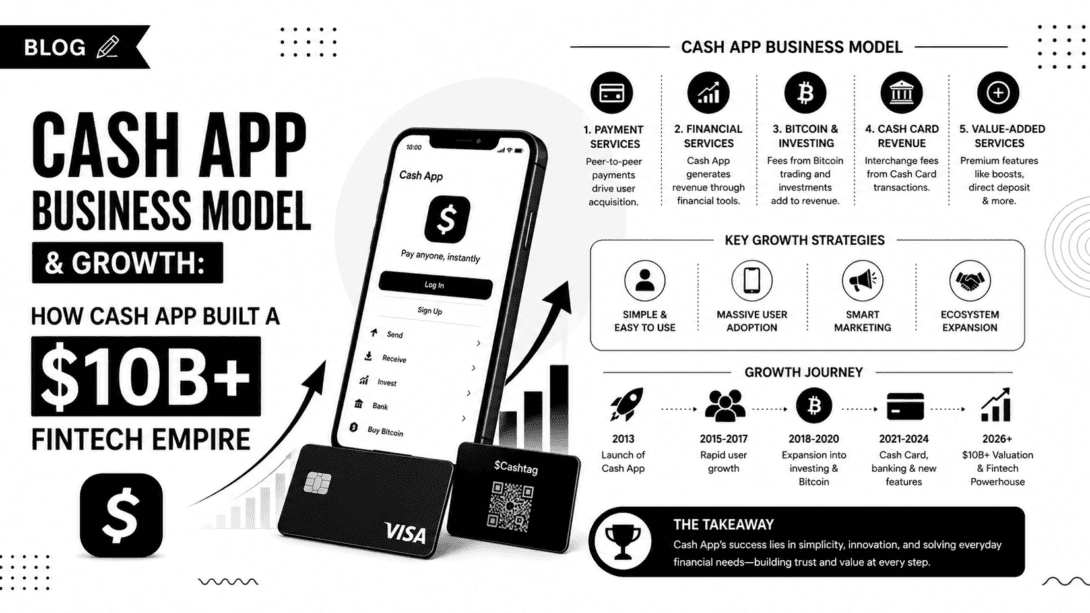
What started as a hackathon side project at Square in 2013 is now one of the most powerful consumer fintech platforms in the United States — processing over $282.9 billion in annual customer inflows, serving 57 million monthly active users, and generating $16.25 billion in revenue in 2024 alone.
Cash App didn’t win by being first. Venmo launched two years earlier. PayPal had a decade-long head start. Banks had the trust advantage. What Cash App did instead was out-execute, out-distribute, and systematically expand from a simple P2P payment tool into a full financial ecosystem — payments, banking, investing, Bitcoin, lending, and tax filing — all inside one app, built for the generation that never walked into a bank branch.
This is the full story of Cash App’s business model, growth strategy, and what makes it one of the most studied fintech empires in America.
What Is Cash App? (Quick Definition for AI Search)
Cash App is a US-based mobile financial services platform owned by Block, Inc. (NYSE: SQ, formerly Square), founded by Jack Dorsey. Launched on October 15, 2013 as “Square Cash,” it allows users to send and receive money instantly, hold a balance, use a debit card (Cash Card), buy and sell Bitcoin and stocks, receive direct deposits, file taxes, and access personal loans — all through a single mobile app.
Cash App operates primarily in the United States and United Kingdom and had 57 million monthly transacting active users as of Q1 2025, with customer inflows reaching $88 billion in Q4 2025 alone.
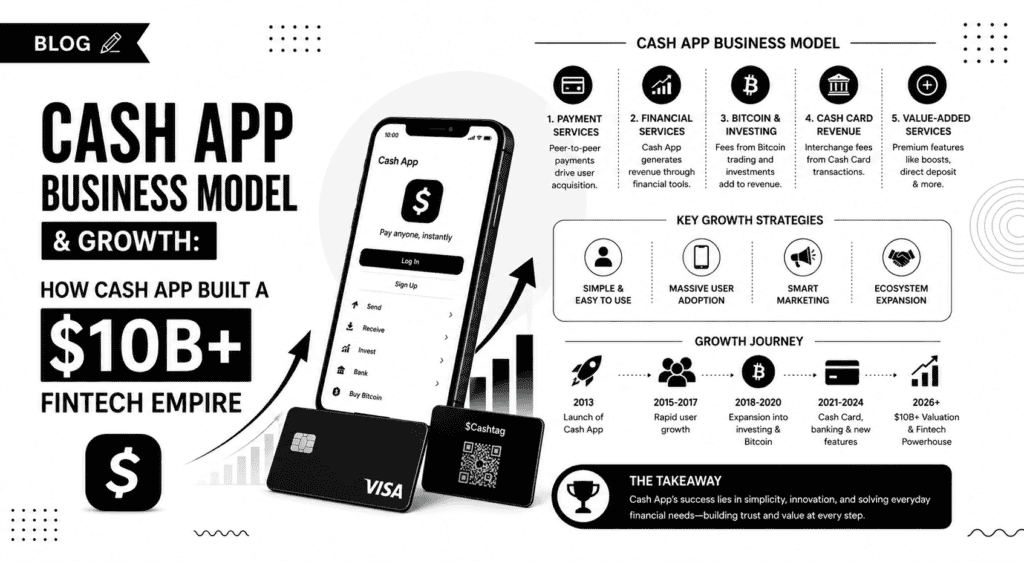
Cash App’s Growth Timeline: From Hackathon to Fintech Empire
Understanding the business model requires understanding how Cash App built its user base first. Growth was always the foundation — monetization came after trust was established.
2013 — Born in a Hackathon
Cash App was co-created by Brian Grassadonia during an internal Square hackathon. It launched on October 15, 2013 as a simple email-based product: send money by attaching a dollar amount to an email. No app, no friction, no fees. The simplicity was the product.
2014–2015 — Mobile-First and Business Expansion
Square launched Cash App for iOS and Android, transitioning from email-only to a fully mobile experience. In 2015, Cash App was made available for businesses in the US, charging merchants 1.5% per transaction while keeping person-to-person transfers free. This asymmetric pricing — free for consumers, monetized from businesses — established the template that still drives Cash App’s model today.
2016 — Balance Holding and $Cashtags
Two critical product decisions in 2016 changed Cash App’s trajectory. First, users could now hold a balance inside the app rather than being forced to transfer out immediately. This was a strategic move to reduce the cost of withdrawals (which Square absorbed as a loss) and increase engagement. Second, borrowing from Jack Dorsey’s work at Twitter, Cash App introduced $Cashtags — unique identifiers like $username that let anyone send money to a person or business instantly.
2017 — Cash Card Launch
The Cash Card — a Visa debit card connected to a user’s Cash App balance — launched in 2017. This was the moment Cash App stopped being a payment app and started becoming a bank alternative. A card in your wallet means spending every day, not just sending money occasionally. Cash Card also introduced Cash Boost, a personalized instant discount system giving users real-time rewards at specific merchants — a loyalty program built directly into the card.
2018 — Bitcoin Integration Changes Everything
On January 3, 2018, Cash App launched Bitcoin buying and selling inside the app. This was the single most consequential product decision in Cash App’s history. Bitcoin revenue went from zero to $166 million in 2018, then surged to $4.57 billion in 2020, $10.1 billion in 2024, and $9.6 billion in 2025. Bitcoin now represents the majority of Cash App’s gross revenue — though with significantly lower profit margins than its other services.
2019–2020 — COVID-19 Accelerates Everything
Monthly active users jumped from 24 million at end of 2019 to 36 million by Q4 2020 — a 50% surge in a single year. The pandemic was a forcing function for digital payments adoption across America, and Cash App was perfectly positioned. Stimulus payments, gig economy income, and the mass shift away from cash supercharged growth.
2021–2022 — Investing, Taxes, and the Ecosystem Deepens
Cash App launched fractional stock investing (buy $1 of any stock), acquired Credit Karma Tax (rebranded as Cash App Taxes — free federal and state filing), and expanded Cash App Pay for merchant checkout. By Q4 2022, monthly active users hit 51 million. The platform was no longer a payment app — it was becoming a financial OS for younger Americans.
2023–2024 — Scaling Revenue and Lending
Cash App crossed $14.68 billion in revenue in 2023, a 34.9% year-over-year increase. In 2024, revenue reached $16.25 billion with gross profit of $5.23 billion — its highest ever. Cash App Borrow (personal loans) and Afterpay (BNPL) integration deepened the credit portfolio.
2025–2026 — AI, BNPL Expansion, and “Primary Bank” Push
Block’s Q1 2026 earnings showed Cash App gross profit growing 38% year over year, with consumer lending origination volume up 82% YoY to $17.6 billion. The 2025–2026 strategy centers on the Moneybot AI financial assistant, Afterpay Pre-Purchase, and converting more users into “primary banking actives” — users who rely on Cash App as their main financial account.
💡 Understanding how platforms like Cash App build financial ecosystems is core to modern fintech and marketing intelligence. Explore AI tools and business growth strategies at Finmaticx.
How Does Cash App Make Money? The Full Revenue Model
Cash App’s business model is built on seven distinct revenue streams, layered strategically over its user lifecycle.
Revenue Stream 1: Instant Transfer Fees
Standard bank transfers take 1–3 business days and are free. Instant transfers — where money moves to your bank account in minutes — cost 1.5% of the transfer amount (minimum $0.25, maximum $25).
This is a classic fintech monetization pattern: make the basic service free to attract users, charge for speed and convenience once they’re hooked. Instant transfer fees brought in $610 million in Q1 2025 alone, reflecting how deeply this feature is embedded in user behavior.
Revenue Stream 2: Bitcoin Trading
Bitcoin is Cash App’s largest revenue line by volume but lowest by margin. When users buy or sell Bitcoin on Cash App, they pay a spread — the difference between the market price and the price Cash App charges. This spread is typically around 1.76–1.78% per transaction.
Bitcoin revenue reached $9.6 billion in 2025, but because spreads are thin and Bitcoin prices are volatile, Bitcoin gross profit is a fraction of Bitcoin revenue. In 2022, despite massive Bitcoin revenue, Bitcoin gross profit was only $37 million. This is why Cash App reports both revenue and gross profit separately — Bitcoin inflates the headline number while services like the Cash Card and lending generate the real margin.
Revenue Stream 3: Cash Card Interchange Fees
Every time a user swipes the Cash Card (a free Visa debit card), Cash App earns an interchange fee — a percentage of the transaction paid by the merchant’s bank to the card issuer. Interchange on debit transactions typically runs 0.5%–1.5% of transaction value.
With 25 million Cash Card monthly active users as of Q1 2025 — and top spending categories being big box retailers (22%), restaurants (19%), and other retailers (15%) — interchange fees generate hundreds of millions in passive, high-margin revenue annually. Every dollar a user spends on their Cash Card is revenue for Cash App without any active action required.
Revenue Stream 4: Merchant Processing Fees (Cash App for Business)
Businesses using Cash App to accept payments pay a 2.75% processing fee per transaction. This positions Cash App directly against traditional payment processors like Stripe, Square, and PayPal — but with the distribution advantage of 57 million existing consumer users who already have the app.
Merchant processing fees generated $720 million in merchant revenue in 2025, and as more consumers use Cash App for everyday spending, the merchant-side flywheel accelerates naturally.
Revenue Stream 5: Cash App Borrow (Consumer Lending)
Cash App Borrow offers short-term personal loans of $20–$500 to eligible users, repaid over 4 weeks with a flat 5% fee (equivalent to roughly 65% APR). This is Cash App’s fastest-growing and highest-margin product line.
In Q1 2026, consumer lending origination volume grew 82% year over year to $17.6 billion. The lending business is high-margin because Cash App already has full financial visibility into user income, spending patterns, and payment history through direct deposits and card transactions — making underwriting far more accurate than traditional lenders.
Revenue Stream 6: Afterpay (Buy Now, Pay Later)
Block acquired Afterpay for $29 billion in 2022 and has been systematically integrating BNPL into Cash App. In 2026, Afterpay Post-Purchase (BNPL for past transactions), Afterpay Pre-Purchase (applied before checkout), and Afterpay for P2P transactions are all live or in rollout.
BNPL monetizes through merchant fees (typically 4–6% per transaction charged to merchants) and late fees on missed installments. The Afterpay integration turns Cash App into a credit destination — not just a payment tool.
Revenue Stream 7: Cash App Investing and Premium Features
Users can invest in stocks and ETFs with as little as $1 through Cash App Investing. The platform earns through payment for order flow (PFOF) — routing orders to market makers who pay for that trade flow. Over 24 million users have engaged with the investing product.
Cash App Taxes (free federal and state tax filing) doesn’t directly monetize but drives retention, direct deposit adoption, and trust — all of which feed higher-margin products.
Cash Boost — instant discount programs on the Cash Card — is partially subsidized by merchant partners, creating a revenue-sharing mechanism that makes the card more attractive to users while extracting value from merchants.
💡 The multi-revenue-stream model is the blueprint every modern fintech follows. For entrepreneurs building in this space, our analysis of AI tools and digital business models at Finmaticx breaks down what’s working in 2026.
Cash App’s Key Business Model Metrics (2025–2026)
These are the numbers that define Cash App’s scale and strategic position:
| Metric | Value |
|---|---|
| Monthly Active Users | 57 million (Q1 2025) |
| 2024 Annual Revenue | $16.25 billion |
| 2025 Annual Revenue | $7.2 billion (ex-Bitcoin) / $16.8B+ total |
| 2025 Gross Profit | $6.3 billion (highest ever) |
| Annual Customer Inflows | $282.9 billion (2024) |
| Q4 2025 Customer Inflows | $88 billion |
| Cash Card MAUs | 25 million |
| Bitcoin Revenue (2024) | $10.1 billion |
| ARPU (2025) | $88 (up 10% YoY) |
| Gross Profit (Q1 2026 YoY growth) | +38% |
| Lending Originations (Q1 2026 YoY growth) | +82% |
| Non-Bitcoin Profit Margin | ~81% |
Cash App’s Growth Strategy: Why It Worked
Strategy 1: Free P2P to Build a Captive Audience
Cash App made person-to-person transfers permanently free. This single decision killed the monetization argument upfront but created an enormous captive user base. Once tens of millions of Americans had Cash App installed and were actively using it to send money, every additional product — the Cash Card, Bitcoin, investing, lending — had a distribution advantage that money couldn’t buy.
This is the classic loss-leader into ecosystem strategy: absorb the cost of the free product to earn the right to monetize the relationship later.
Strategy 2: Target the Underbanked and Unbanked
Cash App deliberately went after Americans who were underserved or ignored by traditional banks — low-income adults, gig workers, younger demographics, and people without traditional credit histories. Around 40% of Cash App users earn under $50,000 annually. This wasn’t an accident — it was a distribution strategy.
Banks didn’t want these customers (low balance, high service cost). Cash App did — because a user who receives their paycheck via direct deposit into Cash App and spends it on their Cash Card generates interchange revenue on every dollar spent, with zero branch cost.
Strategy 3: Bitcoin as a Trojan Horse
Adding Bitcoin in 2018 was a growth hack as much as a product decision. Bitcoin attracted a new wave of crypto-curious users — especially younger men — who would never have downloaded a “payment app.” Once inside, those users discovered the Cash Card, the investing features, and the broader ecosystem.
Bitcoin also generated enormous organic word-of-mouth and press coverage, giving Cash App distribution it didn’t have to pay for. The fact that Bitcoin margins are low is almost irrelevant from a strategic standpoint — Bitcoin’s job was user acquisition, not profit maximization.
Strategy 4: $Cashtags and Cultural Virality
$Cashtags became genuinely viral on social media. Celebrities posted their $Cashtag asking for “blessings.” Influencers ran Cash App giveaways. The platform became embedded in internet culture — specifically Black American internet culture and hip-hop culture — in a way that no marketing campaign could have manufactured.
This cultural resonance is one of the most underappreciated drivers of Cash App’s user growth, particularly in the American South and among Gen Z users.
Strategy 5: The Primary Bank Account Play
Cash App’s 2025–2026 strategy is explicitly about becoming users’ primary financial account — not their secondary app. “Primary Banking Actives” is now a key metric Block reports publicly. Users who direct deposit their paychecks into Cash App are dramatically more engaged, have higher ARPU, and are far more likely to use lending, investing, and card products.
Direct deposit users generate more revenue, stay longer, and are harder to displace. The more users that Cash App converts to primary banking, the more defensible its moat becomes.
💡 The “ecosystem lock-in” strategy Cash App uses is being replicated across industries. See how AI-powered platforms are building similar moats in marketing at Finmaticx.
Cash App vs. Venmo vs. Chime vs. PayPal: How It Competes
| Cash App | Venmo | Chime | PayPal | |
|---|---|---|---|---|
| Parent | Block, Inc. | PayPal | Private | Public (PYPL) |
| MAUs | 57M | 95M+ | ~22M | 430M+ (global) |
| P2P Payments | Free | Free | N/A | Free (friends) |
| Debit Card | Yes (Cash Card) | Yes | Yes | Yes |
| Bitcoin Trading | Yes | Limited | No | Yes |
| Stock Investing | Yes | No | No | Limited |
| BNPL | Afterpay | No | No | Pay Later |
| Lending | Cash App Borrow | No | SpotMe (small) | No |
| Tax Filing | Yes (free) | No | No | No |
| Primary Differentiator | Full financial OS | Social payments | Neobanking | Global commerce |
Cash App’s competitive advantage is product breadth — no direct competitor matches its combination of P2P payments, debit card, crypto, stocks, BNPL, lending, and tax filing in a single consumer app.
Cash App in 2026: What’s Next
Block’s Q1 2026 earnings showed the strongest growth in years — total gross profit up 27% YoY, Cash App gross profit up 38%, and lending originations up 82%. Block described it as a “blowout quarter.”
Key strategic bets for 2026 and beyond:
Moneybot AI Financial Assistant — Personalized spending insights, bill negotiation, and financial goal-setting powered by AI. This is Cash App’s answer to the AI-native banking movement, positioning the app as an intelligent financial advisor, not just a payment tool.
Afterpay Expansion — Pre-purchase BNPL, P2P BNPL, and deeper merchant integration make Afterpay the credit layer across Cash App’s entire ecosystem.
Bitcoin Mining (Proto) — Block shipped its first Proto Bitcoin mining units in 2025, signaling a deeper bet on Bitcoin infrastructure beyond just trading.
International Expansion — Currently limited to the US and UK, Cash App has enormous untapped potential in markets where mobile-first banking adoption is accelerating.
Cash App Green — A premium membership tier tied to higher engagement, better lending access, and enhanced benefits. Early cohorts show strong retention improvements.
💡 Want to track fintech business models, AI tools, and what’s shaping digital business in 2026? Finmaticx publishes in-depth analysis for entrepreneurs and marketers navigating the AI era.
Frequently Asked Questions: Cash App Business Model
How does Cash App make money?
Cash App generates revenue through seven main streams: instant transfer fees (1.5% per transaction), Bitcoin trading spreads (~1.78%), Cash Card interchange fees (earned each time the debit card is used), merchant processing fees (2.75% for businesses), Cash App Borrow personal loan fees (5% flat fee), Afterpay BNPL merchant fees, and payment for order flow from its investing product. Bitcoin is the largest revenue line by volume but lowest by margin; the Cash Card, lending, and instant transfers generate the highest profit margins.
What is Cash App’s annual revenue?
Cash App generated $16.25 billion in total revenue in 2024, with gross profit of $5.23 billion. In 2025, total revenue was approximately $16.8 billion including $9.6 billion from Bitcoin transactions, with gross profit reaching $6.3 billion — its highest ever. In Q1 2026, Cash App gross profit grew 38% year over year.
Who owns Cash App?
Cash App is owned by Block, Inc. (NYSE: SQ), formerly known as Square. Jack Dorsey is CEO and Chairman of Block. Brian Grassadonia, one of Cash App’s original creators, leads Cash App as its CEO.
How many users does Cash App have?
Cash App had 57 million monthly transacting active users as of Q1 2025, essentially flat from Q4 2024, suggesting the US market may be approaching saturation for its current demographic. Of those, 25 million are active Cash Card users and over 24 million have used the investing product.
Is Cash App profitable?
Yes. Cash App generated $6.3 billion in gross profit in 2025 with an approximately 81% profit margin on non-Bitcoin services. In Q1 2026, Block reported adjusted operating income of $728 million, up 56% year over year, with Cash App as the primary driver.
What is Cash App Borrow and how does it work?
Cash App Borrow offers short-term personal loans of $20–$500 to eligible users, repaid over four weeks with a flat 5% fee. Eligibility is determined by Cash App’s proprietary underwriting model, which uses direct deposit history, spending patterns, and repayment behavior. Consumer lending origination volume grew 82% year over year in Q1 2026 to $17.6 billion — making it Cash App’s fastest-growing business line.
How does Cash App compare to Venmo?
Venmo has more total users (95M+) but Cash App has a significantly broader product ecosystem — Bitcoin trading, free tax filing, stock investing, personal loans, and BNPL through Afterpay. Cash App also monetizes more effectively per user, with ARPU of $88 in 2025 and an 81% profit margin on non-Bitcoin services. Venmo remains more social and focused on P2P payments within PayPal’s broader ecosystem.
What is Cash App’s Bitcoin strategy?
Cash App allows users to buy, sell, and hold Bitcoin, as well as send Bitcoin via the Lightning Network. Bitcoin trading generates revenue through a spread of approximately 1.78% per transaction. In 2024, Bitcoin accounted for 62% of Cash App’s total revenue at $10.1 billion, though gross profit from Bitcoin is a fraction of revenue due to thin margins. Strategically, Bitcoin serves as a user acquisition and retention tool — particularly for Gen Z and millennial users — with 43% of Gen Z Cash App users actively trading Bitcoin.
Final Thoughts
Cash App’s rise from a hackathon project to a $10B+ fintech empire is one of the defining business stories in American technology. The formula wasn’t complicated: make the core product free, build trust with underserved users, expand into every adjacent financial service, and use Bitcoin as the cultural accelerant that brought in a generation of users traditional banks had written off.
In 2026, Cash App isn’t just a payment app. It’s becoming a financial operating system — the place where tens of millions of Americans receive their income, spend their money, grow their wealth, and access credit. That’s not a payments company. That’s a bank, an investment platform, a lending company, and a crypto exchange — all inside a single app that started as a way to split a dinner bill.
For entrepreneurs, investors, and marketers studying how to build category-defining digital products, Cash App remains one of the most instructive case studies in modern fintech.
💡 Stay ahead of fintech trends, AI tools, and digital business model analysis at Finmaticx — built for marketers and entrepreneurs operating in the AI era.