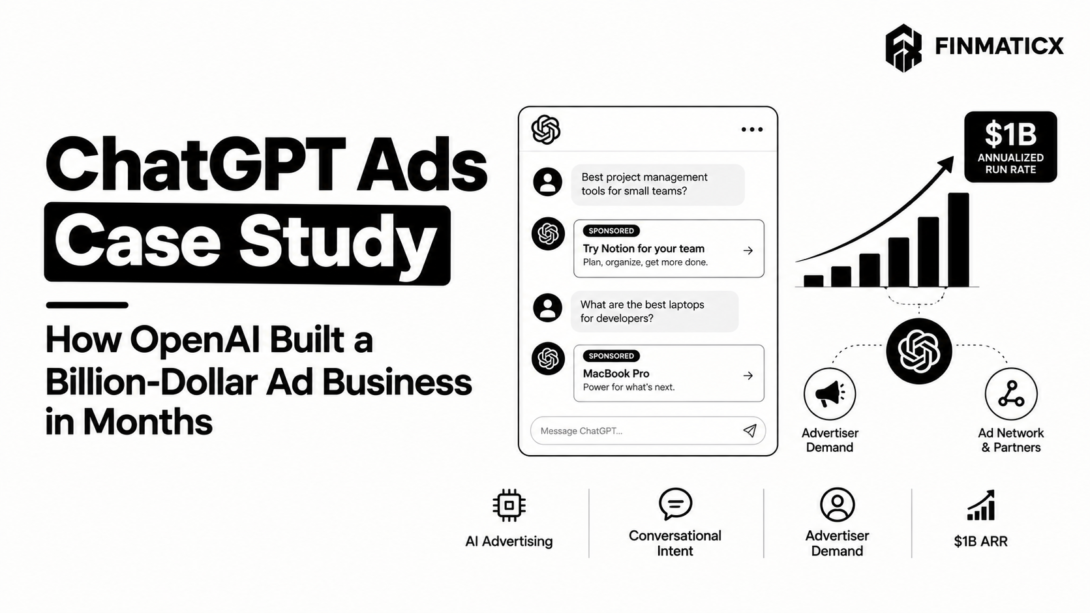
For years, OpenAI CEO Sam Altman described advertising as a “last resort” business model, something the company would only turn to if every other option ran out. In February 2026, that resort became reality. In under 200 days, ChatGPT Ads went from a small, invite-only pilot to a self-serve advertising platform generating a billion-dollar annualized revenue run rate, with tens of thousands of advertisers and expansion into markets across the US, UK, Latin America, Asia, and now India, Europe, and the Middle East.
This case study walks through exactly how that happened: the ad format OpenAI built, how targeting works without traditional keyword bidding, the privacy safeguards baked into the system from day one, the pace of its rollout, and where advertising fits inside OpenAI’s broader business model.
What Is ChatGPT Ads?
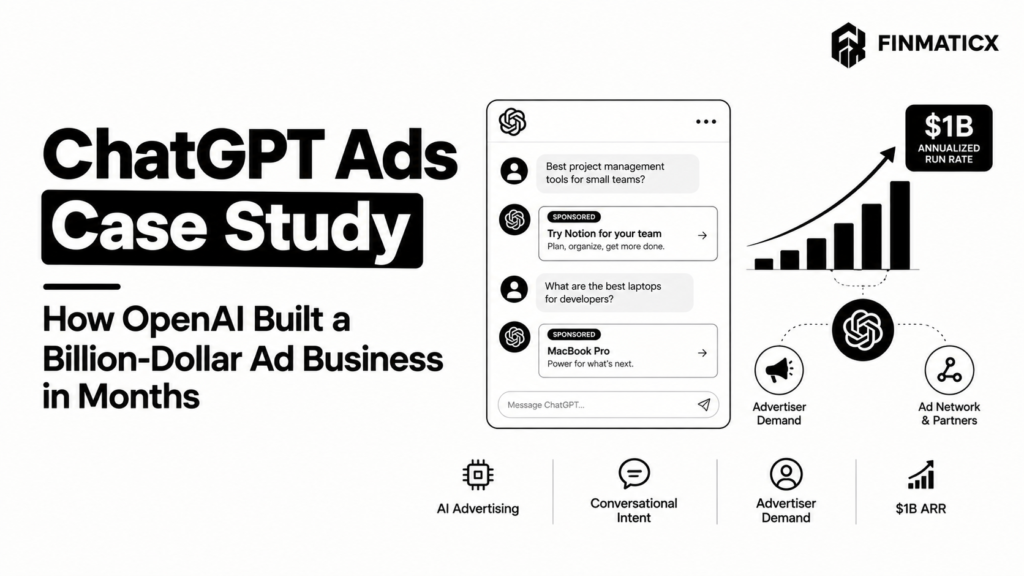
ChatGPT Ads is OpenAI’s advertising platform, which places sponsored content directly inside ChatGPT conversations for users on the Free and ChatGPT Go plans. Rather than interrupting a conversation or appearing as a separate banner, ads show up as a single, clearly labeled sponsored card beneath an AI-generated response, matched contextually to what the user is currently discussing.
The platform represents OpenAI’s answer to a familiar tech-industry challenge: how to keep a product free and fast for hundreds of millions of users while funding the enormous infrastructure and compute costs that a service like ChatGPT requires.
Timeline: From “Last Resort” to Launch
OpenAI’s public position on advertising shifted considerably over a relatively short window. In a widely referenced 2024 interview, Altman described advertising as a business model OpenAI would only pursue as a last resort, reflecting a broader industry wariness about mixing AI-generated answers with paid placements. By 2026, that position had changed, and OpenAI moved deliberately and quickly through a structured rollout:
- February 9, 2026 — ChatGPT Ads began as a test with logged-in adult users on the Free and ChatGPT Go plans in the United States
- May 5, 2026 — OpenAI opened a self-serve Ads Manager to US businesses, removing the enterprise-only minimum spend requirement that had defined the earliest pilot phase
- July 22, 2026 — OpenAI formally launched “Advertise in ChatGPT” as a broader self-serve platform, with early case studies from recognizable retail brands
- August 11, 2026 — ChatGPT Ads expanded to the United Kingdom, Mexico, Brazil, Japan, and South Korea
- August 31, 2026 — OpenAI announced ChatGPT Ads had reached a $1 billion annualized revenue run rate in under 200 days, alongside expansion of self-serve buying into India, Europe, the Middle East, and North Africa
How the ChatGPT Ads Test Began
According to OpenAI’s own announcement, the initial test was framed around supporting broad, free access to ChatGPT while maintaining clear labeling, keeping ads separate from ChatGPT’s actual answers, and giving users meaningful control over their experience. OpenAI was explicit that the test would expand carefully, learning from real-world usage in each market before scaling further, and that ads would not appear in accounts identified or predicted to belong to users under 18, or near sensitive and regulated topics such as health, mental health, or politics.
The Chat Card: ChatGPT’s Ad Format
The core ad unit in ChatGPT Ads is known as a chat card, a sponsored card that appears below an AI response, visually separated and clearly labeled as sponsored. A chat card typically includes a headline, a short description, an image, and a link to the advertiser’s destination page. Users can also tap into a chat card and ask ChatGPT questions about it directly, with OpenAI stating that advertisers do not influence how ChatGPT responds to those follow-up questions.
This single-format approach kept the initial rollout simple and predictable for both users and advertisers, avoiding the kind of format sprawl that can make an advertising platform feel cluttered in its earliest stages.
How Targeting Works in ChatGPT Ads
ChatGPT Ads uses contextual targeting rather than the keyword-bidding and demographic-targeting model that has defined search and social advertising for two decades. According to OpenAI’s own Help Center documentation, ad matching considers multiple signals, including the context and intent of the user’s current conversation, the advertiser’s landing page, title, and copy, advertiser-provided context hints and targeting selections, and, when a user has ads personalization enabled, select signals from that user’s broader ChatGPT experience.
Advertisers do not bid on keyword terms and cannot target users by demographic categories in the way traditional ad platforms allow. This positions ChatGPT Ads as fundamentally different from Google Ads or Meta’s advertising products, built around conversational intent rather than audience profiling.
Privacy and Trust Safeguards
OpenAI has been notably direct about the privacy architecture underpinning ChatGPT Ads, describing several specific commitments in its official advertiser documentation:
- Conversation privacy — advertisers do not receive access to users’ chats, chat history, memories, or personal identifiers
- Aggregated reporting only — advertisers receive aggregate performance data, such as total ad views and clicks, rather than any individual-level user data
- No data sales — OpenAI states it does not sell user data to advertisers
- User control — users can toggle ad personalization on or off and clear their ads data at any time
- Answer independence — OpenAI states that ads never influence the actual content of ChatGPT’s responses
This privacy-forward framing is a deliberate positioning choice, aimed at differentiating ChatGPT Ads from the cookie-based, cross-site tracking model that has drawn increasing regulatory scrutiny across the broader digital advertising industry.
Who Sees Ads (and Who Never Will)
Ads in ChatGPT appear only for users on the Free and ChatGPT Go plans. According to OpenAI’s official Help Center, users on Plus, Pro, Business, Enterprise, and Edu plans do not see ads at all, and OpenAI does not show ads to accounts it identifies as belonging to people under 18. This tiered approach mirrors a familiar freemium structure: the free experience is subsidized in part by advertising, while paid subscription tiers remain ad-free.
From Pilot to Self-Serve: Opening Ads Manager
The earliest phase of ChatGPT Ads operated as a gated pilot, reportedly involving a significant minimum spend commitment that limited access primarily to larger enterprise advertisers, consistent with how many new ad platforms initially launch to manage scale and quality. On May 5, 2026, OpenAI opened a self-serve Ads Manager to US businesses, removing that minimum spend requirement entirely and introducing more flexible bidding options, according to industry reporting on the rollout. This shift, from an invite-only enterprise pilot to open self-serve access, took roughly 86 days, a notably fast timeline for a brand-new advertising platform to reach broad market accessibility.
Early Advertisers and Agency Partners
As ChatGPT Ads scaled toward its broader self-serve launch, OpenAI highlighted early case studies from recognizable retail brands, including Best Buy, Lowe’s, and VistaPrint, as examples of advertisers using the platform to reach ChatGPT users during active research and decision-making moments. On the agency and technology side, major advertising holding companies including Dentsu, Omnicom, Publicis, and WPP became partners on the platform, alongside integrations from established ad-tech and creative platforms such as Adobe, Criteo, Kargo, Pacvue, and StackAdapt, giving existing advertising teams familiar tools for managing ChatGPT campaigns alongside their other channels.
Global Expansion Timeline
ChatGPT Ads expanded methodically beyond its initial US test, following the deliberate, market-by-market approach OpenAI described when the test began. By August 11, 2026, the platform had expanded to the United Kingdom, Mexico, Brazil, Japan, and South Korea. By the end of August 2026, OpenAI announced further self-serve expansion into India, Europe, the Middle East, and North Africa, reflecting a rapid but staged global rollout across a wide range of regulatory environments and market conditions.
ChatGPT Ads’ Revenue Milestone
On August 31, 2026, OpenAI announced that ChatGPT Ads had reached a $1 billion annualized revenue run rate in under 200 days since its initial test launch, with the platform used by tens of thousands of advertisers at that point. OpenAI framed advertising explicitly as one pillar of a diversified business model, positioned alongside consumer subscriptions, enterprise offerings, and usage-based API revenue, rather than as a replacement for any of those existing revenue streams.
Where Advertising Fits Into OpenAI’s Business Model
OpenAI’s own framing positions ChatGPT Ads as a way to fund broad, free access to ChatGPT for the hundreds of millions of people who use the Free and Go plans, without changing how the product works for those users or requiring them to pay a subscription to keep using it. Advertising sits alongside OpenAI’s other established revenue lines, consumer subscriptions such as ChatGPT Plus and Pro, enterprise offerings for businesses, and usage-based API access for developers, giving the company multiple, complementary paths to fund continued product development and the significant infrastructure investment that large-scale AI services require.
Why This Case Study Matters for Marketers
For marketers and business owners, ChatGPT Ads represents a genuinely new advertising surface, one built around conversational intent rather than keyword search or social scrolling. A user asking ChatGPT for help planning a purchase, comparing options, or solving a problem represents a high-intent moment that traditional search and social advertising formats were not originally designed to capture in the same conversational context. Understanding how contextual targeting, the chat card format, and OpenAI’s privacy commitments work together gives marketers a clearer picture of how to plan a first campaign on the platform as it continues to expand into new markets.
If you’re researching how to position a campaign for a new advertising channel like this one, the AI Prompt Generator can help you structure sharper research prompts, Finmaticx GPT is a free, no-login tool for quick research along the way, and Finmaticx Ads GPT can help you draft copy across 14+ advertising platforms as you plan your next campaign.
FAQ: ChatGPT Ads Case Study
What is ChatGPT Ads? ChatGPT Ads is OpenAI’s advertising platform, which places clearly labeled, sponsored “chat card” content beneath AI responses for users on ChatGPT’s Free and Go plans.
When did ChatGPT Ads launch? ChatGPT Ads began as a test with US users on the Free and ChatGPT Go plans on February 9, 2026, followed by a self-serve Ads Manager opening to US businesses on May 5, 2026.
Who sees ads in ChatGPT? Ads appear only for users on the Free and ChatGPT Go plans. Users on Plus, Pro, Business, Enterprise, and Edu plans do not see ads.
How does ChatGPT Ads targeting work? ChatGPT Ads uses contextual targeting based on the user’s current conversation, the advertiser’s ad content and targeting selections, and, when enabled, signals from the user’s broader ChatGPT experience, rather than traditional keyword bidding or demographic targeting.
Does ChatGPT Ads use my personal chat history? According to OpenAI, advertisers do not receive access to users’ chats, chat history, memories, or personal identifiers, and OpenAI states it does not sell user data to advertisers.
How much revenue has ChatGPT Ads generated? OpenAI announced on August 31, 2026, that ChatGPT Ads had reached a $1 billion annualized revenue run rate in under 200 days since launch.
Which brands have advertised on ChatGPT? Early advertisers highlighted by OpenAI include Best Buy, Lowe’s, and VistaPrint, alongside agency partnerships with holding companies including Dentsu, Omnicom, Publicis, and WPP.
What is the ad format used in ChatGPT? The primary ad format is the chat card, a sponsored card appearing below an AI response with a headline, short description, image, and destination link.
Which countries have ChatGPT Ads expanded to? As of the timeline covered in this case study, ChatGPT Ads had expanded from the US to the UK, Mexico, Brazil, Japan, South Korea, and, most recently, self-serve buying in India, Europe, the Middle East, and North Africa.
Final Thoughts
ChatGPT Ads is a clear example of how quickly a well-resourced AI company can move from cautious experimentation to a fully scaled advertising business once it commits to the model. In under 200 days, OpenAI took ChatGPT Ads from a gated enterprise pilot to a self-serve platform generating a billion-dollar annualized revenue run rate across multiple continents, while building a contextual targeting model and a set of privacy commitments designed specifically for a conversational product rather than borrowed wholesale from search or social advertising. For marketers, it’s a new channel still in its early, fast-moving stages, and for the broader AI industry, it’s an early signal of how conversational AI products may increasingly fund themselves at scale.
For more breakdowns like this, browse the Finmaticx blog archive or explore the free AI tools directory to speed up your own research. Learn more about what Finmaticx does on the About page.
Sources
- OpenAI — A milestone in expanding access to AI (August 31, 2026 announcement: $1B annualized revenue run rate, expansion to India, Europe, Middle East, North Africa, business model framing)
- OpenAI — Testing ads in ChatGPT (initial test launch details, safeguards, under-18 exclusion, sensitive-topic restrictions, August 11, 2026 update on UK/Mexico/Brazil/Japan/South Korea expansion)
- OpenAI Help Center — Ads in ChatGPT (eligible plans, targeting signals, privacy commitments, February 9, 2026 US test start date)
- Launchcodex — ChatGPT ads are live: A complete breakdown (chat_card format detail, May 5, 2026 self-serve launch, pricing evolution, 86-day pilot-to-self-serve timeline)
- explainx.ai — ChatGPT Ads Launch — OpenAI Ads Manager 2026 (July 22, 2026 self-serve platform launch, Best Buy/Lowe’s/VistaPrint case studies, Sam Altman “last resort” context)
- 2Point Agency — ChatGPT Advertising: The Complete 2026 Guide (agency and ad-tech partner list: Dentsu, Omnicom, Publicis, WPP, Adobe, Criteo, Kargo, Pacvue, StackAdapt)