If you’ve spent any time in digital marketing, you’ve heard the term thrown around. But what is performance marketing, really — and why does it matter so much in 2026?
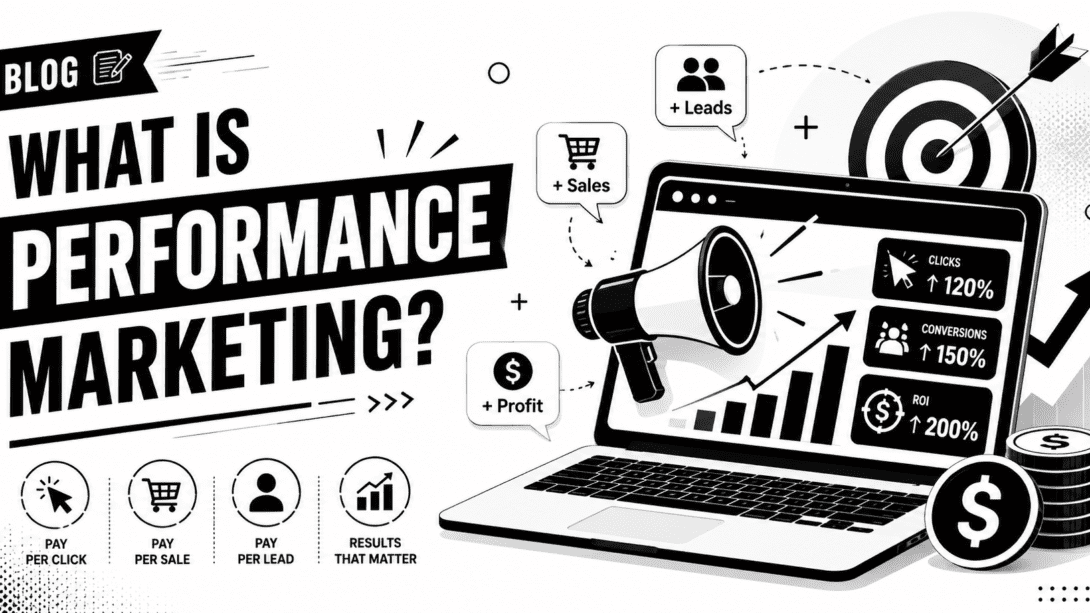
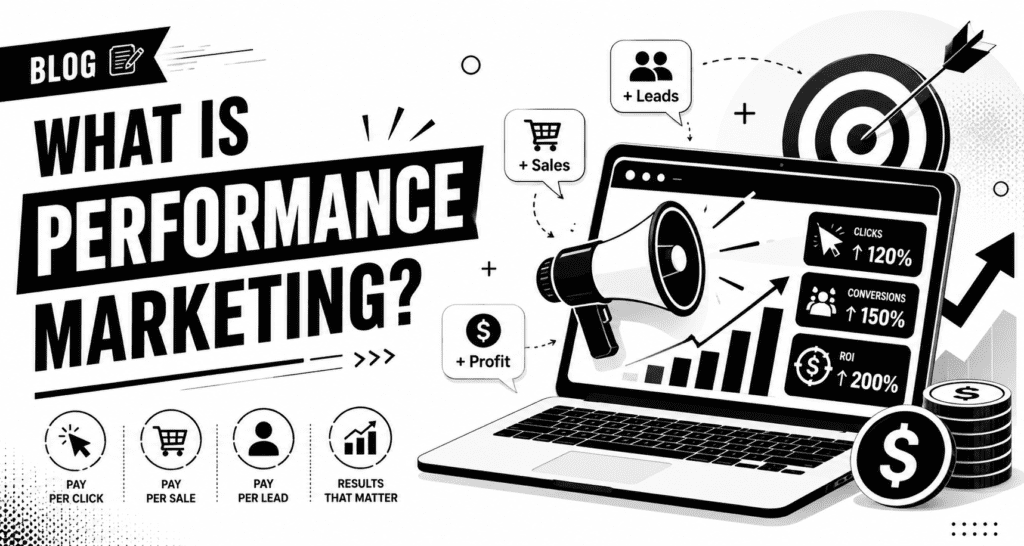
At its core, performance marketing is a results-driven approach to digital advertising where you only pay when a specific action is completed. That action could be a click, a lead, a sale, an app install, or any conversion goal your business defines. Unlike traditional advertising where you pay upfront for impressions with no guaranteed outcome, performance marketing ties every dollar directly to a measurable result.
For brands in the US spending heavily on digital channels, this shift from “spray and pray” to “track and pay” has been transformational. Let’s break it all down.
How Performance Marketing Works
Performance marketing operates on a simple principle: pay for outcomes, not exposure.
Here’s the basic flow:
- Advertiser defines a goal — a sale, a sign-up, a form fill, a call.
- Ad platform or network distributes the ad across relevant placements.
- User takes the desired action.
- Advertiser pays — but only when the action is completed.
This makes performance marketing fundamentally different from traditional brand advertising, where you pay for a TV slot or a billboard regardless of how many people actually respond.
The entire model is powered by tracking infrastructure — pixels, UTMs, conversion APIs, and attribution platforms that record exactly what happened after a user saw or clicked your ad.
Performance Marketing vs Brand Marketing
A common question is: what’s the difference between performance marketing and brand marketing?
| Performance Marketing | Brand Marketing | |
|---|---|---|
| Goal | Direct conversions | Awareness & recall |
| Payment model | Pay per action (CPC, CPA, CPL) | Pay per impression (CPM) |
| Timeline | Short-term, measurable | Long-term, hard to measure |
| KPIs | ROAS, CPA, CVR, CTR | Brand lift, share of voice |
| Best for | D2C, e-commerce, lead gen | Enterprise, new category creation |
The best marketing strategies in 2026 blend both — using performance channels to drive immediate revenue while building brand equity over time. But for most growing businesses, performance marketing is where budget gets the clearest ROI.
The Key Channels in Performance Marketing
Performance marketing isn’t a single channel — it’s a category. Here are the primary channels powering it today.
1. Paid Search (SEM / Google Ads)
Paid search remains the backbone of performance marketing for most US advertisers. You bid on keywords and your ads appear at the top of Google or Bing’s search engine results pages (SERPs) when users search for those terms. You pay per click — only when someone actively engages.
What makes paid search so powerful is intent. When someone types “buy running shoes size 10” into Google, they’re not browsing — they’re ready to purchase. Capturing that intent at the right moment is what makes Google Ads one of the highest-ROAS channels available.
For e-commerce brands especially, Google Shopping and Performance Max campaigns have become dominant. PMax automatically optimizes ads across Search, Display, YouTube, and Discover — letting machine learning find the highest-converting placements.
💡 Want to go deeper on running AI-powered Google Ads campaigns? Read our guide on AI marketing tools at Finmaticx to see how modern marketers are using AI to optimize ad performance.
2. Paid Social (Meta, TikTok, LinkedIn)
Social platforms offer massive scale combined with demographic and interest-based targeting. Unlike search (which captures existing demand), paid social creates demand by putting your offer in front of users who match your ideal customer profile.
Meta (Facebook + Instagram) remains the dominant player for D2C and e-commerce. TikTok has grown rapidly for consumer brands targeting under-35 audiences. LinkedIn dominates for B2B lead generation.
Each platform uses its own bidding system, but the performance model is consistent — you define a conversion goal, and the algorithm optimizes delivery toward users most likely to complete it.
3. Affiliate Marketing
In affiliate marketing, you partner with publishers, influencers, or websites who promote your product. They earn a commission when their audience converts. You only pay when a sale or lead is generated — making it a pure performance model.
Affiliate is particularly powerful for e-commerce brands because it unlocks distribution at scale without upfront media spend. Networks like Impact, CJ Affiliate, and ShareASale power most US affiliate programs.
4. Display & Programmatic Advertising
Programmatic advertising uses real-time bidding (RTB) to place display ads across millions of websites. When aligned to performance goals (retargeting cart abandoners, targeting look-alike audiences), programmatic becomes a strong performance channel — not just a reach play.
Retargeting in particular is one of the highest-efficiency tactics in performance marketing. You’re re-engaging users who already showed intent but didn’t convert.
5. Email & SMS Marketing
Often underrated as a “performance” channel, email and SMS deliver among the best CPA of any digital channel for existing customer bases. Automated flows — abandoned cart sequences, post-purchase upsells, win-back campaigns — are fully measurable and directly tied to revenue.
Core Performance Marketing Metrics You Must Track
Performance marketing lives and dies by data. Here are the metrics that matter most:
CTR (Click-Through Rate) — How often people who see your ad click it. Indicates ad relevance and creative quality.
CPC (Cost Per Click) — How much you pay for each click. Lower CPC with maintained quality = better efficiency.
CVR (Conversion Rate) — The percentage of clicks that result in the desired action. Your landing page and offer quality drive this.
CPA (Cost Per Acquisition) — How much it costs to generate one conversion. The single most important metric for most performance campaigns.
ROAS (Return on Ad Spend) — Revenue generated per dollar spent on ads. The north star for e-commerce performance marketing.
LTV (Lifetime Value) — How much a customer is worth over their entire relationship with your brand. High-LTV customers justify higher CPAs.
💡 Using AI to automate keyword research and performance analysis? Check out the Finmaticx KW Tool — built specifically for performance marketers who need fast, accurate keyword data with AI-powered insights.
What Makes a Strong Performance Marketing Strategy in 2026?
1. Start With the Right Attribution Model
You can’t optimize what you can’t measure. In 2026, multi-touch attribution and data-driven attribution (DDA) models have largely replaced last-click. Google Ads’ native DDA model, combined with tools like Northbeam or Triple Whale for e-commerce, gives you a far more accurate picture of which channels and creatives are actually driving revenue.
2. Let AI Bidding Work — But Feed It Clean Data
Smart Bidding strategies (Target CPA, Target ROAS, Maximize Conversions) use machine learning to optimize bids in real time. But they’re only as good as the conversion signals you feed them. Poor tracking = poor AI decisions. Prioritize:
- Accurate conversion tracking (with enhanced conversions turned on)
- Sufficient conversion volume (30+ per month per campaign ideally)
- Clear conversion values for value-based bidding
3. Nail Your Landing Page Experience
An ad gets the click. The landing page gets the conversion. Too many performance marketers obsess over creative and bids while sending traffic to slow, generic pages that kill CVR.
Fast load speed, message match (your landing page headline should echo your ad copy), a clear single CTA, and strong social proof are non-negotiable.
4. Test Creatives Constantly
In paid social especially, creative is your targeting. The algorithm finds the audience — your job is to give it multiple creatives to test across formats (static, video, UGC, carousel). A/B testing ad variations systematically, not randomly, is what separates scalable brands from those who plateau.
5. Build Audience Strategy Around Funnel Stage
Not all traffic is equal. Performance marketing works best when you match your message to where the user is in the funnel:
- Top of funnel (TOF): Awareness — broad audiences, video content, engagement campaigns
- Middle of funnel (MOF): Consideration — retargeting website visitors, email nurture, case studies
- Bottom of funnel (BOF): Conversion — cart abandoners, high-intent search keywords, direct offer ads
Performance Marketing and AI: What’s Changing in 2026
AI has become deeply embedded in performance marketing — both in the platforms themselves and in the tools marketers use to manage campaigns.
On the platform side, Google’s Performance Max and Meta’s Advantage+ campaigns use AI to automate targeting, placement, bidding, and even creative optimization. Advertisers are increasingly moving into a “feed the machine” model — providing assets, conversion goals, and audience signals, then letting AI optimize delivery.
On the marketer side, AI tools are changing how keyword research, ad copy, audience segmentation, and competitive analysis get done. Tasks that once took hours now take minutes.
💡 At Finmaticx, we build AI-powered tools specifically for marketers navigating this shift. Explore our AI marketing resources to stay ahead of the curve.
The marketers winning in 2026 aren’t fighting AI — they’re using it to go faster, test more, and make smarter decisions with their budgets.
Performance Marketing for E-Commerce: A Special Note
For D2C and e-commerce brands, performance marketing is the engine of growth. The standard playbook looks something like this:
- Google Shopping / PMax — capture high-intent purchase-ready traffic
- Meta Ads — build demand and retarget engaged audiences
- Email / SMS — convert and retain with automated flows
- Affiliate — scale distribution without upfront media cost
The key lever across all of these is product data quality. Your product titles, descriptions, images, and pricing feed directly into ad performance — especially in Google Shopping. Poorly optimized product feeds are one of the biggest untapped levers for most e-commerce advertisers.
Common Performance Marketing Mistakes to Avoid
Optimizing for the wrong conversion event. If you tell the algorithm to optimize for “add to cart” but your goal is purchases, you’ll get a lot of adds and few checkouts. Align your optimization event as close to your actual business goal as possible.
Pausing campaigns too early. AI-driven campaigns need data to learn. Pausing or making major changes in the first 2 weeks disrupts the learning phase and resets the algorithm.
Ignoring creative fatigue. Ad performance drops sharply once audiences have seen your creative multiple times. Refresh creatives regularly — especially on Meta and TikTok where frequency builds quickly.
Not accounting for incrementality. ROAS and CPA figures from platform dashboards often include conversions that would have happened anyway (direct traffic, organic). Incrementality testing reveals the true lift your ads are driving.
Frequently Asked Questions About Performance Marketing
What is performance marketing in simple terms?
Performance marketing is digital advertising where you pay only when a specific result happens — like a click, a sale, or a lead. It’s the opposite of paying upfront for impressions with no guaranteed outcome.
What are the main performance marketing channels?
The primary channels are paid search (Google Ads, Bing Ads), paid social (Meta, TikTok, LinkedIn), affiliate marketing, programmatic display, and email/SMS marketing.
Is Google Ads a performance marketing channel?
Yes. Google Ads is one of the most widely used performance marketing platforms. You pay per click (PPC), and campaigns can be optimized toward specific conversion goals like purchases, leads, or calls.
What’s the difference between performance marketing and digital marketing?
Digital marketing is the broad umbrella — it includes everything from SEO to social media to content. Performance marketing is a subset of digital marketing focused specifically on paid, trackable, results-based campaigns.
What is a good ROAS for performance marketing?
It depends on your margins and business model, but a common benchmark for e-commerce is 3x–5x ROAS. However, brands with high LTV can profitably run at lower ROAS if customers continue buying over time.
How is performance marketing changing with AI in 2026?
AI has automated much of the bidding, targeting, and placement optimization within major ad platforms. Marketers now focus more on strategy, creative quality, audience signals, and data feed quality — while AI handles the real-time optimization layer.
Final Thoughts
Performance marketing in 2026 is more measurable, more automated, and more competitive than ever. The brands winning are those who combine smart strategy with clean data, strong creative, and the right AI tools to move faster than their competitors.
Whether you’re running your first Google Ads campaign or scaling a multi-channel D2C operation across markets, the fundamentals stay the same: define your goals, track everything, test constantly, and let the data tell you where to invest next.
💡 Ready to level up your performance marketing with AI? Explore Finmaticx — where we build tools and publish actionable guides for marketers who want real results.