How Does Acorns Make Money? Full Business Model Explained (2026)I still remember the first time a friend showed me her Acorns app. She’d been “investing” for six months without ever really deciding to. Every latte, every grocery run, every Uber ride rounded up to the nearest dollar and quietly slid the difference into a portfolio of ETFs. She had over $600 saved and couldn’t tell me a single time she’d manually added money.
That’s the trick Acorns has built its entire company around. But here’s the question that doesn’t get asked enough: if users are only investing spare change, how does Acorns actually turn a profit?
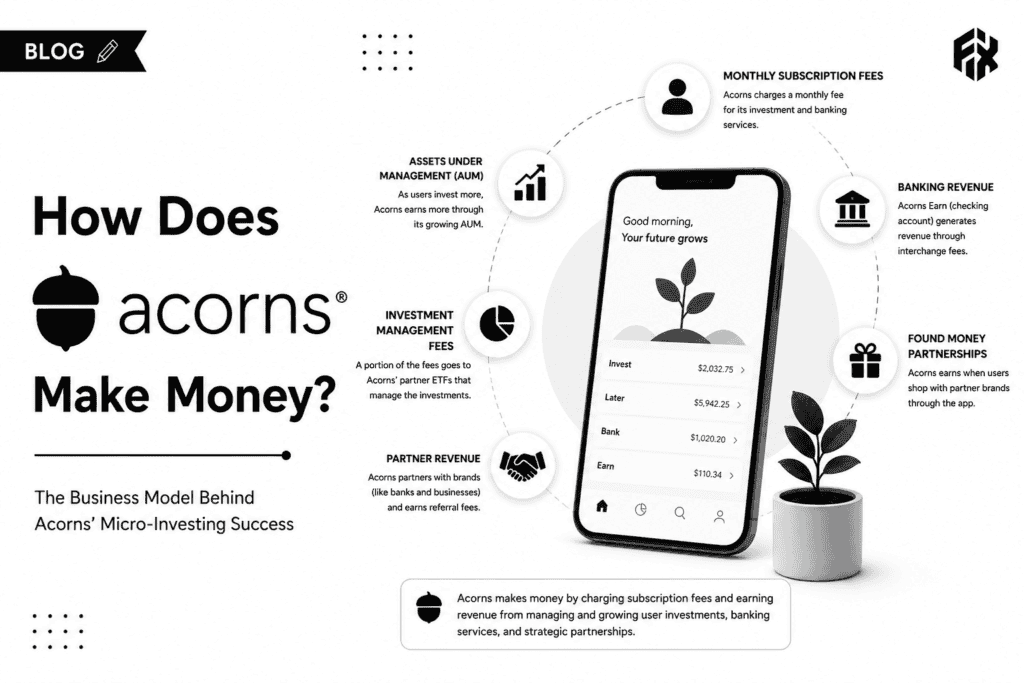
The honest answer is that Acorns isn’t really in the business of managing your round-ups. It’s in the business of subscriptions, with a few smart side businesses layered on top. By the end of this article, you’ll know exactly where every dollar of Acorns’ revenue comes from, how its pricing has changed, and how its model stacks up against competitors like Robinhood and Betterment.
The Quick Answer : How does acorns make money
Acorns makes money primarily through flat monthly subscription fees ($3 to $12 depending on the plan), supplemented by debit card interchange fees, brand partnership commissions through its Acorns Earn program, and interest earned on customer cash balances. Unlike many trading apps, Acorns does not rely on payment-for-order-flow or per-trade commissions.
A Quick Recap: What Is Acorns?
Acorns launched in 2014 as one of the first “micro-investing” apps, built around a simple behavioral hook: round up everyday purchases and invest the spare change automatically. Since then, it has grown into a full financial app covering investing, retirement accounts, banking, and kids’ accounts. According to figures published directly on Acorns’ own site, more than 14 million people have opened accounts as of early 2026, and customers have collectively invested over $30 billion since the company’s founding.
That scale matters, because Acorns’ entire business model depends on turning a large number of small, recurring payments into a predictable revenue base, rather than chasing big-balance investors the way traditional wealth managers do.
Revenue Stream #1: Subscription Fees (The Biggest Piece)
This is the heart of the business. Acorns doesn’t charge a percentage of your portfolio the way most robo-advisors do. Instead, it charges a flat monthly fee, no matter how much money you have invested.
As of 2026, Acorns offers three subscription tiers:
| Plan | Monthly Price | What You Get |
|---|---|---|
| Acorns Bronze | $3/month | Acorns Invest (diversified ETF portfolio), Round-Ups®, Recurring Investments, Acorns Later (IRA), Acorns Checking |
| Acorns Silver | $6/month | Everything in Bronze, plus a 1% IRA match on new contributions in year one, an Emergency Savings account, and a 25% match on Acorns Earn bonus investments |
| Acorns Gold | $12/month | Everything in Silver, plus a 3% IRA match, Custom Portfolios (pick individual stocks/ETFs), Money Manager, Acorns Early (kids’ investing and debit card), free tax filing, a complimentary will, and $10,000 in life insurance |
This structure is laid out directly on Acorns’ own pricing and plans page.
Here’s why the flat-fee model is clever from a business standpoint: it becomes cheaper, as a percentage of assets, the more money a customer accumulates. On a $500 balance, a $3/month plan works out to roughly 7.2% a year, which is expensive. But at around $14,400 in assets, that same $3 fee equals about 0.25% annually — which happens to match the industry-standard fee charged by percentage-based robo-advisors like Betterment and Wealthfront. Past that point, the flat fee keeps getting relatively cheaper as balances grow.
For Acorns, this means two things: predictable, forecastable monthly cash flow, and an incentive structure that keeps users depositing more, since a bigger balance makes the subscription feel “worth it.”
Historically, subscription revenue has made up the clear majority of Acorns’ income. In its 2021 SPAC filing — the last time the company shared detailed financials publicly — subscription fees accounted for roughly 79% of total revenue, with the remaining share coming from interchange, partnerships, and bank fees. Acorns has been a private company since that SPAC deal fell through in 2022, so current exact percentages aren’t publicly disclosed, but the subscription-first structure hasn’t changed.
Revenue Stream #2: Debit Card Interchange Fees
Acorns Checking, and the Mighty Oak debit card tied to Silver and Gold plans, isn’t just a convenience feature. It’s a revenue source. Every time a customer swipes their Acorns debit card, the merchant’s bank pays a small interchange fee, a portion of which flows back to Acorns through its banking partners.
This is a common playbook among fintechs. Companies like Chime built much of their early business around interchange revenue instead of subscriptions. For Acorns, it’s a secondary stream that adds up meaningfully across millions of checking account holders, especially since Acorns doesn’t charge overdraft, maintenance, or in-network ATM fees the way traditional banks might.
Revenue Stream #3: Acorns Earn (Brand Partnerships)
Acorns Earn works like a cashback program, except instead of cash back, you get bonus investments. When users shop with partner brands through the Acorns app, a percentage of that purchase gets invested into their Acorns account instead of paid out as cash.
For Acorns, this is a marketing-and-monetization play rolled into one: partner brands pay Acorns a referral or affiliate commission for driving sales, and Acorns passes part of that along to users as an investing incentive. It’s a clever loop — the more attractive the bonus investments are, the more likely users are to shop through Acorns, which increases the commissions Acorns earns from its retail partners.
Revenue Stream #4: Management Fees Within the Subscription
Most Acorns users pay their monthly subscription instead of a separate advisory fee. But baked into that subscription is a small underlying advisory and wrap-fee structure, disclosed in Acorns’ official Form CRS and Wrap Fee Brochure, that funds portfolio management, trading, and custody. For example, Acorns’ own disclosures note that its $6/month Silver plan includes a $0.10 advisory fee and a larger program fee, showing how the flat subscription is really a bundle of smaller components under the hood.
Revenue Stream #5: Interest on Customer Cash
Like most banks and fintech platforms, Acorns earns interest income on cash sitting in customer checking and Emergency Savings accounts before that money is invested or spent. Acorns deposits idle cash with partner banks — Lincoln Savings Bank and nbkc Bank — and the spread between what it earns and what it pays customers in APY becomes another modest revenue source, a strategy shared by nearly every neobank and robo-advisor in the space.
How Acorns’ Model Compares to Other Investing Apps
| Platform | Primary Revenue Model | Charges Per-Trade Fees? |
|---|---|---|
| Acorns | Flat monthly subscription + interchange + partnerships | No |
| Robinhood | Payment for order flow, margin interest, subscriptions | No (but PFOF-driven) |
| Betterment / Wealthfront | Percentage-based AUM fee (~0.25%) | No |
| M1 Finance | Margin interest, subscription tier, interchange | No |
The key distinction: Acorns bets on a flat, predictable fee that scales down, as a percentage, with balance size, while AUM-based robo-advisors scale their fees up as your balance grows. If you’re weighing the tradeoffs of fee structures across fintech products more broadly, it’s worth reading FinmaticX’s breakdown of how NerdWallet makes money, where lead-generation commissions replace subscription fees entirely — a completely different monetization philosophy for a similarly consumer-facing fintech brand.
Is Acorns Profitable?
Acorns doesn’t publish current profitability figures, since it has been a private company since its SPAC merger with Pioneer Merger Corp fell through in 2022. What we do know is that the business model — built on high subscriber retention, low marginal cost per user, and multiple secondary revenue streams — is designed for the kind of scale-driven margin expansion typical of subscription fintechs. The more subscribers Acorns retains without meaningfully increasing support or infrastructure costs, the more profitable each additional user becomes.
For context on how differently other well-known fintech names monetize similarly large user bases, it’s worth comparing this to how Klarna makes money off buy-now-pay-later merchant fees, or how Cash App built its business around peer-to-peer transfers and Bitcoin trading. Both are very different paths to profitability than Acorns’ subscription-first approach.
Frequently Asked Questions
Does Acorns charge trading commissions?
No. Acorns does not charge per-trade commissions. Its revenue comes from flat monthly subscriptions, not transaction-based fees.
How much does Acorns cost per month in 2026?
Acorns has three plans: Bronze at $3/month, Silver at $6/month, and Gold at $12/month, each unlocking more features like IRA matching, banking, and kids’ accounts.
What is Acorns Earn?
Acorns Earn is a bonus-investment program where shopping with partner brands invests a percentage of your purchase into your Acorns account instead of paying you cash back.
Does Acorns make money from my spare change directly?
Not directly. Round-Ups® fund your own investment account — Acorns doesn’t keep your spare change. It profits from your subscription fee, not from the invested amount itself.
Is Acorns a bank?
No. Acorns is not a bank. Banking and debit card services are provided through partner banks, Lincoln Savings Bank and nbkc Bank, both FDIC members.
Is Acorns worth the subscription fee?
It depends on your balance size. The flat fee becomes proportionally cheaper as your account grows, matching or beating typical 0.25% robo-advisor fees once your balance passes roughly $14,000.
Final Thoughts
Acorns’ business model is a good reminder that in fintech, the product people see — round-ups, spare change, a friendly app — isn’t always where the money actually comes from. The real engine is a subscription model wrapped around behavioral nudges that keep people depositing consistently, with interchange fees, brand partnerships, and interest income quietly filling in the gaps.
If you found this breakdown useful, check out FinmaticX’s deep dives into how Zelle moves over a trillion dollars a year without charging users directly, or how Affirm profits from 0% APR loans — good examples of fintech monetizing in ways that aren’t obvious at first glance. More breakdowns like these live in the FinmaticX blog.
External Sources Referenced
- Acorns pricing and plans: https://www.acorns.com/pricing/
- “Is Acorns Worth It?” (plan features, customer/AUM figures): https://www.acorns.com/learn/acorns/is-acorns-worth-it/
- Acorns Form CRS: https://www.acorns.com/form-crs/
- SEC Investor.gov: https://www.investor.gov
- FINRA: https://www.finra.org
- SIPC: https://www.sipc.org