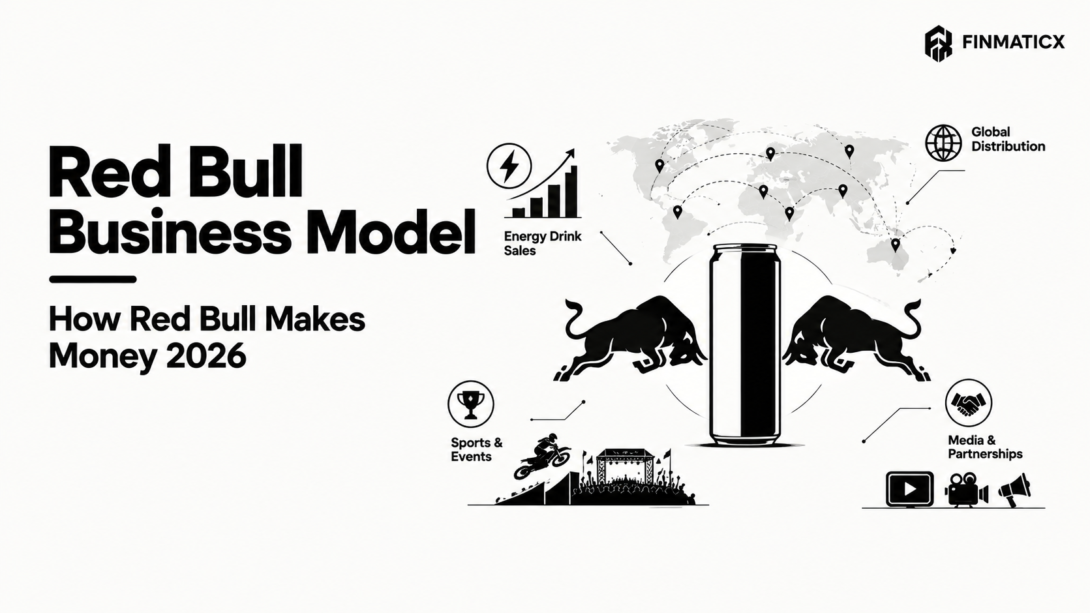
The Red Bull business model moves roughly 443 cans of energy drink every single second. That’s not a slogan. It’s arit2026hmetic on the 13.969 billion cans Red Bull says it sold worldwide in 2025.
Now look at what’s missing from the picture. For most of its history, Red Bull has left the filling of its cans to a partner. It sells one flagship drink in one slim can. And yet it owns a Formula 1 team, football clubs, a record label, and a media house, and it once streamed a man jumping from the edge of space to the biggest live audience YouTube had ever seen.
So is Red Bull a beverage company, a media company, or a sports company? The honest answer is that it is a beverage company that spends like a media company. This guide breaks down the Red Bull business model piece by piece: where the money comes from, who makes the product, how it is distributed, why it spends over a billion euros a year on athletes, and what could go wrong next. Every number comes from Red Bull’s own published figures, official filings, or major financial reporting, and any figure we calculated ourselves is labeled as such.
If you read business case studies for a living (or for a class), this one is built to be reused. It includes a business model canvas, a financial table, a competitive analysis, a SWOT, and discussion questions at the end.
What Is the Red Bull Business Model?
The Red Bull business model is a brand-led, single-product beverage model. Red Bull owns the brand and formula, outsources most can filling to long-term partners such as Rauch, sells through a tightly managed distribution network, and reinvests a very large share of revenue into athletes, events, and owned media to protect a premium price.
In plain English: Red Bull makes money by selling cans of energy drink at a premium price, and it uses sport, content, and culture instead of ordinary advertising to make people want that can.
Red Bull at a Glance (FY2025 Key Facts)
| Metric | Figure | Source |
|---|---|---|
| Cans sold worldwide (2025) | 13.969 billion (+10.2%) | Red Bull company profile |
| Group turnover (2025) | €12.196 billion (+8.6%, from €11.227 billion) | Red Bull company profile |
| Net income (2025) | €1.9 billion (+12%) | Bloomberg |
| Employees (end of 2025) | 21,924 (up from 19,973) | Red Bull Q&A |
| Countries sold in | 178 | Red Bull company profile |
| Athlete and team marketing spend | More than €1.5 billion (about 48% of marketing budget) | Bloomberg |
| US energy drink dollar share (Q2 2025) | 36.8% | Celsius Holdings investor presentation (SEC) |
| Ownership | Yoovidhya family 51%, Mark Mateschitz 49% | Follow the Money |
| Headquarters | Fuschl am See, Salzburg, Austria | Wikipedia: Red Bull GmbH |
Red Bull History: From Krating Daeng to Global Brand
You can’t understand the Red Bull business model without the origin story, because the most important decisions were made before the first can ever hit a shelf in Europe.
The drink itself is Thai. Chaleo Yoovidhya created a syrupy tonic called Krating Daeng (“red gaur” in Thai) in 1976, and it became popular with truck drivers and manual workers. In 1982, an Austrian marketer named Dietrich Mateschitz, then working for the toothpaste maker Blendax, tried it on a trip to Thailand.
What Mateschitz saw wasn’t a drink. It was a category that didn’t yet exist in the West.
Red Bull Timeline
| Year | Milestone |
|---|---|
| 1976 | Chaleo Yoovidhya creates Krating Daeng in Thailand |
| 1982 | Dietrich Mateschitz discovers the drink on a trip to Thailand |
| 1984 | Red Bull GmbH is founded; each partner invests US$500,000 and holds 49%, with 2% assigned to Chaleo’s son |
| 1984 to 1987 | The product is reformulated for European tastes: carbonation added, sweetness reduced |
| April 1, 1987 | Red Bull Energy Drink launches in Austria |
| 2005 | Red Bull Racing enters Formula 1 (formerly the Jaguar Racing team) |
| 2007 | Red Bull Media House and Red Bull Records are established |
| 2010 to 2013 | Red Bull Racing wins four straight Constructors’ and Drivers’ titles |
| October 14, 2012 | Red Bull Stratos: Felix Baumgartner’s jump draws a record 8 million concurrent YouTube viewers |
| 2012 | Co-founder Chaleo Yoovidhya dies; his family’s stake passes to the next generation |
| October 2022 | Dietrich Mateschitz dies at 78; his 49% stake passes to his son Mark |
| 2021 and 2025 onward | Red Bull, Rauch, and Ball build US can-filling plants: Glendale, Arizona (production began 2021) and Concord, North Carolina (groundbreaking 2025) |
| 2025 | Record year: 13.969 billion cans and €12.196 billion in turnover; Christian Horner leaves Red Bull Racing |
| 2026 | Red Bull Ford Powertrains debuts in Formula 1 |
Sources: Red Bull company profile, Wikipedia: Red Bull GmbH, Wikipedia: Red Bull Racing, Campaign, REBusinessOnline.
One detail from this timeline matters a lot for the business model: the three years between 1984 and 1987. Red Bull spent that time reformulating the product and building the brand concept before selling a single can. Mateschitz was a marketer first, and the company has behaved like one ever since.
Who Owns Red Bull? Ownership and Leadership
Red Bull is privately held and has never been listed on any stock exchange. That single fact explains a lot about how it behaves: no quarterly earnings calls, no pressure from public shareholders, and very limited public disclosure.
The ownership split is simple. The Thai Yoovidhya family controls 51% of the company, and Mark Mateschitz holds the remaining 49%, which he inherited from his father in 2022. According to Follow the Money, Mateschitz holds his stake through the family company Distribution & Marketing GmbH.
Dietrich Mateschitz ran the business until his death, and he designed his own succession. Instead of naming a single successor, Red Bull moved to a three-person leadership structure of Oliver Mintzlaff, Franz Watzlawick, and CFO Alexander Kirchmayr, as reported by The Brand Hopper. Mintzlaff and Watzlawick are the co-CEOs.
Two practical consequences follow from this structure:
- Red Bull can think in decades. A private company with no debt doesn’t need to hit a quarterly number, so it can fund F1 engines, record-label signings, and multi-year content projects.
- Outsiders see only what Red Bull chooses to show. It publishes selected annual metrics on its website, and fuller annual accounts appear through Austria’s company registry, which is where Bloomberg gets figures like net income.
Red Bull Business Model Canvas
The business model canvas is the quickest way to see how the pieces fit together. Here’s the Red Bull business model laid out on one page.
| Canvas Block | Red Bull |
|---|---|
| Customer segments | Young adults, students, athletes, shift workers, drivers, and nightlife consumers; broad mass-market appeal reinforced by an action-sports image |
| Value proposition | A functional energy drink with a distinct taste in a slim 250 ml can, wrapped in a brand identity built on performance and adventure (the “gives you wings” idea) |
| Channels | Convenience stores, grocery, gas stations, bars and venues, e-commerce, and events; plus owned media (video, magazines, TV) for brand reach |
| Customer relationships | Sampling by student brand managers and street teams, athlete and event fandom, content, and a very recognizable look and feel |
| Revenue streams | Beverage sales (the overwhelming core); Red Bull does not publish revenue from media or sports separately |
| Key resources | The Red Bull brand, the formula, athlete and event IP, the media house, distribution relationships, and a no-debt balance sheet |
| Key activities | Brand and content creation, athlete and event management, supply chain coordination, and sales and distribution management |
| Key partners | Rauch (filling), Ball Corporation (aluminum cans), distributors and retailers, athletes, teams, and sports organizations |
| Cost structure | Marketing and sponsorship (the biggest discretionary line), packaging and ingredients, filling fees, logistics, and people costs for 21,924 employees |
The key insight from the canvas: Red Bull’s “cost of goods” is not where the action is. The strategic spending sits in marketing, and the strategic asset is the brand.
How the Red Bull Business Model Makes Money
Let’s answer the big question directly: how does Red Bull make money? It sells cans of energy drink. That’s it. Bloomberg’s coverage of Red Bull’s 2025 results describes beverage sales as the primary growth engine even as the sports portfolio expands, according to a GuruFocus summary of the company’s data.
Red Bull’s range includes the original Red Bull Energy Drink, Red Bull Sugarfree, Red Bull Zero, and Red Bull Editions, the flavored line, as listed on Red Bull’s own site.
What About the Media House, Records, and Sports Teams?
Red Bull Media House produces films, magazines, TV, and events. Red Bull Records signs music artists. Red Bull Racing competes in Formula 1. All of these exist. But Red Bull does not publish revenue by segment, and nothing in its public reporting suggests these units drive the top line. The sensible reading is that they function mainly as marketing assets: they build the brand, and the brand sells the can.
Red Bull Revenue and Volume, 2023 to 2025
| Metric | 2023 | 2024 | 2025 |
|---|---|---|---|
| Cans sold | 12.138 billion | About 12.7 billion (+4.4%) | 13.969 billion (+10.2%) |
| Group turnover | About €10.55 billion | €11.227 billion (+6.4%) | €12.196 billion (+8.6%) |
| Employees (year-end) | n/a | 19,973 | 21,924 |
| Net income | n/a | About €1.7 billion (implied) | €1.9 billion (+12%) |
Sources: Red Bull company profile, Bloomberg (2024 results), Bloomberg (2025 results), Bloomberg (net income). The 2023 turnover and 2024 net income figures are derived from the reported growth rates.
Unit Economics: What One Can of Red Bull Earns
Because Red Bull sells one core product, we can do something most companies don’t allow: simple per-unit math. These are our own calculations from the reported 2025 figures, so treat them as blended global averages rather than a price list.
| Derived Metric (2025) | Calculation | Result |
|---|---|---|
| Net revenue per can | €12.196B ÷ 13.969B cans | About €0.87 |
| Net income per can | €1.9B ÷ 13.969B cans | About €0.14 |
| Net profit margin | €1.9B ÷ €12.196B | About 15.6% |
| Cans sold per second | 13.969B ÷ 31.5M seconds | About 443 |
| Revenue per employee | €12.196B ÷ 21,924 | About €556,000 |
| Revenue growth, 2023 to 2025 | Compound annual rate | About 7.5% a year |
A few observations from the data:
- Volume grew faster than revenue in 2025. Cans rose 10.2% while turnover rose 8.6%. On our math, blended revenue per can slipped by roughly 1.4% (about €0.886 in 2024 to €0.873 in 2025). Red Bull doesn’t explain the gap. Currency moves, market mix, and pack mix are all plausible drivers, but they’re our speculation, not company statements.
- Profit grew faster than revenue. Net income rose 12% against turnover growth of 8.6%, which suggests operating leverage even as marketing spending climbed.
- The business funds itself. Red Bull is closely held, has no financial debt, and says its 2026 growth plans will be financed from operating cash flow, per the GuruFocus report. The same report cites a €648 million dividend paid to Mark Mateschitz on his 49% stake.
Red Bull Business Model: Production and Supply Chain
Here’s where the Red Bull business model surprises people. The company that sells nearly 14 billion cans a year has historically not run its own filling lines.
The Rauch Partnership
Red Bull’s filling partner is Rauch Fruchtsäfte, a family-owned Austrian juice company based in Rankweil. According to Inside Beer, Rauch has been the bottler for Red Bull from the very beginning in 1987. In Austria and Switzerland (Widnau), Rauch fills Red Bull in the immediate vicinity of aluminum can plants run by Ball, which keeps empty cans from traveling far.
This is an asset-light choice. Red Bull concentrates on the two things that create value (the brand and the demand) and lets a specialist handle capital-intensive filling.
The US Expansion: Glendale and Concord
As volume grew, Red Bull and its partners shifted from “outsourcing” to “co-investing”:
- Glendale, Arizona. A joint venture of Red Bull, Rauch, and Ball (RRB Beverage Operating) invested about US$250 million in a 700,000-square-foot can-filling plant, announced in 2019 (GPEC). It began production in 2021.
- Concord, North Carolina. Red Bull, Ball, and Rauch North America have broken ground on a 2.3-million-square-foot production and distribution plant. Reported as a $1.5 billion investment, it is expected to begin operations in 2028, fill up to 3 billion cans of Red Bull a year, and create up to 700 jobs, with full capacity targeted for 2031 (REBusinessOnline). Ball will build an 800,000-square-foot can plant on the same site.
Why does this matter? The US is Red Bull’s most visible market for share data, and building local capacity shortens delivery distances, cuts transport costs, and reduces supply risk. A plant built to fill up to 3 billion cans a year is also a statement about expected demand: that volume alone is more than a fifth of everything Red Bull sold worldwide in 2025.
Distribution and Pricing
Red Bull publishes very little about how it distributes. It is sold in 178 countries, and its distribution mix varies by market. Trade analysts generally describe a hybrid approach: company-run distribution in some markets and partner distributors in others. Because Red Bull doesn’t confirm the details, treat any exact split you read online with caution.
What can be said with confidence is where energy drinks get bought. In its 2026 industry reporting, NACS Magazine noted that packaged beverages brought in over $45,000 per US convenience store per month in 2025, with more than 28% of that from energy drinks. For a brand like Red Bull, the convenience channel is core real estate.
Premium Pricing
Red Bull consistently sits at the premium end of the shelf. That’s a deliberate choice, and it explains the marketing budget: the spending protects the price. A brand that discounts to win volume gives up the margin that pays for sports sponsorships. Red Bull’s revenue per can (about €0.87 blended globally) reflects a mix of high-priced convenience channels and lower-priced multipack and emerging-market sales, so it shouldn’t be read as a shelf price.
The product is also physically distinctive: a small 250 ml can (a 250 ml serving contains about 80 mg of caffeine, per the UK Food Standards Agency figure cited by Gulf News). A small can at a high price per millilitre is itself a signal that this isn’t a soft drink.
Red Bull Business Model: The Marketing Engine
If one section of this article explains why Red Bull is a case study, it’s this one.
How Much Does Red Bull Spend on Marketing?
Red Bull doesn’t publish a single marketing figure, but Bloomberg’s reporting on its 2025 accounts gives us hard numbers. Red Bull’s spending on athletes, teams, and sponsorship exceeded €1.5 billion for the first time, sponsorship costs jumped 22%, and payments to athletes and teams made up about 48% of the marketing budget, according to Bloomberg.
Do the arithmetic and the total marketing budget lands at roughly €3 billion or more (this is our back-of-envelope inference: €1.5B ÷ 0.48 ≈ €3.1B). That would be about 25% of turnover (€3.1B ÷ €12.2B ≈ 25.6%).
For perspective, Nike’s total demand creation expense (brand marketing plus sports marketing) was $4.754 billion in fiscal 2026 on $46.4 billion of revenue, or roughly 10%. We cover that in detail in our Nike case study. The two figures aren’t perfectly comparable, since companies classify marketing differently, but the gap shows how marketing-intensive Red Bull really is.
Red Bull Media House: Owning the Content
In 2007, Red Bull established Red Bull Media House to produce content that “spoke to the nature of its product: youth, energy and sports,” as a student analysis on Harvard Business School’s Digital Initiative platform put it. Over time the media arm grew to include magazines such as The Red Bulletin, Servus TV in Austria, Red Bull Records, Red Bull Music Publishing, and Red Bull Photography, per Wikipedia.
The strategic logic is simple. A brand that buys ad space rents attention. A brand that owns the content owns the audience.
The Stratos Case: A Marketing Masterclass
On October 14, 2012, Felix Baumgartner jumped from a balloon about 24 miles above New Mexico, reaching 833.9 mph and becoming the first skydiver to break the speed of sound. Red Bull ran the whole thing as its own production, and the YouTube livestream reached eight million concurrent viewers, the highest concurrent audience in the platform’s history at that time. The previous record for a single web video service was around 500,000 concurrent streams, set during the London Olympics.
Notice what Red Bull did not do. It didn’t sponsor someone else’s event. It built the event, owned the broadcast, and let every news outlet in the world cover a story with its name on the capsule.
Student Brand Managers and Sampling
Not all of Red Bull’s marketing is spectacle. A great deal is small, local, and repetitive. Red Bull’s own job listings describe Student Brand Managers whose goals include driving trial through one-to-one seeding, coordinating “Wings Teams,” and assisting the local sales team to ensure distribution and visibility around campus, as shown in this posting.
The model pairs top-of-funnel spectacle (Stratos, F1, cliff diving) with bottom-of-funnel sampling (a free can in your hand at exam time). The first creates desire; the second creates trial.
The Athlete and Event Portfolio
Red Bull sponsors individual athletes across many disciplines and runs its own events such as Red Bull Flugtag, Rampage, and Cliff Diving. The point isn’t any single event’s ROI. It’s that the portfolio keeps the brand permanently associated with performance, and that association supports a premium price.
If you’re planning campaigns of your own and want to test messaging angles quickly, Finmaticx’s Ads GPT and free AI prompt generator are built for exactly that kind of brainstorming.
Red Bull Racing and Sports Ownership
Formula 1 is the most visible piece of the Red Bull business model, and it’s worth separating what’s known from what’s speculated.
What’s known:
- Red Bull Racing has won six Constructors’ Championships (2010 to 2013, 2022, 2023) and eight Drivers’ Championships (2010 to 2013, 2021 to 2024), according to Wikipedia.
- Christian Horner managed the team from its formation in 2005 until 2025, when he left and Laurent Mekies became Team Principal and CEO.
- In 2026, Red Bull began building its own engines through Red Bull Powertrains in partnership with Ford. According to ESPN, the project started from scratch, brought in over 700 people, and built three factories. Mekies has publicly called it a “mountain to climb”.
- The team runs under the name Oracle Red Bull Racing, and its sister team, Racing Bulls, uses the same Red Bull Ford engines (Motorsport.com).
What Red Bull doesn’t tell us: how much the F1 operation costs, or how much sponsorship (such as Oracle’s title deal) offsets it. That means we can’t say whether F1 is a profit center, a break-even asset, or a very large advertising line item. The most reasonable reading is the last one, and it fits the broader pattern: Red Bull’s sports properties are the content engine that feeds the beverage business.
Red Bull’s footprint extends well beyond F1. Its subsidiaries include RB Leipzig, FC Red Bull Salzburg, New York Red Bulls, Red Bull Bragantino, and the ice hockey clubs EHC Red Bull München and EC Red Bull Salzburg, per the company’s Wikipedia entry. Each team is another year-round channel for brand exposure.
Athlete endorsements work the same way at Nike, with a very different cost structure. If you want that comparison, read our Nike case study.
Competitors and Market Share
Red Bull does not publish global market share, but US retail data is public through competitors’ filings. Celsius Holdings’ investor presentation to the SEC includes Circana data on quarterly dollar share of the US ready-to-drink energy category across multi-outlet and convenience channels.
US Energy Drink Dollar Share, Q1 2022 vs Q2 2025
| Brand | Q1 2022 | Q2 2025 | Change |
|---|---|---|---|
| Red Bull | 38.1% | 36.8% | −1.3 pts |
| Monster | 31.3% | 26.8% | −4.5 pts |
| Celsius Holdings (Celsius + Alani Nu) | 6.3% | 17.3% | +11.0 pts |
Source: Celsius Holdings Q2 2025 investor presentation (SEC filing), citing Circana Total US MULO+ w/C, RTD Energy. In Q3 2025, Celsius Holdings reported 20.8% share after adding Rockstar Energy, per its 8-K.
Two things stand out.
Red Bull has defended its position far better than Monster. Over 14 quarters, Red Bull lost about 1.3 points of share, while Monster lost about 4.5. Red Bull has said it kept its US share above 35% in 2025, per the GuruFocus summary.
The challenger story is Celsius, not Monster. Celsius Holdings (backed by a PepsiCo distribution partnership) went from a rounding error to roughly a sixth of the category by combining Celsius with the acquired Alani Nu brand. Its pitch is “modern energy”: zero sugar, fitness positioning, and strong appeal to women. A Morning Consult analysis found that Red Bull and Monster skew male, while Alani Nu is a meaningful brand among women specifically (Morning Consult).
Monster is distributed through Coca-Cola’s network, while Celsius is increasingly tied to PepsiCo, meaning the two largest beverage distributors each have an energy horse. Red Bull, by contrast, is a standalone company fighting two distribution giants with brand power.
Strategic Analysis: Five Forces and SWOT
Porter’s Five Forces for Red Bull
| Force | Assessment | Why |
|---|---|---|
| Competitive rivalry | High | Monster and Celsius Holdings are well-funded, and share has shifted meaningfully since 2022 |
| Threat of new entrants | Moderate to high | Alani Nu and Celsius show that new brands can reach double-digit share within a few years, though shelf space and distribution are barriers |
| Bargaining power of buyers | Moderate | Large retailers control shelf space, but consumers show strong brand loyalty and low willingness to trade down on a “functional” purchase |
| Bargaining power of suppliers | Moderate | Aluminum cans and filling capacity are essential, which is why Red Bull co-invests with Ball and Rauch |
| Threat of substitutes | Moderate | Coffee, ready-to-drink coffee, cola, and other functional drinks all compete for the same “need a boost” occasion |
(This table is our analysis, based on the data above.)
Red Bull SWOT
| Strengths | Weaknesses |
|---|---|
| Category-defining brand with about 37% US share (Q2 2025) | Revenue depends overwhelmingly on one core product |
| Record 2025: €12.196B turnover, €1.9B net income | Limited disclosure makes the business harder to benchmark |
| No financial debt; growth funded from operating cash flow | Very high marketing intensity (our estimate: roughly a quarter of turnover) |
| Owned content engine: Media House, sports teams, events | Ownership structure ties key decisions to two families |
| Long-standing production partnership with Rauch and Ball | Revenue per can slipped slightly in 2025 despite volume growth (our calculation) |
| Opportunities | Threats |
|---|---|
| Volume growth reaccelerated to +10.2% in 2025 | Age-based sales restrictions on high-caffeine drinks spreading across markets |
| New US capacity (Concord, up to 3B cans a year from 2028) | Fast-growing sugar-free challengers such as Celsius and Alani Nu |
| Zero and Sugarfree variants for health-conscious buyers | Distribution advantages of Coca-Cola (Monster) and PepsiCo (Celsius) |
| F1 engine program as a showcase for technology credibility | F1 engine program is a major execution risk in 2026 |
Risks Facing the Red Bull Business Model
A fair case study includes the risks. These are the ones that matter most.
1. Regulation of High-Caffeine Drinks
This risk is real and getting more concrete. On July 16, 2026, the UK government confirmed it will legislate to ban sales of high-caffeine energy drinks to under-16s in England, with a target start of April 2027, subject to parliamentary approval (Hansard). The restriction applies to drinks (other than tea or coffee) with more than 150 mg of caffeine per litre and bans sales through vending machines.
A standard 250 ml Red Bull contains about 80 mg, which works out to roughly 320 mg per litre, so it falls inside the definition (our calculation). The Library of Congress’s Global Legal Monitor summarizes the policy, and legal analysts note penalties of £1,500 to £2,500 per offence for retailers.
England isn’t alone. According to Wikipedia’s overview of energy drink age restrictions, Norway introduced a 16+ rule on January 1, 2026, and Croatia introduced an 18+ rule on June 1, 2026. Red Bull’s youth-and-student marketing heritage makes this trend especially relevant. Red Bull hasn’t disclosed any estimate of the financial effect.
2. Single-Product Concentration
Red Bull’s strength is also its exposure. If tastes shift away from sweetened or traditional energy drinks, the whole business feels it. The company’s Zero and Sugarfree variants are the hedge, and the data on Celsius shows how quickly modern, zero-sugar brands can take share.
3. Competitive Pressure From Better-Distributed Rivals
Celsius Holdings gained 11 points of US share in 3.5 years with PepsiCo’s distribution behind it. Monster has Coca-Cola. Red Bull’s defense is brand strength, but rivals have scale in distribution.
4. The F1 Engine Gamble
Building a Formula 1 power unit from scratch is a high-stakes bet. The team principal has openly acknowledged how steep the climb is, and a bad 2026 would hurt a brand that sells performance. The financial exposure is undisclosed.
5. Leadership and Key-Person Transition
Dietrich Mateschitz ran Red Bull for nearly four decades. The three-person structure that replaced him is still relatively new, and 2025 saw Christian Horner, a central figure in the F1 story for 20 years, leave the team. Red Bull’s results in 2025 suggest the beverage business is stable, but the post-Mateschitz era is still being written.
Lessons From the Red Bull Business Model
Whether you’re building a startup or studying for an exam, these are the transferable ideas.
1. Own one thing and make it iconic. Red Bull sold essentially one product for decades. Focus made the brand unmistakable.
2. Treat marketing as product experience, not advertising. Stratos wasn’t an ad. It was an event people chose to watch. The best brand-building creates things audiences want to consume.
3. Spend to protect price. Red Bull’s marketing intensity is the cost of staying premium. Cutting that spend might raise short-term margin, but it would risk the pricing power that creates the margin.
4. Be asset-light where it doesn’t create advantage, and co-invest where scale demands it. Red Bull let Rauch fill cans for decades, then built joint-venture plants when volume justified it.
5. Keep the balance sheet clean. No financial debt means Red Bull can keep investing through downturns, in F1 engines, content, and capacity.
6. Disclose selectively. Red Bull shares headline metrics and little else. That preserves competitive advantage, though it also makes the company harder to analyze.
If you’re naming a brand from scratch, you can brainstorm options with Finmaticx’s free AI business name generator. And if you want to see how another consumer brand scaled across markets from a single category, read our Weightworld case study on the UK-to-pan-European D2C playbook.
Case Study Discussion Questions
Use these for a class, a team workshop, or your own analysis:
- Red Bull’s marketing spend appears to be around a quarter of turnover. At what point does marketing intensity stop building brand equity and start destroying margin?
- Is the Red Bull business model defensible if sugar-free challengers keep taking share, or does it need a second hero product?
- Red Bull outsourced filling for decades and then began co-investing in plants. What triggers should lead a brand to make that shift?
- Should Red Bull treat its Formula 1 team as an advertising expense or as a strategic asset? What data would you need to decide?
- How should Red Bull respond to age-based sales restrictions, given its youth-oriented marketing heritage?
- Revenue per can fell about 1.4% in 2025 on our math while volume rose 10.2%. What additional information would you request to determine whether that is a problem?
Need a quick way to structure your answers or draft a case write-up? Try Finmaticx GPT to outline your analysis, or browse the full set of AI tools on Finmaticx.
Red Bull Business Model FAQ
What is the Red Bull business model? The Red Bull business model is a brand-led, single-product beverage model: Red Bull owns the brand, outsources most can filling to partners like Rauch, sells through managed distribution, and invests heavily in athletes, events, and media to sustain a premium price.
How does Red Bull make money? Red Bull makes money by selling cans of energy drink. It sold 13.969 billion cans in 2025 and generated €12.196 billion in turnover. The media house, sports teams, and events primarily function as marketing assets rather than disclosed revenue lines.
How much money does Red Bull make a year? In 2025, Red Bull reported turnover of €12.196 billion and net income of €1.9 billion, according to Red Bull’s published figures and Bloomberg’s reporting on its annual accounts.
How many cans of Red Bull are sold each year? Red Bull sold 13.969 billion cans worldwide in 2025, up 10.2% from 2024. That’s roughly 443 cans per second on average (our calculation).
Who owns Red Bull? Red Bull GmbH is privately owned. The Yoovidhya family of Thailand holds 51%, and Mark Mateschitz holds 49% after inheriting his father Dietrich Mateschitz’s stake in October 2022.
Does Red Bull make its own drinks? Historically, Red Bull has relied on Rauch to fill its cans, with production in Austria and Switzerland. It has since co-invested with Rauch and Ball in US plants, including Glendale, Arizona, which began production in 2021, with a larger North Carolina plant planned for 2028.
How much does Red Bull spend on marketing? Red Bull spent more than €1.5 billion on athletes and teams in 2025, which Bloomberg reports was about 48% of its marketing budget. That implies a total marketing budget of roughly €3 billion or more (our estimate).
Is Red Bull a media company? Red Bull runs a large media operation, including Red Bull Media House, magazines, Servus TV, and Red Bull Records, but its reported growth and revenue still come mainly from beverage sales. A more accurate description is a beverage company that uses media as its marketing engine.
What is Red Bull’s market share? In the US, Red Bull held 36.8% of energy drink dollar sales in Q2 2025, according to Circana data in Celsius Holdings’ SEC presentation, and said it stayed above 35% for 2025.
Is Red Bull profitable? Yes. Red Bull reported record operating profit in 2025 and net income of €1.9 billion, up 12%. The company is closely held and reports no financial debt.
Who are Red Bull’s main competitors? Monster Beverage (distributed via Coca-Cola’s network) and Celsius Holdings (Celsius, Alani Nu, and Rockstar, tied to PepsiCo) are the main US competitors.
Does Red Bull own a Formula 1 team? Yes. Red Bull owns Oracle Red Bull Racing and its sister team Racing Bulls. Since 2026, both use Red Bull Ford Powertrains engines.
Is Red Bull sold in India? Yes. Red Bull is sold in India through Red Bull India Pvt. Ltd., and shelf prices vary by city and pack type.
What risks does the Red Bull business model face? Key risks include age restrictions on high-caffeine energy drinks (England’s under-16 ban is planned for April 2027), single-product concentration, stronger-distributed competitors, and the execution risk of its F1 engine program.
More Business Model Breakdowns on Finmaticx
If this guide was useful, these related breakdowns on Finmaticx cover other brands and platforms using the same data-first approach. You can also browse the full business case studies category.
- Nike Case Study: Business Model, Strategy and Revenue Breakdown: another athlete-led brand, with very different economics.
- Weightworld Case Study: UK to Pan-European D2C Empire: how a supplement brand scaled across markets.
- ChatGPT Ads Case Study: How OpenAI Built a Billion-Dollar Ad Business in Months: attention as a business model.
- How Does Shopify Make Money? 101 Revenue Breakdown: the platform behind countless D2C brands.
- How Does Meesho Make Money? 101 Revenue Breakdown: a zero-commission marketplace model in India.
- How Does Zerodha Make Money? 101 Revenue Breakdown: India’s bootstrapped brokerage giant.
- How Does PhonePe Make Money? 101 Revenue Breakdown: monetizing free UPI payments.
- How Does Webull Make Money? Webull Business Model: what “zero commission” really means.
Want to know who writes this and why? Read What Is Finmaticx? Mission, Purpose and How It Helps Businesses, learn more about us, or explore Finmaticx AI’s free tools. Have a company you’d like us to break down next? Contact us.
Sources and Methodology
Red Bull is privately held and publishes only selected metrics, so this article combines company-published figures with reputable third-party reporting. Where we calculated a figure ourselves (per-can economics, net margin, cans per second, marketing budget inference, compound growth rates, revenue per can in 2024 vs 2025, caffeine per litre), we say so in the text. Data was last checked on October 9, 2026.
Primary and company sources
- Red Bull company profile: cans sold, turnover, employees, countries.
- Red Bull Q&A: how many employees and how many cans.
- Oracle Red Bull Racing 2026 livery launch.
- Celsius Holdings Q2 2025 investor presentation (SEC) and Q3 2025 8-K (SEC): Circana market share data.
- UK Parliament Hansard, July 16, 2026 and Library of Congress Global Legal Monitor.
Financial and business press
- Bloomberg: 2025 can sales and revenue, 2025 net income and sponsorship, 2024 results.
- GuruFocus summary of 2025 results.
- Follow the Money: Red Bull and The Brand Hopper: ownership.
- Inside Beer: Rauch and Red Bull, GPEC: Glendale facility, REBusinessOnline: Concord plant.
- NACS Magazine: energy drink trends and Morning Consult: top energy drink brands.
- Campaign: Red Bull Stratos and Harvard Business School Digital Initiative: Red Bull analysis.
- Formula 1 coverage: Formula1.com, ESPN, Motorsport.com.
- Reference: Wikipedia: Red Bull GmbH, Wikipedia: Red Bull Racing, Wikipedia: Age restrictions on energy drinks by country.