So how does Duolingo make money from an app whose entire personality is a cartoon owl guilt-tripping you into not skipping a lesson? You open the app to keep a streak alive, get a notification that says your progress is “in danger,” do one five-minute lesson, and close it again. No ad. No upsell. Nothing that feels like a business transaction at all. And yet in 2025, that same guilt-and-gamification loop generated Duolingo’s first billion-dollar revenue year.
The short version: Duolingo makes money almost entirely from subscriptions, with advertising and a standardized English proficiency test filling in the rest. But 2025 also revealed something more interesting — Duolingo pushed its monetization so hard that it started hurting the very user growth the whole business depends on, and 2026 has become a very public correction of that mistake.
How Does Duolingo Make Money? The Short Answer
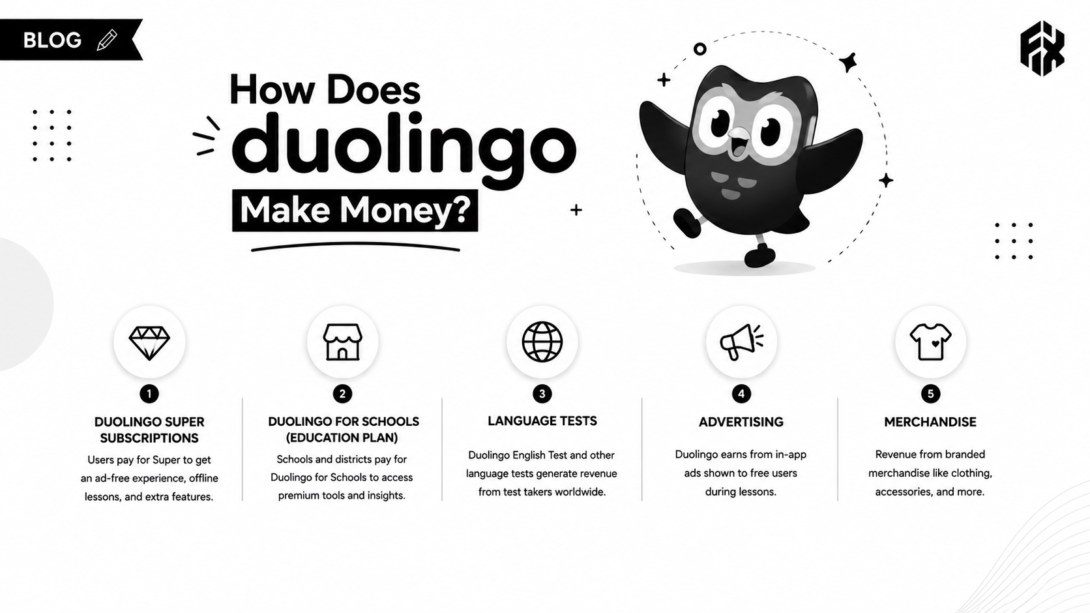
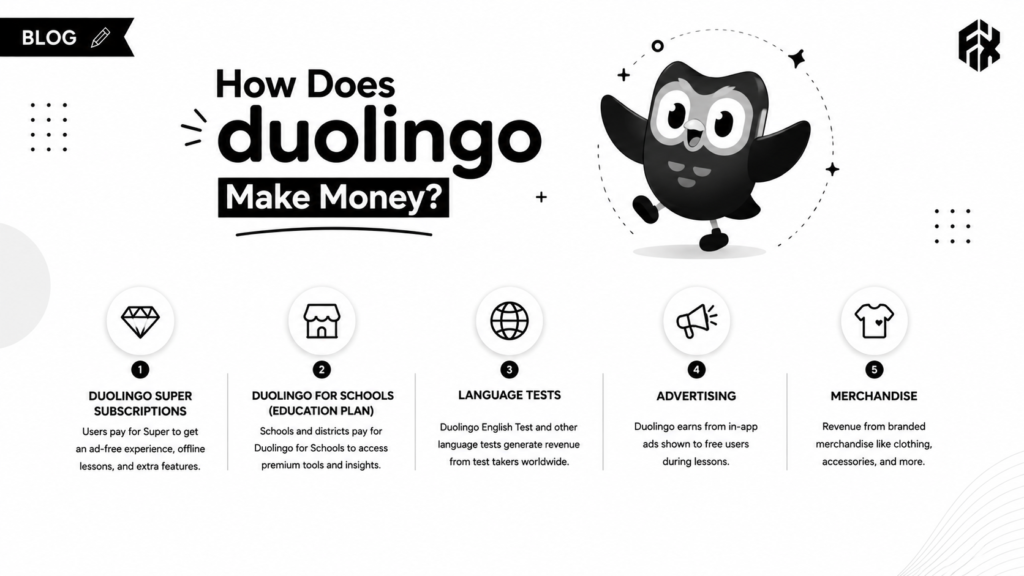
Duolingo makes money three ways: subscriptions (Super Duolingo and the higher-priced, AI-powered Duolingo Max), advertising shown to free users, and the Duolingo English Test, a standardized English proficiency exam accepted by thousands of universities worldwide. Subscriptions dominate — roughly 84% of total revenue in 2025 — with advertising and the English Test splitting the remaining share. Full-year 2025 revenue reached $1.037 billion, up 38.6% from $748 million in 2024, according to Duolingo’s own Q4 2025 shareholder letter filed with the SEC.
That’s a genuinely rare milestone for a consumer app built almost entirely around free education — Duolingo has always insisted its core language courses stay free, and it hit $1 billion in annual revenue without ever charging for the thing most users actually came for.
The Problem Duolingo Actually Set Out to Solve
Duolingo was founded in 2011 by Luis von Ahn, a Carnegie Mellon computer science professor, and his PhD student Severin Hacker. Von Ahn had already built and sold reCAPTCHA to Google, and his founding thesis for Duolingo was almost stubbornly idealistic: language learning software at the time was either boring, expensive, or both, while the people who needed it most — often in developing countries – usually couldn’t afford $500 software or private tutors. Duolingo’s answer was to build something genuinely free and make it as addictive as a mobile game, funded by a small paying minority rather than by charging everyone.
That free-first stance became the company’s defining trait, and it’s still the backbone of how Duolingo makes money today. The core language courses have never gone behind a paywall. Instead, Duolingo built its business around monetizing the layer around the free experience — removing friction, adding conveniences, and eventually adding entirely new premium products — while keeping the core lessons untouched. Duolingo went public in 2021, and by the end of 2025 its daily active user base had grown to more than five times what it was at IPO, crossing 50 million daily actives for the first time in company history.
It’s worth sitting with how unusual that founding constraint actually was for a venture-backed startup. Most consumer software companies that raise institutional funding eventually face pressure to monetize the core experience directly — a paywall on the main feature, not just the extras around it. Duolingo’s founders built the company around the opposite bet: that a genuinely free, genuinely effective product would grow so large that even a small paying percentage would be enough to build a real business on top of. That bet took roughly a decade to fully prove out, but the 2025 numbers — a billion dollars in revenue built almost entirely on optional upgrades layered over a free core product — are about as strong a vindication of that original thesis as a company this size could ask for.
Super Duolingo: The Subscription Behind the Streak
Super Duolingo (formerly Duolingo Plus) is the core paid tier, and it’s built around removing the exact friction points free users run into constantly. It offers unlimited “Hearts” (Duolingo’s built-in mistake-limit mechanic that otherwise locks free users out of lessons after too many wrong answers), an ad-free experience, unlimited practice with no daily caps, and streak-protection tools like Streak Freeze.
Super is priced around $12.99 a month for an individual plan, with a family plan option that lets multiple accounts share one subscription at a lower effective per-person cost — a structure clearly aimed at parents managing several kids’ accounts under one household subscription. By the end of Q4 2025, Duolingo had 12.2 million paying subscribers across its tiers, up 34% year over year from roughly 8 million a year earlier.
What makes Super such a durable revenue base is that it’s solving a problem the free tier deliberately creates. Hearts limits and ad interruptions aren’t accidents of a scrappy free product — they’re a soft nudge built directly into the free experience, designed to make Super’s core value proposition (“none of that friction”) obvious the moment a motivated learner hits a wall.
Suggested image: comparison graphic of Duolingo’s free tier vs Super Duolingo features (Hearts, ads, Streak Freeze). Filename: how-duolingo-makes-money-super-comparison.webp. Alt text: “How Duolingo makes money — Super Duolingo subscription features compared to the free tier.” Caption: “Super Duolingo removes the friction points built into the free experience.”
Duolingo Max: The AI Tier Changing the Revenue Mix
Sitting above Super is Duolingo Max, a higher-priced tier built around generative AI features — most notably “Explain My Answer,” which gives a conversational AI breakdown of why a specific answer was right or wrong, and “Video Call with Lily,” a roleplay conversation feature that lets subscribers practice speaking with an AI character in real time.
Max has grown from roughly 5% of Duolingo’s paying subscriber base at the end of 2024 to around 9% by late 2025 — meaning approximately 1.1 million of Duolingo’s 12.2 million subscribers were on the pricier Max tier by year-end. That mix shift matters more than the percentage alone suggests: because Max carries a meaningfully higher price point than standard Super, subscription revenue has grown faster than subscriber count in several recent quarters, driven specifically by more subscribers trading up to Max rather than just more people signing up at the base tier.
Notably, as part of its 2026 strategic reset, Duolingo announced it would move the previously Max-exclusive Video Call with Lily feature down into the cheaper Super tier — a deliberate short-term revenue sacrifice management is making in exchange for reducing friction and encouraging more free users to convert to any paid tier at all, rather than gatekeeping the most compelling AI feature behind the priciest option.
Advertising: The Price of Staying Free
For users who never subscribe, Duolingo makes money by showing ads — a mix of banner placements and video ads that free users can watch to earn extra Hearts. This is a smaller slice of total revenue than subscriptions, but it’s the piece that lets Duolingo’s core promise — completely free language learning — actually hold up financially at scale, since the vast majority of Duolingo’s roughly 133 million monthly active users never pay for anything at all.
2025, though, was also the year Duolingo’s advertising and monetization pressure became a visible problem rather than a quiet background revenue stream. The company introduced a new “Energy” mechanic and leaned harder into ad frequency and subscription upsell prompts throughout the year, and users noticed. Complaints about friction and aggressive monetization became common enough that management directly acknowledged, on its own earnings calls, that the pushback had measurably slowed daily active user growth — a rare moment of a company publicly admitting its own monetization had gone too far.
Suggested image: mockup of a Duolingo ad-rewarded Hearts screen shown to free users. Filename: duolingo-free-tier-ads-hearts.webp. Alt text: “How Duolingo makes money through ads shown to free users.” Caption: “Ad-supported Hearts let free users keep learning without subscribing.”
The Duolingo English Test: A Quiet Third Business
Less well known than Super or Max is the Duolingo English Test (DET) — a standardized, AI-graded English proficiency exam that costs a small fraction of legacy tests like TOEFL or IELTS, taken entirely online rather than at a testing center. It’s a genuinely separate business line from language learning, aimed at international students and immigration applicants who need to prove English proficiency for university admissions or visa applications.
The test has grown quickly: more than 700,000 people took the DET in 2024 alone, a 130% increase over three years. Its institutional acceptance has grown just as fast — all eight Ivy League universities, 98 of the top 100 US News-ranked schools, more than 3,100 US universities, and over 6,000 accepting programs worldwide now recognize DET scores. Each test taken is a paid transaction, making DET a meaningful, if still secondary, contributor to Duolingo’s overall revenue mix — and one that’s largely insulated from the consumer-app monetization pressure affecting Super and advertising, since students and universities are a completely different buyer than a casual language learner deciding whether to upgrade.
DET’s growth story is really a story about trust compounding over time. Getting a single university to accept an alternative to TOEFL or IELTS is a slow, credibility-dependent sales process — admissions offices don’t casually swap out a standardized test they’ve relied on for decades. But once enough major institutions signed on, acceptance became somewhat self-reinforcing: prospective students increasingly ask whether a school accepts DET before choosing which test to take, which puts pressure on remaining universities to add it simply to stay competitive for international applicants. That dynamic is part of why DET’s adoption curve has accelerated rather than plateaued, even without the kind of aggressive consumer marketing Duolingo uses for its core app.
Bookings vs. Revenue — Why the Two Numbers Don’t Match
If you look closely at Duolingo’s own financial filings, you’ll notice two different numbers reported side by side: bookings and revenue. They’re not the same thing, and the difference matters for understanding how Duolingo makes money in an accounting sense.
Bookings represent the cash value of subscriptions actually sold in a given period — someone paying for a 12-month Super subscription today counts as a full year of bookings immediately. Revenue, by contrast, is recognized ratably over the life of that subscription — so a 12-month subscription sold in January only contributes one-twelfth of its value to that month’s recognized revenue, with the rest spread across the following months. In Q4 2025, Duolingo’s total bookings grew 24% year over year while revenue grew 35% — the gap reflects revenue from subscriptions sold in prior quarters finally being recognized, layered on top of newer bookings.
This distinction is exactly why bookings tend to be a better real-time signal of current sales momentum, while revenue tends to lag and smooth out short-term swings — useful context for reading any Duolingo earnings report without mistaking one number for the other.
Duolingo’s Revenue, Year by Year
Here’s the growth trajectory, based on Duolingo’s own SEC filings and shareholder letters:
| Period | Revenue | YoY Growth | Daily Active Users |
|---|---|---|---|
| FY2024 (full year) | $748 million | — | ~38 million (year-end) |
| Q3 2025 | $271.7 million | +41% | 50.5 million |
| Q4 2025 | $282.9 million | +35% | ~52.7 million |
| FY2025 (full year) | $1.037 billion | +38.6% | 52.7 million (year-end) |
| Q1 2026 | $292.0 million | +27% | 56.5 million |
| FY2026 (guidance) | $1.20–1.22 billion | +15–18% (guided) | ~20% growth targeted |
The deceleration built into that 2026 guidance is deliberate, not a sign of the business struggling — and it’s the single biggest story in how Duolingo makes money right now.
The 2026 Pivot: Trading Monetization for Growth
On its Q4 2025 earnings call, CEO Luis von Ahn announced a strategic reset that stunned Wall Street: Duolingo would deliberately slow bookings and revenue growth in 2026 in order to re-accelerate daily active user growth, targeting roughly 20% DAU growth for the year and a longer-term goal of 100 million daily actives by 2028. Management estimated this shift would forgo more than $50 million in bookings that more aggressive monetization could otherwise have captured — a number von Ahn was direct about on the call, framing it as a trade Duolingo was making on purpose rather than a shortfall it was making excuses for.
The mechanics of the pivot include reducing conversion friction for free users, expanding previously Max-exclusive AI features like Video Call with Lily down into the cheaper Super tier, and doing what management described as thousands of ongoing A/B tests to find a gentler balance between monetization and user experience. Full-year 2026 guidance reflects that trade directly: bookings growth of just 10–12%, revenue growth of 15–18%, and an adjusted EBITDA margin around 25% — down from nearly 30% in 2025.
Von Ahn’s framing of the whole strategy boils down to a simple equation: long-term value comes from the size of the active learner base multiplied by how well that base eventually monetizes. If aggressive monetization in 2025 shrank “the size of the pie” by driving away users, then a temporary retreat on monetization in 2026 is meant to grow the pie back before Duolingo tries to slice it again.
Why the Stock Cratered Even as Revenue Hit $1 Billion
This is the part of Duolingo’s story that looks contradictory on the surface: 2025 was a record year by almost every headline metric — first billion-dollar revenue year, first time crossing 50 million daily actives, over $300 million in adjusted EBITDA — and yet Duolingo’s stock fell sharply on both its Q3 and Q4 2025 earnings calls, ultimately dropping from a 2025 peak market capitalization of roughly $21.7 billion to around $5.7 billion by April 2026.
The market’s read was straightforward, if brutal: investors had priced Duolingo as a company that could keep growing both users and monetization simultaneously and aggressively. When management openly said it would sacrifice near-term bookings and profit margin to fix a user-growth problem that its own monetization decisions had caused, that read the same to Wall Street as “growth has a ceiling we didn’t expect this soon” — even though Duolingo’s underlying revenue and user numbers were both still growing at a pace most software companies would envy. It’s a useful reminder that how a company frames a strategic shift can move a stock as much as the actual numbers behind it.
The scale of the reaction is worth noting on its own. Duolingo’s stock fell roughly 22 to 25% in the trading session immediately following its Q4 2025 results — one of its largest single-day declines on record — even after the company beat both revenue and adjusted EBITDA estimates for the quarter. Multiple Wall Street analysts, including firms like Morgan Stanley and Evercore ISI, downgraded the stock in the days that followed, citing the same concern: not that Duolingo’s numbers were bad, but that the multiple investors had been willing to pay assumed a growth trajectory management itself was now choosing to interrupt. That’s a distinct type of risk from a simple earnings miss, and it’s part of why the stock’s recovery has depended less on subsequent quarterly beats and more on whether the 20% DAU growth target actually materializes through 2026.
The Gamification Engine Behind All of It
None of Duolingo’s monetization tools would work without the layer underneath them: gamification mechanics specifically designed to make daily use feel almost involuntary. Streaks, experience points, leaderboards, “Hearts” as a soft mistake penalty, and Duo the owl’s now-famous, slightly unhinged notification style all exist to maximize one thing — how often people open the app, since daily active usage is the input every other revenue stream (subscriptions, ads, and eventually institutional trust for the English Test) depends on.
Duolingo’s marketing leans into this same instinct at a brand level. Its 2025 “Dead Duo” campaign — a viral stunt around the mascot’s apparent death — reportedly cost the company next to nothing to produce yet generated roughly 2 billion impressions, an efficiency ratio most paid marketing budgets could never approach. That kind of low-cost, high-virality marketing has become as central to Duolingo’s growth engine as any single product feature, and it’s part of why the company can afford to prioritize DAU growth in 2026 even while pulling back on paid monetization — cheap, viral distribution gives it room to absorb short-term bookings losses that a company more dependent on paid acquisition couldn’t.
This is also why the 2025 backlash was such a genuine strategic problem rather than just noisy social media chatter. Duolingo’s entire growth model depends on the app feeling like a habit worth returning to daily, largely for free, with monetization sitting quietly in the background rather than at the center of the experience. When ad frequency and conversion prompts became visible and annoying enough to draw sustained public complaint, it didn’t just risk losing a few subscription upsells — it risked damaging the daily-habit loop that every other part of the business, from ad impressions to eventual subscription conversion to DET’s word-of-mouth growth, ultimately depends on. That’s the real reason management chose to walk back friction so publicly and so quickly rather than waiting out the criticism.
What Could Threaten This Model
Even with a record revenue year behind it, Duolingo’s business carries real, currently visible risks.
- The 2026 pivot might not work. Management is betting that easing monetization friction will meaningfully reaccelerate DAU growth. If it doesn’t hit the roughly 20% DAU growth target, the entire rationale for sacrificing bookings and margin falls apart, and the stock’s current skepticism will likely deepen.
- Monetization and user trust are in ongoing tension. 2025 proved Duolingo can push too hard on ads and conversion friction and visibly damage growth. Finding the right balance going forward is an ongoing experiment, not a solved problem.
- Non-language expansion carries execution risk. Duolingo’s newer Chess, Math, and Music courses are a genuine growth bet — Chess alone had reached 7 million daily actives — but building institutional trust and course depth in entirely new subjects is a different challenge than refining two decades of language-learning content.
- Currency exposure is significant. More than half of Duolingo’s bookings come from outside the US, and the company has stated that every 1% shift in the dollar against its currency basket moves full-year bookings by roughly $8 million.
- Competitive pressure from AI language tools. General-purpose AI chatbots can now hold basic conversational practice sessions for free, a capability that overlaps directly with some of what Duolingo Max charges a premium for.
- The subscriber mix shift could stall. Much of Duolingo’s recent subscription revenue growth has come from existing subscribers trading up from Super to the pricier Max tier rather than pure new-subscriber growth. If that upgrade path saturates, subscription revenue growth could slow independently of the broader DAU story.
- Institutional reliance for the English Test cuts both ways. DET’s growth depends heavily on universities and immigration bodies continuing to recognize it as equivalent to legacy tests like TOEFL and IELTS — a trust relationship that took years to build and could, in theory, be affected by any single high-profile dispute over test integrity or fraud.
None of these risks are hypothetical — several are actively playing out in Duolingo’s own 2026 guidance and stock performance right now, which is exactly what makes this such a live case study in how far a subscription-and-ads business can push monetization before it becomes self-defeating.
Duolingo vs Legacy Language Learning: Babbel and Rosetta Stone
It’s worth briefly placing Duolingo’s model against the language-learning competitors it displaced. Rosetta Stone built its early business on relatively expensive, one-time software purchases and later shifted to subscriptions, historically priced well above what Duolingo charges and marketed toward serious, often professional learners. Babbel followed a more moderate subscription-only path, without a free tier as expansive as Duolingo’s, positioning itself as a slightly more structured, curriculum-driven alternative.
Duolingo’s free-first, gamified, ad-and-subscription hybrid model is what allowed it to reach a user base an order of magnitude larger than either competitor — hundreds of millions of monthly users compared to competitors’ millions — even though its per-user monetization is lower than either Rosetta Stone’s or Babbel’s historically has been. That trade-off, familiar by now from Discord’s and Canva’s own stories, is the same one every freemium consumer product makes: reach versus revenue-per-user, with the bet that reach compounds into a bigger business over time than a narrower, higher-priced product ever could.
What This Means If You’re Actually Using Duolingo
If you’re a free user wondering whether Super is worth paying for, the honest answer depends entirely on how often Hearts limits or ads are actually interrupting your practice. Casual learners who study a few minutes every couple of days rarely hit Duolingo’s built-in friction points often enough to justify a subscription. Learners doing multiple lessons daily, especially anyone using Duolingo as a primary study tool rather than a supplement, tend to hit Hearts limits regularly enough that Super pays for itself in restored momentum alone.
Duolingo Max is a narrower recommendation — it’s genuinely most useful for learners at an intermediate level or higher who want actual speaking practice, since the AI roleplay features are the tier’s core differentiator. Beginners typically get more value from simply working through more of the free curriculum before paying extra for conversational practice they’re not ready to use yet.
FAQs
Is Duolingo actually free? Yes. Duolingo’s core language courses have always been free to use. Super Duolingo, Duolingo Max, and the Duolingo English Test are optional paid products layered around the free experience.
How much revenue does Duolingo make? Duolingo reported $1.037 billion in revenue for full-year 2025, up 38.6% from $748 million in 2024 — its first year crossing the billion-dollar mark.
What’s the difference between Super Duolingo and Duolingo Max? Super Duolingo removes ads, gives unlimited Hearts, and adds streak-protection tools. Duolingo Max sits above Super at a higher price and adds generative AI features like conversational roleplay practice and AI-explained answers.
Why is Duolingo slowing down its own revenue growth in 2026? Management determined that aggressive monetization and ad frequency in 2025 was slowing daily active user growth. Duolingo is deliberately easing that friction in 2026, forecasting slower bookings and revenue growth in exchange for reaccelerating user growth toward a goal of 100 million daily actives by 2028.
Does Duolingo make money from the Duolingo English Test? Yes. The Duolingo English Test is a paid, standardized English proficiency exam accepted by thousands of universities worldwide, and each test taken is a separate paid transaction distinct from subscription revenue.
Why did Duolingo’s stock drop despite record revenue? Investors reacted to management’s announcement that it would sacrifice near-term bookings growth and profit margin to fix slowing user growth — a signal some read as growth hitting a ceiling sooner than expected, even though revenue and user numbers were both still climbing.
Final Word
How does Duolingo make money? Mostly by staying free where it matters most and charging for convenience, speed, and AI-powered depth around the edges — Super and Max subscriptions, supplemented by advertising and a genuinely useful standardized test business. What makes 2025 and 2026 worth studying together is the rare, public admission that Duolingo pushed its own monetization too far, and is now deliberately trading short-term revenue for the long-term health of its user base. Whether that bet pays off by 2028 is the open question the entire model now hinges on.
If you’re studying monetization and growth strategy for your own product or content, Finmaticx’s AI Prompt Generator and Finmaticx GPT tools can help you move faster on research and content creation. You’ll find more platform revenue breakdowns like this one in the Finmaticx blog, and you can learn more about what we cover on our About Us page.