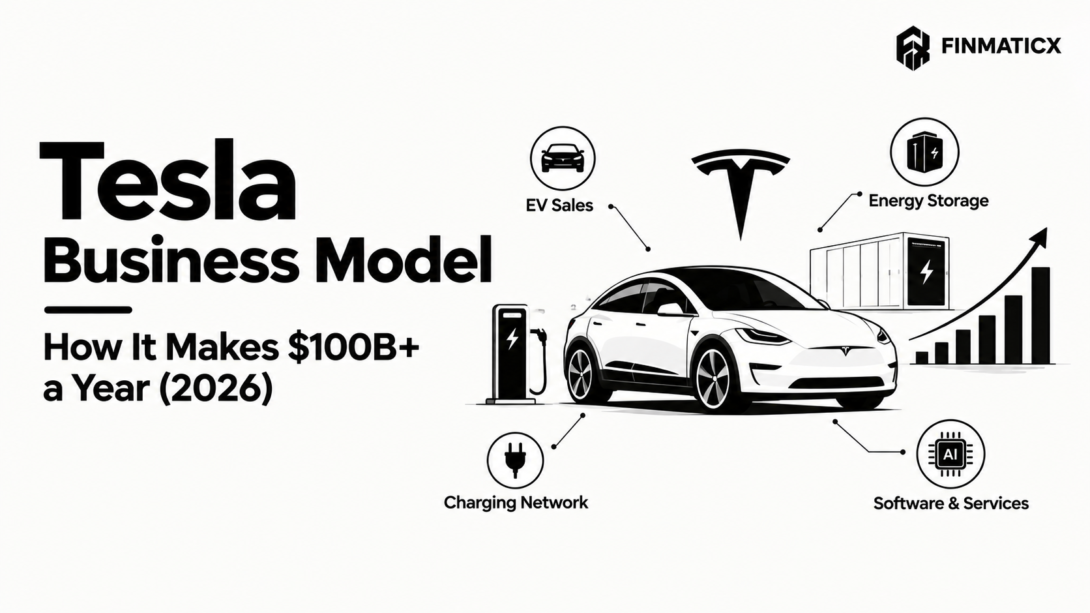
The Tesla business model produced a record $28.2 billion of revenue in the second quarter of 2026, and an operating margin of just 1.4%. Both numbers are true at the same time, and the gap between them is the whole story.
On one side, Tesla sold a record 480,126 vehicles in the quarter, grew its services revenue 50%, and passed $100 billion in trailing-twelve-month revenue for the first time. On the other side, operating income fell 57% because the company is spending at a pace that would make most automakers flinch: a planned $25 billion-plus of capital spending in 2026 on factories, AI computing, robotaxis, and a humanoid robot.
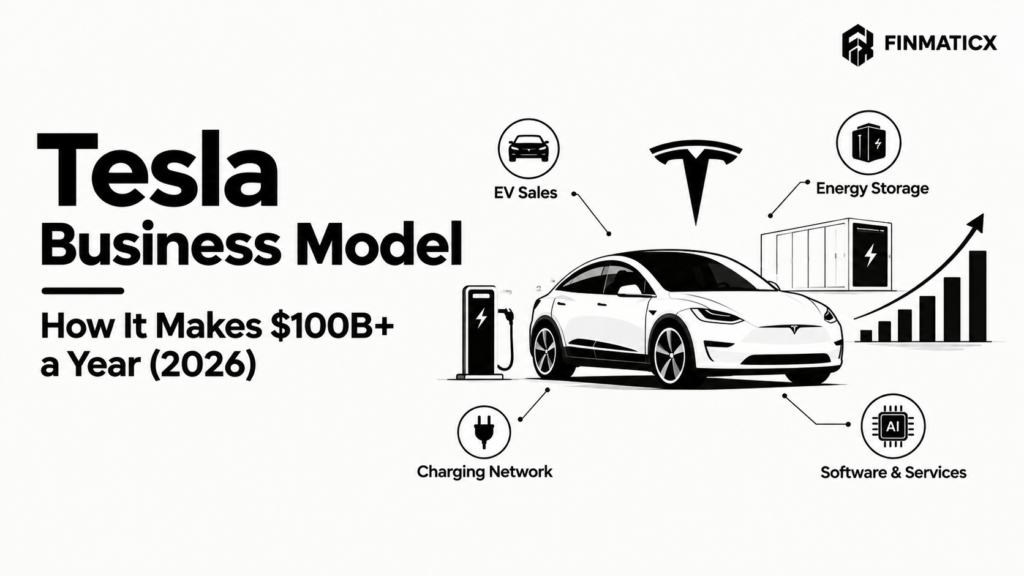
So what is Tesla, exactly? A car company, an energy company, a software subscription business, or an AI bet that happens to sell cars? This guide breaks down the Tesla business model line by line, using Tesla’s own SEC filings, earnings decks, and delivery reports through October 2026. Every figure is sourced, and anything we calculated ourselves is labeled as such.
If you’re studying Tesla for a class, a pitch, or an investment thesis, the structure below is built to be reused: revenue streams, multi-year financials, a business model canvas, competition, risks, and discussion questions.
What Is the Tesla Business Model?
The Tesla business model is a vertically integrated, direct-to-consumer model that earns most of its revenue from selling electric vehicles, plus a growing share from energy storage, services, and software. Tesla designs and builds its own vehicles, batteries, and charging network, sells directly to customers, and reinvests heavily in manufacturing, AI, robotaxis, and robotics.
In plain English: Tesla makes money by selling cars today, while spending that money to build the machines, software, and fleets it hopes will earn more tomorrow.
Tesla at a Glance (Key Facts, October 2026)
| Metric | Figure | Source |
|---|---|---|
| FY2025 total revenue | $94.83 billion (down $2.86 billion; first annual decline on record) | Tesla FY2025 10-K, CNBC |
| FY2025 net income (GAAP) | $3.79 billion (down $3.30 billion) | Tesla FY2025 10-K |
| FY2025 vehicle deliveries | 1,636,129 (down 8.6%) | Tesla Q4 2025 delivery report (SEC) |
| FY2025 energy storage deployed | 46.7 GWh (up 49%) | Tesla Q4 2025 delivery report (SEC) |
| Q2 2026 revenue | $28.24 billion (up 26%), a record | Tesla Q2 2026 update (SEC) |
| Q3 2026 deliveries | 486,532; 13.7 GWh storage deployed | Tesla Investor Relations |
| Cash and investments (end of 2025) | $44.06 billion | Tesla FY2025 10-K |
| 2026 capital spending plan | More than $25 billion | CFO Dive |
| Headquarters; listing | Austin, Texas; Nasdaq: TSLA | Wikipedia: Tesla, Inc. |
| Next earnings date | Q3 2026 results on October 21, 2026 | Tesla Investor Relations |
Tesla History: From a San Carlos Garage to $100B in Revenue
Tesla’s business model only makes sense in light of how it got here, because several of its most unusual choices (selling direct, building its own chargers, owning the software) were born out of necessity, not strategy decks.
Martin Eberhard and Marc Tarpenning incorporated the company as Tesla Motors on July 1, 2003, in San Carlos, California. Elon Musk led the Series A round in February 2004, investing $6.5 million of the $7.5 million raised, and became chairman. A 2009 legal settlement lets five people (Eberhard, Tarpenning, Ian Wright, JB Straubel, and Musk) call themselves co-founders, according to Wikipedia’s history of Tesla.
Tesla Timeline
| Year | Milestone |
|---|---|
| July 1, 2003 | Tesla Motors incorporated by Martin Eberhard and Marc Tarpenning |
| February 2004 | Musk leads the $7.5M Series A (investing $6.5M) and becomes chairman |
| 2008 | Roadster production begins; Musk becomes CEO in October |
| June 29, 2010 | IPO on Nasdaq: 13.3 million shares at $17, raising $226 million; the first US automaker IPO since Ford in 1956 |
| June 22, 2012 | Model S deliveries begin |
| 2015 | Model X launches |
| 2017 | Model 3 launches |
| 2019 to 2022 | Gigafactories in Shanghai, Berlin-Brandenburg, and Texas come online |
| 2020 | Model Y launches |
| 2022 | Tesla Semi enters production |
| November 2023 | Cybertruck deliveries begin; Tesla delivers a record 1,808,581 vehicles in 2023 |
| June 2025 | Robotaxi service launches in Austin |
| September 30, 2025 | US federal EV tax credit of up to $7,500 ends |
| November 6, 2025 | Shareholders approve the 2025 CEO Performance Award |
| January 2026 | Tesla reports its first annual revenue decline on record ($94.8B for 2025) |
| February 14, 2026 | FSD (Supervised) becomes subscription-only in the US |
| Q2 2026 | Record Q2 deliveries (480,126), record revenue ($28.2B), Cybercab production begins |
| October 2, 2026 | Q3 2026 deliveries of 486,532 reported |
Sources: Wikipedia: Tesla, Inc., Wikipedia: History of Tesla, Inc., Tesla delivery reports (SEC), Tesla FY2025 10-K, Tesla 10-K/A on the 2025 CEO award, TRT World.
Notice the shape of that history. Tesla survived its early years through emergency financing, a US Department of Energy loan, and then the 2010 IPO. It built its own sales and charging channels because no dealer network existed for a new kind of car. That “build it ourselves” habit hardened into a strategy: vertical integration.
Leadership and Ownership
Unlike Red Bull, Tesla is a public company. Its shares trade on the Nasdaq under TSLA, and its filings are open to anyone. Elon Musk has been CEO since 2008, and Vaibhav Taneja serves as CFO, as heard on the company’s earnings calls.
The most important governance detail for understanding the Tesla business model today is the 2025 CEO Performance Award, approved by shareholders on November 6, 2025. It is built around 12 market-capitalization milestones, 12 operational milestones, and adjusted EBITDA milestones, in 12 tranches over a ten-year period, per the Tesla 10-K/A.
The operational milestones read like a map of where the business is going:
- 20 million Tesla vehicles delivered (cumulative, counting from the first delivery)
- 10 million active FSD subscriptions
- 1 million bots delivered (Optimus robots)
- 1 million robotaxis in commercial operation
The award also includes adjusted EBITDA milestones that top out at $400 billion. Compensation plans tell you what a board wants the company to become. This one says: more than cars.
Tesla Business Model Canvas
The business model canvas is the fastest way to see how all the pieces fit together. Here’s the Tesla business model on one page.
| Canvas Block | Tesla |
|---|---|
| Customer segments | Consumers and businesses buying EVs; commercial and utility customers buying storage; homeowners buying Powerwall and solar; drivers paying for charging, software, and services |
| Value proposition | Software-defined electric vehicles with over-the-air updates, a proprietary fast-charging network, and (increasingly) driver-assistance and autonomy software; large-scale storage that helps grids manage power |
| Channels | Direct online ordering and company-owned stores (no franchised dealers), the Tesla app, Supercharger stations, and direct energy sales |
| Customer relationships | Ongoing software updates, subscriptions (FSD), app-based service and charging, and brand loyalty |
| Revenue streams | Vehicle sales, regulatory credits, leasing, energy generation and storage, services (used cars, parts, collision, insurance, Supercharging), and software such as FSD |
| Key resources | Gigafactories, battery and manufacturing know-how, the Supercharger network, driving data from the fleet, AI compute, and the Tesla brand |
| Key activities | Vehicle and battery manufacturing, software and AI development, energy product deployment, and network expansion |
| Key partners | Battery and materials suppliers, utilities and developers (for storage), and charging-network partners |
| Cost structure | Materials and manufacturing, tariffs and duties, research and development (including AI), a rapidly growing capital budget, and operating expenses, which rose 47% year over year in Q2 2026 |
The canvas highlights something unusual: Tesla’s “key resources” are mostly things it built itself, not things it rents or franchises.
How the Tesla Business Model Makes Money
Let’s answer the headline question directly: how does Tesla make money? Mostly by selling vehicles, but with an increasingly important set of other streams.
Tesla’s financial statements split revenue into a few lines: automotive sales, automotive regulatory credits, automotive leasing, energy generation and storage, and services and other. Here is the full-year 2025 picture, built from Tesla’s four quarterly reports:
| FY2025 Revenue Line | Amount | Share of Total |
|---|---|---|
| Total automotive (sales, credits, leasing) | $69.53 billion | 73.3% |
| Energy generation and storage | $12.77 billion | 13.5% |
| Services and other | $12.53 billion | 13.2% |
| Total revenue | $94.83 billion | 100% |
Sources: quarterly figures from Tesla’s Q4 2025 update, Q3 2025 10-Q, and Q2 2026 update. Annual totals and shares are our sums of the four reported quarters; total matches the $94.83 billion in the 10-K.
The most important trend sits underneath those percentages. In 2021, energy plus services made up about 12% of revenue. In 2025, they made up about 27%. The Tesla business model is slowly becoming less of a pure car business, even though cars still generate nearly three-quarters of sales.
Tesla Revenue Streams in Detail
1. Automotive Sales
This is the core. Tesla sells the Model 3, Model Y, and, in smaller numbers, the Cybertruck, Semi, and other models. Two vehicles dominate: in Q3 2026, the Model 3 and Model Y accounted for 478,237 of 486,532 deliveries, or about 98% (our calculation from Tesla’s delivery report).
That concentration is both an efficiency (two platforms, high volumes) and a risk (a problem with either model hits the whole business).
Automotive sales revenue rose 27% in Q2 2026 on roughly 25% more cash deliveries, according to the Q2 2026 10-Q. Tesla also noted a lower average selling price per vehicle, including mix effects.
2. Automotive Regulatory Credits
Regulatory credits are a revenue line most car companies don’t have. Governments set emissions and zero-emission-vehicle rules. Automakers that fall short can buy credits from companies that exceed the requirements, and Tesla, which sells only EVs, has generated a lot of them.
Tesla doesn’t disclose the margin on credits, but they involve little direct cost, which is why analysts treat them as very high margin. That makes their decline a real issue:
| Period | Regulatory credit revenue | Change |
|---|---|---|
| Q2 2025 | $439 million | n/a |
| Q2 2026 | $146 million | down 67% |
| First half 2025 | $1,034 million | n/a |
| First half 2026 | $526 million | down 49% |
| FY2025 (our sum of four quarters) | About $1.99 billion | n/a |
Sources: Tesla Q2 2026 10-Q, Q3 2025 10-Q, Q1 2025 10-Q, and Yahoo Finance for Q4 2025’s $542 million.
To see why this matters, compare two of our derived numbers: Tesla’s 2025 credit revenue (about $2.0 billion) is roughly 45% of its 2025 GAAP operating income (about $4.4 billion). Credits are about 2% of revenue but a far bigger slice of operating profit, so a falling credit line pressures profit much more than the revenue figure suggests.
3. Automotive Leasing
Tesla leases some vehicles directly. Leasing revenue was $364 million in Q2 2026, down 16% from a year earlier, according to the 10-Q. Only about 1% to 2% of recent deliveries were subject to operating lease accounting, so leasing is a small part of the model.
4. Energy Generation and Storage
Tesla’s energy business sells Megapack (utility-scale batteries), Powerwall (home batteries), and solar products. It has become the fastest-growing major line:
- FY2025 energy revenue: about $12.8 billion, up 27%, with record gross profit, per the Q4 2025 call summary.
- FY2025 deployments: 46.7 GWh, up 49%.
- Q2 2026: $3.14 billion in revenue (up 13%) and 13.5 GWh deployed; revenue growth came mainly from Megapack deployments, partly offset by a lower average Megapack selling price.
- Q3 2026: 13.7 GWh deployed, up from 12.5 GWh a year earlier but short of the 15.9 GWh analysts expected (Not a Tesla App).
Profitability is where the story gets interesting. Energy gross margin hit a record 39.5% in Q1 2026, then fell to 20.4% in Q2 2026, and management said industrial storage pricing is falling as competition increases (Investing.com transcript). Tesla’s 10-K also notes that the current tariff regime has a relatively larger effect on energy than on automotive.
Tesla is building more capacity: Megafactory Texas is nearing completion, with production planned to start in 2026, per Tesla’s Q2 2026 update.
5. Services and Other
This is the quiet star of the Tesla business model. Services and other covers used-vehicle sales, non-warranty maintenance, collision repair, parts, paid Supercharging, and the insurance business.
Growth has been rapid:
- FY2025: $12.53 billion, up 19%.
- Q1 2026: $3.75 billion, up 42%.
- Q2 2026: $4.58 billion, up 50% and an all-time record, with both gross profit and gross margin at record highs (Yahoo Finance).
Tesla attributes the growth to used-vehicle volume, repair and collision work, paid Supercharging sessions, and the insurance business. The logic is the classic installed-base play: every car sold becomes a recurring customer for charging, repairs, insurance, and software. With millions of Teslas on the road, that base is large.
6. Software: FSD and Connectivity
Tesla sells driver-assistance software called FSD (Supervised). It used to offer a one-time purchase of about $8,000 or a $99 monthly plan. On January 14, 2026, Musk announced that Tesla would end the one-time option after February 14, 2026, making FSD subscription-only (Yahoo Finance).
Why does that change the economics? Our math, using the reported prices: $99 a month is $1,188 a year, so an $8,000 purchase equals about 6.7 years of subscription fees. Selling a subscription spreads revenue over time instead of booking it upfront, which can reduce near-term margin but creates a recurring stream. Tesla’s CFO said on the Q4 2025 call that the shift would have a short-term negative effect on automotive margin, and that about 1.1 million customers were paying for FSD at that point (Yahoo Finance call highlights).
By Q2 2026, Tesla said FSD (Supervised) penetration continued to grow, with more customers choosing a subscription at the time of purchase, and listed higher ancillary sales driven by FSD subscriptions among the drivers of revenue growth (Tesla Q2 2026 update).
Tesla also carries deferred revenue tied to FSD access, internet connectivity, free Supercharging programs, and over-the-air updates: $3.60 billion as of both December 31, 2024 and March 31, 2025, per the Q1 2025 10-Q. It’s a reminder that Tesla’s customers are paying for software and services they receive after the sale.
Tesla Business Model Financials: 2021 to 2026
Annual Revenue by Segment (in $ millions)
| Revenue Line | 2021 | 2022 | 2023 | 2024 | 2025 |
|---|---|---|---|---|---|
| Total automotive | 47,232 | 71,462 | 82,419 | 77,070 | 69,526 |
| Energy generation and storage | 2,789 | 3,909 | 6,035 | 10,086 | 12,771 |
| Services and other | 3,802 | 6,091 | 8,319 | 10,534 | 12,530 |
| Total revenue | 53,823 | 81,462 | 96,773 | 97,690 | 94,827 |
| Energy + services share | 12.2% | 12.3% | 14.9% | 21.1% | 26.7% |
Source: Tesla’s Q4 2025 update for 2021 to 2024 and quarterly reports for 2025. Totals, 2025 sums, and shares are our calculations, and they match Tesla’s reported totals.
Three things jump out:
- Automotive revenue peaked in 2023 at $82.4 billion and fell 15.6% by 2025 (our calculation).
- Energy grew about 4.6 times from 2021 to 2025, and services about 3.3 times.
- Total revenue grew about 76% from 2021 to 2025, a compound rate of roughly 15% a year, but growth stalled after 2023.
Vehicle Deliveries and Energy Storage
| Period | Vehicle deliveries | Energy storage deployed |
|---|---|---|
| 2021 | 936,222 | n/a |
| 2022 | 1,313,851 | n/a |
| 2023 | 1,808,581 | n/a |
| 2024 | 1,789,226 | n/a |
| 2025 | 1,636,129 | 46.7 GWh |
| Q1 2026 | 358,023 | 8.8 GWh |
| Q2 2026 | 480,126 | 13.5 GWh |
| Q3 2026 | 486,532 | 13.7 GWh |
Sources: Tesla Q4 2025 update, Tesla delivery reports for Q4 2025 and Q3 2026.
Through the first three quarters of 2026, Tesla has delivered 1,324,681 vehicles, compared with 1,217,902 in the same period of 2025. That’s an increase of about 8.8% (our calculation), so deliveries are recovering after two years of decline, though they remain below 2023’s peak pace.
The Last Five Quarters
| ($ millions) | Q2 2025 | Q3 2025 | Q4 2025 | Q1 2026 | Q2 2026 |
|---|---|---|---|---|---|
| Automotive revenue | 16,661 | 21,205 | 17,693 | 16,234 | 20,516 |
| Energy revenue | 2,789 | 3,415 | 3,837 | 2,408 | 3,139 |
| Services and other | 3,046 | 3,475 | 3,371 | 3,745 | 4,581 |
| Total revenue | 22,496 | 28,095 | 24,901 | 22,387 | 28,236 |
| Gross profit | 3,878 | 5,054 | 5,009 | 4,720 | 4,751 |
| Gross margin | 17.2% | 18.0% | 20.1% | 21.1% | 16.8% |
| Operating expenses | 2,955 | 3,430 | 3,600 | 3,779 | 4,353 |
| Operating income | 923 | 1,624 | 1,409 | 941 | 398 |
| Operating margin | 4.1% | 5.8% | 5.7% | 4.2% | 1.4% |
| Net income (GAAP) | 1,172 | 1,373 | 840 | 477 | 1,114 |
Source: Tesla Q2 2026 update, Exhibit 99.1 (SEC).
What the Numbers Say About Profitability
- FY2025: GAAP gross margin was 18.0%, GAAP operating income was about $4.4 billion, and GAAP net income was $3.79 billion, down roughly 46% from 2024. That works out to a net margin of about 4.0% (our calculation).
- Q2 2026: Revenue jumped 26%, but operating expenses rose 47% and gross margin slipped to 16.8%, so operating income fell 57% to $398 million. Automotive gross margin excluding credits was 16.3%, down from 19.2% in Q1 (Investing.com).
- Net income vs. operating income: Q2 GAAP net income ($1.11 billion) was far higher than operating income ($398 million) because of non-operating items. Electrek points to a roughly $590 million gain in other income, and Yahoo Finance reports a $1.005 billion unrealized gain on Tesla’s SpaceX equity investment that Tesla excluded from non-GAAP figures. Either way, operating income is the cleaner read on the core business.
Cash Flow and Capital Spending
| Metric | FY2024 | FY2025 | 2026 |
|---|---|---|---|
| Operating cash flow | $14.92 billion | $14.75 billion | Q2: $4.7 billion |
| Capital expenditures | $11.34 billion | $8.53 billion | Plan: more than $25 billion |
| Free cash flow | n/a | About $6.2 billion | Q2: about negative $1.1 billion |
Sources: Tesla FY2025 10-K, Tesla Q2 2026 update, CFO Dive. FY2025 free cash flow is operating cash flow minus capex.
This table is the clearest picture of the Tesla business model in 2026. A company that made about $6 billion of free cash flow in 2025 plans to spend more than four times its 2025 capex in 2026. Capex guidance of more than $25 billion equals roughly a quarter of trailing-twelve-month revenue (about $103.6 billion, our sum of the last four reported quarters). Tesla ended 2025 with $44.06 billion of cash and investments to fund it, and executives have said they are also considering bank financing or other options for longer-term infrastructure projects.
Tesla Business Model: Manufacturing and Vertical Integration
Most automakers assemble parts made by suppliers. Tesla has spent two decades pulling as much of the value chain in-house as it can: vehicle design, software, battery packs, charging, and increasingly cells, materials, and AI compute.
Here is what the filings show:
- Factories on several continents. Tesla builds vehicles at its factories in California, Texas, Nevada (Semi), Shanghai, and Berlin-Brandenburg, and uses a manufacturing approach for Cybercab it describes as “unboxed” (Tesla Q1 2025 update).
- Battery and materials. Tesla’s Q1 2026 10-Q reports ramps across new battery and material factories, including cathode material and lithium refining in Texas (10-Q). On the Q4 2025 call, executives described six factories in the capex plan: a refinery, LFP battery factories, Cybercab, Semi, a new Megafactory, and an Optimus factory.
- Battery packs as a bottleneck. Tesla said battery pack capacity is the main limit on near-term vehicle production growth.
- Legacy models winding down. On the Q4 2025 call, Tesla said Model S and Model X production would end the following quarter, with the factory space repurposed for Optimus (Quartr summary).
Why Vertical Integration Matters
Owning more of the chain gives Tesla three advantages: control over cost and supply, faster iteration between hardware and software, and a story investors value (a company that can improve its own products continuously).
It also means Tesla carries more of the capital burden and more of the execution risk than a company that buys parts. That tradeoff is a core theme of the 2026 capex plan.
Tariffs show the exposure. Tesla’s CFO said tariff costs exceeded $500 million in Q4 2025 alone. In Q2 2026, lower inbound duties helped reduce cost per vehicle (Tesla Q2 2026 update).
Sales, Distribution, and the Supercharger Network
Direct Sales
Tesla sells directly to customers through its website, app, and company-owned stores, not through franchised dealers. That choice gives it control over pricing, the customer relationship, and the data that flows back from each car. It’s a very different approach from the wholesale-heavy model we covered in our Nike case study, where a direct-to-consumer push eventually forced a rebalancing toward retail partners. The difference (in our view) is that Tesla’s direct model is structural: there was no established EV dealer network to fall back on, and software updates and pricing changes work best when one company controls the customer relationship.
The Supercharger Network
Charging is both a customer benefit and a revenue line. As of Q2 2026, Tesla’s network had 8,704 stations (up 18% year over year) and 82,357 connectors (up 17%), after adding more than 2,400 net new stalls in the quarter, according to the EVwire recap of Tesla’s update. At the end of Q4 2025 the count was 77,682 connectors.
Paid Supercharging sessions are one of the drivers of the services and other growth Tesla cites in its filings, so every connector added supports both vehicle sales and recurring revenue.
Pricing as a Lever
Because Tesla controls its own sales channel, it can adjust prices, financing offers, and software bundles quickly. In Q1 2025, Tesla cited lower average selling prices driven by mix and higher customer incentives such as attractive financing options. In Q2 2026, average selling price per vehicle fell again, including mix effects.
Autonomy, Robotaxi, and Optimus: The Next Business Model
If you only look at the car-selling side, Tesla looks like a mature, low-margin manufacturer. The capex plan and the CEO award tell you it wants to be something else. Tesla’s own filings say it is “focused on bringing artificial intelligence into the real world” through FSD (Supervised), Robotaxi, and AI robots including Optimus.
Robotaxi
- June 2025: Robotaxi launches in Austin, per the FY2025 10-K.
- July 2026: Tesla launched Robotaxi in three cities in Florida, according to its Q2 2026 update. On the Q2 call, the CFO said the service had reached seven US markets (CFO Dive).
- Cybercab: a purpose-built robotaxi. Pilot production began in Q1 2026 and production began at Gigafactory Texas in Q2 2026.
The tone from management has also been notably careful. On the Q2 call, Musk said the company is prioritizing safety as it expands the service.
What a Robotaxi Business Would Change
If it works, a robotaxi changes who captures the revenue. Today Tesla earns a one-time margin on a car and then smaller recurring amounts. A fleet that Tesla operates earns revenue every time a customer takes a ride. It would turn a hardware sale into a service business, which is why investors assign it such a large part of Tesla’s valuation. We can’t verify those valuation claims, and no public filing yet shows robotaxi profit. Treat it as a bet, not a revenue line.
Optimus
Tesla is also working toward commercial production of its humanoid robot. On the Q1 2026 call, management said it was preparing Fremont for the start of Optimus production later in 2026 (Investing.com). The 2025 CEO award sets a milestone of 1 million bots delivered. For now, Optimus is an investment, not a revenue stream.
The Software Layer
Taken together, FSD subscriptions, Robotaxi, and Optimus all depend on the same thing: Tesla’s AI and data. The business model argument is that Tesla’s fleet gives it an unusual amount of real-world driving data, and that data improves the software that makes each product more valuable. The 10-K frames it the same way: a “service-driven business model.”
Interested in how AI is reshaping other business models? Our coverage of AI tools and our ChatGPT ads case study look at the same shift from the software side.
Competition: Tesla vs BYD and the EV Field
In 2025, Tesla lost a title it had held for years. BYD sold about 2.26 million battery electric vehicles (up roughly 28%), while Tesla delivered about 1.64 million, making 2025 the first full year in which BYD outsold Tesla in pure EVs (TRT World, InsideEVs). The year before, Tesla had narrowly led, with 1.79 million to BYD’s 1.76 million.
| Factor | Tesla | BYD |
|---|---|---|
| 2025 battery electric vehicle sales | About 1.64 million (down about 9%) | About 2.26 million (up about 28%) |
| Powertrains sold | Battery electric only | Battery electric and plug-in hybrids |
| Model concentration | Model 3 and Model Y are about 98% of deliveries (Q3 2026) | Broad lineup across price points |
| Home-market advantage | US, Europe, China | China, the world’s largest EV market |
Sources: TRT World, InsideEVs, Tesla Q3 2026 delivery report.
Other factors weighed on Tesla in 2025: the end of the US federal EV tax credit on September 30, 2025 pulled demand forward, and Europe was a headwind, with analysts at Wedbush flagging a “more difficult demand environment” after the credit ended. Tesla’s Q4 2025 deliveries fell 16% year over year to 418,227.
The recovery in 2026 is notable. Q2 deliveries (480,126) were up 25% year over year, and Q3 deliveries (486,532) beat analyst expectations of about 461,000 by a wide margin, though they were still down about 2% from Q3 2025’s record 497,099 (Yahoo Finance).
In energy storage, competition is intensifying too, and Tesla itself pointed to falling industrial storage prices as the reason for its margin drop in Q2 2026.
Strategic Analysis: Five Forces and SWOT
Porter’s Five Forces for Tesla
| Force | Assessment | Why |
|---|---|---|
| Competitive rivalry | High | BYD, legacy automakers, and many Chinese brands compete on price and range; storage rivals are cutting prices |
| Threat of new entrants | Moderate | Capital and manufacturing know-how are major barriers, but Chinese EV makers have scaled quickly |
| Bargaining power of buyers | Moderate to high | EV buyers compare prices and incentives, and the end of the US tax credit made price sensitivity visible |
| Bargaining power of suppliers | Moderate | Battery materials and cells are critical, which is why Tesla invests in refining, cathode, and LFP capacity |
| Threat of substitutes | Moderate | Hybrids, plug-in hybrids, and combustion cars remain real alternatives for many buyers |
(This table is our analysis, based on the data above.)
Tesla SWOT
| Strengths | Weaknesses |
|---|---|
| Vertically integrated manufacturing and in-house software | Revenue concentrated in two models (about 98% of deliveries) |
| $44.06B of cash and investments at end of 2025 | Operating margin fell to 1.4% in Q2 2026 |
| Fast-growing, record-setting services and energy lines | Regulatory credit income is shrinking quickly |
| Direct sales and a large Supercharger network | Free cash flow turned negative in Q2 2026 on heavy capex |
| Opportunities | Threats |
|---|---|
| Robotaxi, Cybercab, and FSD subscriptions as recurring revenue | BYD and other Chinese makers selling more EVs at lower prices |
| Energy storage demand and new Megafactory capacity | Falling storage prices and tariff exposure in energy |
| Used-vehicle, repair, insurance, and charging revenue from a growing installed base | Policy changes: tax credits, emissions rules, and tariffs |
| Optimus as a potential new product category | Safety and regulatory scrutiny of autonomous driving |
Risks Facing the Tesla Business Model
A balanced case study includes the risks. These are the ones that matter most.
1. Margin Compression
Q2 2026’s 1.4% operating margin is the warning light. Revenue rose 26% but operating expenses rose 47%, driven by AI and R&D spending. If investment keeps outrunning revenue, profit will stay thin until the new businesses scale.
2. Falling Regulatory Credits
Credits dropped 67% year over year in Q2 2026 and 49% in the first half. Because they carry little cost, losing them hits profit more than revenue. Tesla’s own filings warn that changes in regulations on credits may significantly affect its remaining performance obligations.
3. Capital Intensity and Cash Flow
Planned capex above $25 billion is a bet that returns will arrive. Free cash flow was already about negative $1.1 billion in Q2 2026. Tesla’s $44 billion cash cushion gives it room, but not unlimited room.
4. Execution Risk on Autonomy
Robotaxi expansion, Cybercab production, and Optimus all need to work technically, legally, and safely. Safety incidents or regulatory limits could slow the rollout, and the business case depends on volumes that no public filing yet shows.
5. Competition and Price Pressure
BYD already outsold Tesla in battery electric vehicles in 2025. In storage, Tesla’s own margin swing (39.5% to 20.4% in one quarter) shows how quickly pricing can move.
6. Policy and Tariffs
The end of the US EV tax credit hurt late-2025 demand, and tariff costs exceeded $500 million in Q4 2025. Trade and tax policy remain outside Tesla’s control.
7. Key-Person Dependence
The 2025 CEO award explicitly ties a ten-year incentive plan to Musk remaining in continuous service. That signals how central he is to the strategy, which cuts both ways for investors.
Lessons From the Tesla Business Model
Whether you’re building a startup or writing an exam answer, here are the ideas worth taking away.
1. When the channel doesn’t exist, build it. Tesla built its own stores and charging network because the existing ones didn’t fit a new product. It turned a necessity into a competitive moat.
2. Software changes the economics of hardware. Over-the-air updates and FSD subscriptions turn a one-time sale into an ongoing relationship. The shift to subscription-only FSD is a direct example.
3. The installed base is an asset. Services and other revenue (used cars, repairs, charging, insurance) grew 50% in Q2 2026 because millions of cars are already on the road.
4. Diversify before you need to. Energy and services grew from about 12% of revenue in 2021 to about 27% in 2025. When automotive revenue slipped, those lines cushioned the drop.
5. Don’t confuse profit with revenue quality. Regulatory credits and non-operating gains can flatter results. Operating income is the better guide.
6. Big bets need a funding plan. Tesla’s $44 billion cash pile is what makes a $25 billion-plus capex year possible. Bold strategies need a balance sheet to match.
If you’re naming a new brand of your own, try Finmaticx’s free AI business name generator. To see how another company built a direct-to-consumer engine at scale, read our Weightworld case study or our breakdown of how Shopify makes money.
Case Study Discussion Questions
Use these for a class, a team workshop, or your own analysis:
- Tesla’s automotive revenue fell about 16% from 2023 to 2025 while total revenue held up. How much of the Tesla business model’s resilience comes from energy and services, and is that diversification enough?
- Regulatory credits were roughly 45% of 2025 operating income (our estimate) and are falling fast. What should Tesla do to replace that profit?
- Is shifting FSD to subscription-only a smart long-term move or a short-term margin hit? What data would you need to decide?
- Tesla plans to spend more than $25 billion in 2026 while free cash flow is negative. At what point should a company slow capex to protect its balance sheet?
- The 2025 CEO award rewards 1 million robotaxis and 1 million bots. What are the strengths and risks of tying pay to product-volume milestones?
- BYD outsold Tesla in battery electric vehicles in 2025 with a broader lineup. Should Tesla broaden its range or double down on two models and autonomy?
To outline your answers fast, try Finmaticx GPT or the free AI prompt generator.
Tesla Business Model FAQ
What is the Tesla business model? The Tesla business model is a vertically integrated, direct-to-consumer model. Tesla designs and builds electric vehicles, batteries, and charging infrastructure, sells directly to customers, and earns additional revenue from energy storage, services, regulatory credits, and software such as FSD subscriptions.
How does Tesla make money? Tesla makes money mainly by selling vehicles, which made up about 73% of its $94.8 billion of 2025 revenue. The rest comes from energy storage (about 13.5%) and services and other (about 13%), plus regulatory credits, leasing, and FSD software.
How much revenue did Tesla make in 2025? Tesla reported $94.83 billion of revenue in 2025, down $2.86 billion from 2024, its first annual revenue decline on record. GAAP net income was $3.79 billion.
What was Tesla’s revenue in Q2 2026? Tesla reported record revenue of $28.24 billion in the second quarter of 2026, up 26% year over year. GAAP operating income was $398 million, a 1.4% operating margin, and GAAP net income was $1.11 billion.
How many cars does Tesla sell? Tesla delivered 1,636,129 vehicles in 2025. In 2026 it delivered 358,023 in Q1, 480,126 in Q2, and 486,532 in Q3, for about 1.32 million through the first nine months.
Is Tesla’s energy business profitable? Yes. Energy had record gross profit in 2025, and gross margin hit 39.5% in Q1 2026 before falling to 20.4% in Q2 2026 as storage pricing weakened. Tesla deployed 46.7 GWh of storage in 2025.
What are Tesla regulatory credits? Regulatory credits are earned by Tesla for exceeding emissions and zero-emission-vehicle requirements and are sold to automakers that fall short. They totaled about $2.0 billion in 2025 by our sum, but fell 49% in the first half of 2026 to $526 million.
How much does Tesla FSD cost? Since February 14, 2026, FSD (Supervised) has been subscription-only in the US at $99 per month. Customers who already own FSD keep it.
Does Tesla make money from robotaxis yet? Tesla launched Robotaxi in Austin in June 2025 and has since expanded to several US markets, but its public filings do not break out robotaxi profit. It remains an investment area, not a disclosed revenue line.
Who is Tesla’s biggest competitor? BYD is the biggest EV rival by volume: it sold about 2.26 million battery electric vehicles in 2025 versus Tesla’s roughly 1.64 million. In storage, Tesla also faces growing price competition.
Does Tesla sell through dealers? No. Tesla sells directly to customers online and through company-owned stores, which gives it control over pricing and the customer relationship.
How much is Tesla spending on capital projects in 2026? Management has guided to more than $25 billion of capital expenditures in 2026, funding new factories, AI infrastructure, robotaxi and Optimus fleets, and expanded battery capacity. In 2025, capex was $8.53 billion.
When does Tesla report Q3 2026 results? Tesla will report third-quarter 2026 financial results after market close on October 21, 2026, with a live webcast at 5:30 p.m. Eastern Time.
What risks does the Tesla business model face? The main risks are margin pressure from heavy spending, declining regulatory credits, competition from BYD and in storage, tariffs and policy changes, execution risk on robotaxi and Optimus, and dependence on Elon Musk.
More Business Model Breakdowns on Finmaticx
If this guide was useful, these related breakdowns on Finmaticx use the same data-first approach. You can also browse the full business case studies category.
- Nike Case Study: Business Model, Strategy and Revenue Breakdown: a hardware brand that rebalanced from direct sales back toward wholesale.
- Weightworld Case Study: UK to Pan-European D2C Empire: how a direct-to-consumer brand scaled across markets.
- ChatGPT Ads Case Study: How OpenAI Built a Billion-Dollar Ad Business in Months: AI as a revenue engine.
- How Does Shopify Make Money? 101 Revenue Breakdown: the platform behind direct-to-consumer commerce.
- How Does Klarna Make Money? Full Business Model Explained (2026): buy now, pay later economics.
- How Does Zelle Make Money? The Full Business Model Explained (2026): free payments and who pays for them.
- How Does NerdWallet Make Money? 5 Revenue Streams Explained (2026): referral-fee economics.
- How Does Webull Make Money? Webull Business Model: what “zero commission” really means for investors.
- How Does Meesho Make Money? 101 Revenue Breakdown, How Does Zerodha Make Money?, and How Does PhonePe Make Money?: three India-focused business models.
Want to know who writes this and why? Read What Is Finmaticx? Mission, Purpose and How It Helps Businesses, learn more about us, or explore Finmaticx AI’s free tools. If you’re planning campaigns around a topic like this, the Finmaticx Ads GPT can help with ad copy and angles. Have a company you’d like us to break down next? Contact us.
Sources and Methodology
Tesla is a public company, so most figures here come directly from its SEC filings and investor materials. Where we calculated a figure ourselves (annual segment totals for 2025, revenue shares, trailing-twelve-month revenue, credits as a share of operating income, year-to-date delivery growth, FSD payback math, capex as a share of revenue), the text says so. Data was last checked on October 11, 2026, and Tesla’s Q3 2026 financial results (due October 21, 2026) were not yet available.
Tesla filings and investor materials
- Tesla FY2025 Form 10-K (SEC)
- Tesla Q2 2026 update, Exhibit 99.1 (SEC) and Q2 2026 Form 10-Q
- Tesla Q1 2026 Form 10-Q, Q3 2025 Form 10-Q, Q1 2025 Form 10-Q, and Q1 2025 update
- Tesla Q4 2025 update (PDF)
- Delivery reports: Q4 2025 (SEC) and Q3 2026 (Tesla IR)
- Tesla 10-K/A on the 2025 CEO Performance Award (SEC) and Tesla proxy materials (SEC)
- Tesla Investor Relations
Financial and business press
- CNBC: Q4 and full-year 2025 results and CNBC: Q2 2026 results
- Electrek: Q2 2026 financial results, EVwire: Q2 2026 recap, and Yahoo Finance: Q2 2026 earnings
- Yahoo Finance: Q4 2025 earnings and Q4 call highlights, plus the Quartr Q4 2025 summary
- Earnings call transcripts: Q1 2026 and Q2 2026
- CFO Dive: Tesla’s 2026 capex
- Yahoo Finance: FSD moves to subscription-only
- Yahoo Finance: Q3 2026 deliveries and Not a Tesla App: Q3 2026 deliveries
- IG: Tesla Q4 2025 earnings preview
- TRT World and InsideEVs: BYD vs Tesla in 2025
- Reference: Wikipedia: Tesla, Inc. and Wikipedia: History of Tesla, Inc.