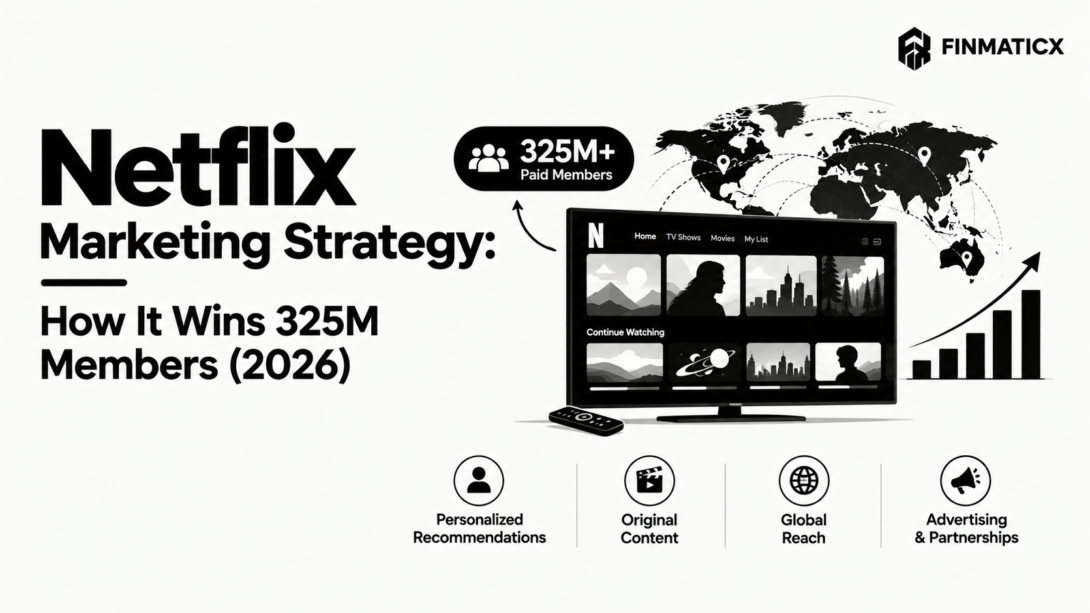
The Netflix marketing strategy is built on one simple idea: make the product do the marketing. Netflix spent $3.3 billion on sales and marketing in 2025, which sounds enormous until you notice it was only about 7% of its $45.2 billion in revenue. That is lower than Nike’s roughly 10% marketing intensity, which we covered in our Nike case study.
So how does a company that spends so little on promotion crack 325 million paid memberships? Because most of the marketing isn’t labeled marketing. The shows are the ads. The recommendation engine is the salesperson. Pricing is the funnel. And live events, theatrical sing-alongs, and fan venues amplify whatever is already working.
But the story has a new twist in 2026. Netflix’s revenue is still growing, yet engagement is nearly flat, YouTube is taking a bigger share of TV time, and the company is reportedly preparing layoffs ahead of its October 20 earnings report. This guide breaks down the Netflix marketing strategy piece by piece using Netflix’s own SEC filings and shareholder letters, then looks honestly at what is and isn’t working. Calculations we made ourselves are labeled as such.
Key Takeaways
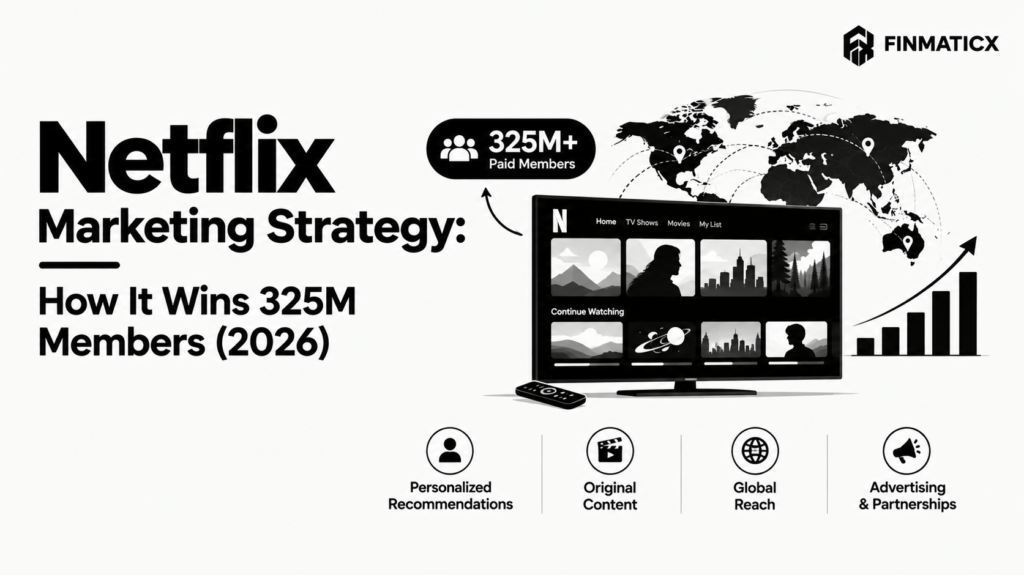
- Marketing spend is modest; content spend is the real marketing budget. Netflix’s 2025 sales and marketing expense was $3.30 billion (about 7% of revenue), against roughly $18 billion of cash content spending.
- Seven plays drive the strategy: content as marketing, personalization, pricing and packaging, advertising, live events, fandom and experiences, and distribution partnerships.
- The ad plan is now the front door. It made up more than 60% of Q1 2026 sign-ups in countries where it’s offered, and Netflix expects about $3 billion of ad revenue in 2026, double 2025.
- The pressure is real. Netflix’s July 2026 share of US TV viewing was 7.8% against YouTube’s 14.2%, and view hours grew only about 2%.
What Is the Netflix Marketing Strategy?
The Netflix marketing strategy is a content-led, data-driven, subscription-and-advertising model. Netflix uses tentpole originals, personalized recommendations, tiered pricing with a low-cost ad plan, live events, and fan experiences to acquire and retain members, rather than relying mainly on traditional advertising.
In plain English: Netflix turns the thing it sells into the thing that sells it, then uses data and pricing to keep people from leaving.
Netflix Marketing Strategy at a Glance (October 2026)
| Metric | Figure | Source |
|---|---|---|
| FY2025 revenue | $45.2 billion (+16%) | Netflix Q4 2025 letter (SEC) |
| FY2025 operating margin | 29.5% (+3 points) | Netflix Q4 2025 letter (SEC) |
| Paid memberships | Passed 325 million in Q4 2025 | Netflix Q4 2025 letter (SEC) |
| FY2025 sales and marketing expense | $3.30 billion (7% of revenue) | Netflix FY2025 10-K (SEC) |
| FY2025 ad revenue | More than $1.5 billion (up more than 2.5x) | Netflix Q4 2025 letter (SEC) |
| Q2 2026 revenue | $12.56 billion (+13%); operating margin 33.4% | Netflix Q2 2026 letter (SEC) |
| 2026 outlook | Revenue $51.0 to $51.4 billion; operating margin 31.5%; ads about $3 billion | Netflix Q2 2026 letter (SEC) |
| US prices (March 2026) | $8.99 with ads, $19.99 Standard, $26.99 Premium | CNBC |
| Next earnings date | Q3 2026 results on October 20, 2026, after market close | Variety |
Netflix Business Context: Where the Marketing Fits
Netflix is a subscription streaming company, and it increasingly sells advertising on top of subscriptions. Its mission, restated in its 2026 shareholder letters, is to entertain the world. Ted Sarandos and Greg Peters are co-CEOs, and Marian Lee is chief marketing officer.
Three recent events matter for understanding the Netflix marketing strategy today.
The membership milestone. Netflix crossed 325 million paid memberships in Q4 2025, up from about 302 million at the end of 2024, per its Q4 2024 letter. That’s growth of roughly 8% (our calculation). Netflix stopped reporting quarterly membership counts in 2025, so milestone announcements like this one are now the main data point.
The Warner Bros. detour. In December 2025, Netflix agreed to acquire Warner Bros. and HBO Max. On February 27, 2026, the deal ended when Warner Bros. Discovery accepted a higher bid from Paramount Skydance, and Paramount paid Netflix a $2.8 billion termination fee, which Netflix recorded in other income in Q1 2026, according to its Q2 2026 10-Q and Variety. Netflix told shareholders the acquisition would have been a nice accelerant but only at the right price, as Adweek reported.
The October 2026 pressure. Puck reported on October 9 that Netflix plans to cut about 5% of its workforce, roughly 800 jobs, ahead of the October 20 earnings report. Netflix has not confirmed the report, according to Variety. We cover the pressure points later in this article.
Netflix Marketing Mix (the 4Ps)
The classic marketing mix is a quick way to see the whole strategy on one page.
| Element | How Netflix Does It |
|---|---|
| Product | A streaming catalog of originals, licensed titles, films, kids content, games, video podcasts, and live events, wrapped in a personalized interface |
| Price | Tiered plans: $8.99 with ads, $19.99 Standard, and $26.99 Premium in the US (March 2026), plus paid options for members outside the household |
| Place | Available in more than 190 countries on connected TVs, phones, and other devices, and through partners such as device makers, TV providers, mobile operators, and internet providers |
| Promotion | Tentpole launches, owned media such as Tudum, personalized recommendations, live events, theatrical sing-alongs, Netflix House, and paid advertising |
Sources: CNBC, Netflix FY2025 10-K, Netflix Q4 2025 letter.
Notice how much of “Promotion” overlaps with “Product.” That’s the defining feature of the Netflix marketing strategy.
Netflix Marketing Strategy Play 1: Content as Marketing
Netflix’s biggest marketing lever is the content slate itself. Cash content spending was about $18 billion in 2025 and is expected to be about $20 billion in 2026, according to CNBC. For comparison, the entire sales and marketing line was $3.3 billion. The content budget is roughly five times the marketing budget (our calculation), and it does much of the same job.
Tentpoles Create Cultural Moments
Netflix’s strategy leans on a handful of shows and films that become conversations. In 2025 those included:
- Stranger Things 5: The first volume scored 59.6 million views in its first five days, the biggest premiere week for an English-language Netflix show, per TheWrap. Netflix released the rest in stages, ending with a New Year’s Eve finale.
- Wednesday season 2: The most-watched TV show of the second half of 2025, with about 123.9 million views.
- KPop Demon Hunters: The breakout of the year (more on this below).
Staging releases (a launch, a Christmas Day batch, a New Year’s Eve finale) keeps the title in the news for weeks. That’s marketing built into the release calendar. The effect shows up in public data too: Netflix said in its January 2025 letter that it accounted for six of the ten most-searched TV shows on Google globally in 2024 (Netflix Q4 2024 letter).
The KPop Demon Hunters Case
KPop Demon Hunters premiered on June 20, 2025. It debuted to 9.2 million views in its first tracked week, then grew to 24.2 million the next week, and became Netflix’s most-watched movie of all time by August, according to TheWrap. In Netflix’s engagement report for the second half of 2025, it was the most-watched title across film and TV, with about 481.6 million views (The Hollywood Reporter). Nielsen’s year-end data showed it was also the most-streamed movie of 2025 in the US, with 20.5 billion viewing minutes (Variety).
Here’s what makes it a marketing case, and not just a hit. The film grew through word of mouth after launch, and Netflix then amplified it. It released sing-along versions in theaters in late August 2025, which became its first film to top the US box office, per Euronews. The soundtrack also became the first to chart four simultaneous Billboard top-10 songs, per the same report.
In our view, the lesson is that Netflix’s best marketing was fast follow-up on organic demand, not a pre-launch blitz.
A Metric That Shows It Working
Netflix’s January 2026 letter notes that view hours rose 2% in the second half of 2025, driven by a 9% rise in viewing of branded originals (Netflix Q4 2025 letter). Branded originals are the titles Netflix owns and markets, so growth there is growth in the part of the catalog that is most directly “marketing.”
Netflix Marketing Strategy Play 2: Personalization
The second play is the one members rarely notice: the recommendation system.
In a widely cited paper, two Netflix executives wrote that the recommender system influences about 80% of hours streamed, and that the combined effect of personalization and recommendations saves Netflix more than $1 billion per year, mainly by reducing cancellations (ACM Transactions on Management Information Systems). The paper also notes that the main goal of changes to recommendation algorithms is improved member retention, and that Netflix tests changes through large A/B tests.
A caution: that paper was published in 2015. The 80% and $1 billion figures describe Netflix at a very different scale, so treat them as evidence of the principle, not as current numbers.
Why does this belong in a marketing article? Because personalization changes what “promotion” means. Instead of showing every member the same trailer, Netflix tailors the homepage to each member. A student write-up on Harvard Business School’s platform described the logic this way: better recommendations make the service more valuable, which keeps members from canceling.
Interested in how AI is changing personalization more broadly? Our AI tools hub covers practical tools, and our ChatGPT ads case study looks at an AI company building an ad business from scratch.
Netflix Marketing Strategy Play 3: Pricing and Packaging
Pricing is the part of the Netflix marketing strategy that moves money fastest. Netflix treats price tiers as both acquisition tools and monetization tools.
The US Price Ladder
| Plan | Before March 26, 2026 | After March 26, 2026 |
|---|---|---|
| Standard with ads | $7.99 | $8.99 |
| Standard (no ads) | $17.99 | $19.99 |
| Premium | $24.99 | $26.99 |
Sources: CNBC, TechCrunch.
The ad plan launched in November 2022 at $6.99, so it has risen about 29% since launch (our calculation). The ad plan now costs about 45% of the Standard price, which means a member switching to ads saves $11 a month, or $132 a year (our calculation).
That gap is deliberate. A cheap ad plan lowers the barrier to joining, and a high-priced ad-free plan captures members who value no ads. Netflix said in its Q1 2026 letter that the ad plan represented more than 60% of all Q1 sign-ups in countries where it’s offered (Netflix Q1 2026 letter). A year earlier, in Q4 2024, the share was over 55%, per its Q4 2024 letter, so the ad plan keeps gaining as the default way in.
Paid Sharing: Turning a Leak Into a Funnel
For years, Netflix tolerated account sharing. In May 2023, it launched paid sharing in more than 100 countries, representing over 80% of its revenue base, and reported 5.9 million net additions in Q2 2023 (Netflix Q2 2023 letter). Netflix described the pattern as an initial cancel reaction followed by new sign-ups and extra-member purchases, as CNBC reported.
The marketing insight is that Netflix reframed an existing behavior (borrowing a login) into two paid options: sign up on your own or add a paid extra member.
Netflix Says Pricing Is Part of a “Virtuous Cycle”
In its Q1 2026 letter, Netflix explained its logic: better monetization lets it invest more in content and product, which raises member value and engagement, which supports long-term revenue growth. That’s the argument behind recent price increases, and it’s also the risk if engagement stalls (see below).
Netflix Marketing Strategy Play 4: Advertising
This is where the Netflix marketing strategy flips. Netflix is no longer only a buyer of attention. It’s also a seller of attention.
The Ad Business in Numbers
- Revenue: More than $1.5 billion in 2025, up more than 2.5 times, with about $3 billion expected in 2026 (Netflix Q2 2026 letter).
- Advertisers: More than 4,000, up 70% year over year (Netflix Q1 2026 letter).
- Audience: Netflix said at its May 2026 upfront that the ad plan reaches more than 250 million monthly active viewers, up from 190 million in November 2025 and 94 million in May 2025, per TIKR and other trade coverage. Part of that jump reflects a change in how Netflix counts viewers (it now multiplies ad-plan members by estimated household size), so the figures are not a like-for-like trend.
By our rough math, $3 billion of 2026 ad revenue spread across 250 million monthly active viewers is about $12 a viewer per year, or about $1 a month. That’s illustrative only, since the definitions differ, but it shows the ad business is still small relative to subscription revenue: about 3.3% of 2025 revenue, rising to roughly 5.9% on the 2026 outlook midpoint (our calculations).
Why Advertising Is a Marketing Move
The ad plan does two things. It’s an acquisition tool (a cheaper way in), and it’s a new revenue line that helps pay for content. Netflix told investors it will launch new products through 2026 to help advertisers measure incrementality using Netflix’s own first-party data.
If you run campaigns yourself, Finmaticx’s Ads GPT is built to help you brainstorm ad angles and copy.
Netflix Marketing Strategy Play 5: Live Events
Live events are the newest play and the most debated.
What Netflix Has Done
- Jake Paul vs. Mike Tyson (November 2024): The fight peaked at 65 million concurrent streams, and Netflix estimated an average audience of 108 million live viewers globally (About Netflix).
- WWE Raw: Moved exclusively to Netflix in January 2025 under a deal reported at more than $5 billion over 10 years (Nasdaq / Motley Fool, Wikipedia: Sports on Netflix).
- NFL Christmas Day games: Netflix has aired them since 2024 and has at least one game in 2025 and 2026.
- 200+ live events in 2025, according to the same Nasdaq report.
- 2026 World Baseball Classic in Japan: Netflix held exclusive rights and reached 31.4 million viewers across 47 games, making it Netflix’s most-watched program ever in Japan (About Netflix, Media Play News).
Does It Pay Off as Marketing?
Ampere Analysis estimated that Netflix’s Christmas Day NFL games triggered about 430,000 new subscribers, and that 45% of people who signed up for the 2024 games were still subscribers a year later, according to the Nasdaq / Motley Fool report. Those are third-party estimates, not Netflix disclosures.
Here’s the honest counterpoint. Variety quoted Netflix management saying live programming takes about 5% of its content budget but generates about 1% of its viewing (Variety). So live events look more like acquisition and buzz tools than viewing engines. Netflix has been open about this logic. In its January 2025 letter, it said it isn’t chasing large regular-season sports packages. Live is about special, can’t-miss events that will likely be a small share of view hours and content expense but should deliver outsized value because each one is an event (Netflix Q4 2024 letter). That fits the idea of “event marketing,” and it explains why Netflix highlights membership and retention effects more than hours watched.
Netflix Marketing Strategy Play 6: Fandom and Experiences
The sixth play turns viewers into fans, and fans into advocates.
Netflix House
Netflix House opened its first location at King of Prussia, Pennsylvania, on November 12, 2025, and a second in Dallas on December 11, 2025. A third location is planned for Las Vegas in 2027. Each is more than 100,000 square feet, free to enter, and pay-as-you-go for experiences, according to Chain Store Age, Netflix Tudum, and TIME.
Chief marketing officer Marian Lee described the idea as fandom coming to life. TIME reports that the concept grew out of the 2020 Stranger Things drive-in experience and that Netflix has since run hundreds of in-person events, from Bridgerton balls to KPop Demon Hunters sing-alongs.
Local Fan Activation
In Japan, Netflix partnered with local governments and schools in the hometowns of 30 players to host public viewing events during the World Baseball Classic, per its announcement. The pattern is the same: use real-world events to make a streaming moment feel communal.
Owned Media
Netflix’s Tudum site publishes weekly Top 10 lists, show news, and event information. These are owned channels where Netflix can promote titles without paying a media partner. We don’t have a verified marketing-spend breakdown for these channels, so we can’t say how much they contribute.
Brand-building like this overlaps with what we cover in our Weightworld case study, where community and consistency also do a lot of the work.
Netflix Marketing Strategy Play 7: Distribution Partnerships
The seventh play is the least glamorous and probably the most important for reaching new households.
Netflix’s 10-K explains that its sales and marketing expense includes payments to marketing and advertising sales partners. Its marketing partners include consumer electronics manufacturers, multichannel video programming distributors (TV providers), mobile operators, and internet service providers. Its advertising sales partners include ad technology providers and ad agencies (Netflix FY2025 10-K).
In plain terms: when Netflix shows up on a TV remote, inside a cable box, or bundled with a phone plan, someone was likely paid or compensated for that placement. Those partner payments are part of the $3.3 billion.
How Much Does Netflix Spend on Marketing?
Netflix reports a single “sales and marketing” line.
| Year | Sales and Marketing Expense | Share of Revenue |
|---|---|---|
| 2023 | $2.66 billion | 8% |
| 2024 | $2.92 billion | 7% |
| 2025 | $3.30 billion | 7% |
Source: Netflix FY2025 10-K.
The 2025 increase of $384 million (13%) came mainly from a $222 million rise in marketing expenses and a $149 million rise in personnel costs tied to growing advertising sales headcount, per the 10-K. That’s an important detail. Not all of this line is consumer promotion, because it also pays for the ad-sales team.
Derived Metrics (Our Calculations)
| Metric | Calculation | Result |
|---|---|---|
| Marketing as a share of 2025 revenue | $3.30B ÷ $45.2B | About 7.3% |
| Marketing vs. content cash spend | $3.30B ÷ about $18B | About 18% |
| Content cash spend as a share of revenue | About $18B ÷ $45.2B | About 40% |
| Average revenue per paid membership | $45.2B ÷ about 313M average members | About $144 a year |
| Sales and marketing per paid membership | $3.30B ÷ about 313M | About $10.50 a year |
The average-members figure uses the midpoint of roughly 302 million (end of 2024) and more than 325 million (end of 2025), so treat these as approximate.
Marketing is growing faster than revenue right now. In Q2 2026, sales and marketing rose about 16% to roughly $824 million while revenue grew 13%, and technology and development rose 22%, according to analysis of the Q2 2026 10-Q. Netflix’s operating margin slipped to 33.4% from 34.1% a year earlier as a result.
The Netflix Marketing Funnel
Putting the seven plays together, here is how they map to the customer journey.
| Stage | Netflix Tactics | Evidence |
|---|---|---|
| Awareness | Tentpole releases, Top 10 lists, live events, theatrical sing-alongs, Netflix House | Stranger Things 5 premiere week; KPop Demon Hunters sing-along; Tyson-Paul peak of 65M streams |
| Consideration | Personalized homepage and recommendations | Recommendations influenced about 80% of hours streamed in 2015 |
| Conversion | Low-priced ad plan, device and carrier partnerships | Ad plan above 60% of Q1 2026 sign-ups in ad markets |
| Retention | Steady content cadence, personalization, live events | Ampere: 45% of 2024 Christmas NFL sign-ups still subscribed a year later |
| Expansion | Price tiers, extra members, advertising | 2026 price increase; ads expected at about $3B |
Netflix Financial Results, 2025 to 2026
| ($ millions) | Q2 2025 | Q3 2025 | Q4 2025 | Q2 2026 |
|---|---|---|---|---|
| Revenue | 11,079 | 11,510 | 12,051 | About 12,560 |
| Operating margin | 34.1% | 28.2% | 24.5% | 33.4% |
Sources: Netflix Q4 2025 letter for 2025 quarters; Netflix Q2 2026 letter and TradingView for Q2 2026. Q1 2026 is left out of the table because it included a one-time $2.8 billion termination fee in other income.
Key points from the latest results:
- Q2 2026: Revenue was $12.56 billion (+13%, +12% excluding currency effects), operating income was $4.19 billion, net income was $3.40 billion, and diluted EPS was $0.80, in line with Wall Street expectations (Variety).
- Outlook: Netflix narrowed 2026 revenue to $51.0 to $51.4 billion, kept its operating margin target at 31.5%, and said ad revenue should roughly double to about $3 billion.
- Q3 guidance: Netflix guided to 12% revenue growth and a 33.2% operating margin. Variety reported that this revenue guidance was below analyst expectations and pushed the stock lower.
Pressure Points: YouTube, Engagement, and Cost Cuts
An honest look at the Netflix marketing strategy has to include the places where it’s being tested.
1. YouTube’s Share of TV Time
Nielsen’s Gauge showed YouTube at 14.2% of US TV viewing in July 2026, against Netflix’s 7.8%, according to TheWrap. A year earlier, Nielsen put Netflix at 8.8% and YouTube at 13.4% for July 2025 (Nielsen).
That implies Netflix lost about a point of share while YouTube gained about 0.8 points (our comparison). A caveat: Nielsen has been recalibrating The Gauge, and it excludes mobile and computer viewing, so cross-year comparisons may not be perfectly like for like (MediaPost).
2. Flat Engagement
View hours grew about 2% in the second half of 2025 per Netflix’s own letter, and roughly 2% again in the first half of 2026 according to Motley Fool coverage. Revenue is growing mainly from membership, pricing, and ads, not from people watching a lot more. Netflix’s co-CEO Greg Peters has explained why the company moved away from raw view hours as its main internal signal, as TIKR reported.
3. Analyst Caution
Analysts at HSBC and Wells Fargo downgraded Netflix in September over “worrying” engagement trends and YouTube competition, per TheWrap.
4. Reported Layoffs
Puck reported that Netflix is preparing to cut about 5% of staff. As of the latest reporting, Netflix hasn’t confirmed it. Co-CEO Ted Sarandos said at a Bloomberg conference that Netflix isn’t growing as fast as he wants, per Deadline.
Investors will get clearer answers on October 20, when Netflix reports Q3 results. We’ll update this article once those numbers are out.
Netflix Marketing Strategy: Segmentation, Targeting, and Positioning
Marketing students will recognize the STP framework. Here is how it maps to Netflix. This table is our analysis, built on the facts above.
| STP Element | How Netflix Approaches It |
|---|---|
| Segmentation | By region, price sensitivity (ad plan vs. ad-free tiers), device, language, and taste, rather than classic age or income brackets |
| Targeting | Households that want a broad catalog at a low entry price (the ad plan), premium households that want no ads and higher quality, and fans of tentpole shows and live events |
| Positioning | A single subscription for an enormous range of stories, summed up in Netflix’s stated mission: to entertain the world |
Where Netflix’s Members Live
Netflix’s marketing has to work in four very different regions. At the end of 2024, Netflix had about 301.6 million paid memberships, spread roughly like this:
| Region | Paid Memberships (end of 2024) | Share of Total |
|---|---|---|
| Europe, Middle East and Africa (EMEA) | About 101.1 million | About 33.5% |
| US and Canada (UCAN) | About 89.6 million | About 29.7% |
| Asia-Pacific (APAC) | About 57.5 million | About 19.1% |
| Latin America (LATAM) | About 53.3 million | About 17.7% |
Source: regional figures from Netflix’s Q4 2024 letter; shares are our calculations.
That mix explains a lot. Less than a third of memberships are in the US and Canada, so global hits (including Korean-language and Korean-themed titles such as Squid Game and KPop Demon Hunters) matter as much as American franchises, and regional pricing and ad-plan rollouts follow different timelines. Netflix reportedly plans to bring the ad plan to 15 more countries starting in 2027, according to the Business Model Analyst, which we couldn’t confirm in a primary filing.
Porter’s Five Forces for Netflix (Our Analysis)
| Force | Assessment | Why |
|---|---|---|
| Competitive rivalry | High | YouTube, Disney, Amazon, and a combined Paramount and Warner Bros. all compete for viewing time and subscription budgets |
| Threat of new entrants | Low to moderate | Content libraries and global distribution are costly, but creators and platforms can capture attention without a library |
| Bargaining power of buyers | High | Members can cancel monthly, and switching costs are low |
| Bargaining power of suppliers | Moderate | Top talent, sports rights, and event rights are expensive, as the WWE and NFL deals show |
| Threat of substitutes | High | Free video platforms, games, social media, and live TV all compete for the same hours |
Netflix Marketing Strategy SWOT
| Strengths | Weaknesses |
|---|---|
| Content scale and tentpoles that drive cultural moments | View-hour growth of only about 2% |
| Personalization and A/B testing built into the product | Marketing and tech costs growing faster than revenue in Q2 2026 |
| 325M+ paid memberships and a fast-growing ad business | Revenue growth now leans on pricing and ads |
| Low marketing intensity (about 7% of revenue) | Smaller share of US TV time than YouTube |
| Opportunities | Threats |
|---|---|
| Ad revenue doubling to about $3B in 2026, plus new measurement products | YouTube’s rising share of TV viewing |
| Live events and sports for acquisition and retention | Costly rights deals with limited viewing share |
| Netflix House and fan experiences as brand-building | Competitors with sports, bundles, or bigger libraries |
| Expansion of the ad plan to more countries | Price-increase fatigue and churn |
Lessons From the Netflix Marketing Strategy
Whether you’re building a startup or studying for an exam, here is what transfers.
1. Make the product the promotion. Netflix spends roughly 18 cents on marketing for every dollar of content cash spend (our calculation). Build something people talk about, and your promotion budget works harder.
2. Follow demand, don’t just forecast it. KPop Demon Hunters grew first, and Netflix amplified it with theatrical sing-alongs and music. Watching what’s working and doubling down is cheaper than guessing.
3. Use pricing as a funnel. A low-cost ad plan brings members in; premium tiers capture those who want more. Pricing architecture is a marketing tool.
4. Turn leaks into channels. Paid sharing converted free borrowing into two paid options.
5. Pair mass reach with real-world moments. Live events and Netflix House give fans something to do, not just something to watch.
6. Diversify your revenue before you need to. Netflix’s ad business gives it a second revenue stream as subscription growth slows.
7. Watch the metric that matters. Netflix has shifted attention from view hours to revenue and operating margin. Pick metrics that tie to your business outcomes.
If you’re naming a new brand of your own, try Finmaticx’s free AI business name generator. For payments and checkout economics behind subscription businesses, see our breakdowns of Klarna and Shopify.
Case Study Discussion Questions
Use these for a class, a team workshop, or your own analysis:
- Netflix’s marketing expense is about 7% of revenue while content is about 40%. Is the content budget really a marketing budget? How would you separate the two?
- KPop Demon Hunters grew through word of mouth before Netflix amplified it. What signals should a company watch to decide when to amplify an organic hit?
- More than 60% of new sign-ups in ad markets choose the ad plan. Does a cheap ad plan strengthen or weaken Netflix’s long-term pricing power?
- Live events take about 5% of the content budget and about 1% of viewing (per management, as quoted by Variety). What would justify that ratio?
- YouTube holds roughly twice Netflix’s share of US TV viewing time. Should Netflix compete on hours, or does it not need to?
- Netflix is reported to be cutting about 5% of staff while raising content spend to about $20 billion. What does that say about how it balances cost discipline and growth?
To structure your answers, try Finmaticx GPT or the free AI prompt generator.
Netflix Marketing Strategy FAQ
What is the Netflix marketing strategy? The Netflix marketing strategy is a content-led, data-driven approach that uses tentpole originals, personalized recommendations, tiered pricing with a low-cost ad plan, live events, and fan experiences to acquire and retain members, rather than relying mainly on traditional advertising.
How much does Netflix spend on marketing? Netflix reported $3.30 billion of sales and marketing expense in 2025, about 7% of its $45.2 billion revenue. That line includes partner payments and advertising sales staff, not only consumer promotion.
What is the Netflix marketing mix? The Netflix marketing mix is: Product (a personalized catalog of originals, licensed titles, live events, and games), Price (tiers from $8.99 with ads to $26.99 Premium in the US), Place (190+ countries on many devices and through partners), and Promotion (tentpole launches, owned media, events, and advertising).
How does Netflix use data in marketing? Netflix uses recommendation algorithms and A/B testing to personalize what each member sees. A 2015 paper by two Netflix executives said recommendations influenced about 80% of hours streamed and saved more than $1 billion per year by improving retention.
How much do Netflix plans cost? In the US since March 26, 2026: $8.99 per month with ads, $19.99 for Standard, and $26.99 for Premium, before taxes.
How many members does Netflix have? Netflix passed 325 million paid memberships in Q4 2025. It no longer reports quarterly membership counts.
Does Netflix have advertising? Yes. The ad plan launched in November 2022. Netflix earned more than $1.5 billion in ad revenue in 2025 and expects about $3 billion in 2026.
How many people use Netflix’s ad plan? Netflix said at its May 2026 upfront that the plan reaches more than 250 million monthly active viewers, up from 190 million in November 2025. Part of the increase reflects a change in how viewers are counted.
What is Netflix House? Netflix House is a permanent, free-to-enter fan venue with shows-themed experiences, dining, and shopping. It opened in King of Prussia, Pennsylvania (November 12, 2025) and Dallas (December 11, 2025), with Las Vegas planned for 2027.
Who is Netflix’s chief marketing officer? Marian Lee is Netflix’s chief marketing officer.
What was the biggest Netflix marketing success of 2025? KPop Demon Hunters. It was the most-watched title across film and TV in the second half of 2025, with about 481.6 million views, and its theatrical sing-along became Netflix’s first film to top the US box office.
Who are Netflix’s biggest competitors? For viewing time, YouTube is the biggest: in July 2026, Nielsen put it at 14.2% of US TV viewing against Netflix’s 7.8%. Other competitors include Disney, Amazon Prime Video, and the combined Paramount and Warner Bros. Discovery, if that deal closes.
What happened with Netflix and Warner Bros.? Netflix agreed to buy Warner Bros. and HBO Max in December 2025, but the deal ended on February 27, 2026, when Warner Bros. Discovery accepted Paramount Skydance’s higher offer. Paramount paid Netflix a $2.8 billion termination fee.
When does Netflix report Q3 2026 earnings? Netflix reports third-quarter 2026 results on Tuesday, October 20, 2026, after market close.
More Business Model Breakdowns on Finmaticx
If this guide was useful, these related breakdowns on Finmaticx use the same data-first approach. You can also browse the full business case studies category.
- Nike Case Study: Business Model, Strategy and Revenue Breakdown: another brand built on storytelling and direct relationships.
- Weightworld Case Study: UK to Pan-European D2C Empire: community and consistency in direct-to-consumer.
- ChatGPT Ads Case Study: How OpenAI Built a Billion-Dollar Ad Business in Months: attention as a business model.
- How Does Shopify Make Money? 101 Revenue Breakdown: the platform behind direct-to-consumer commerce.
- How Does Klarna Make Money? Full Business Model Explained (2026): buy now, pay later economics.
- How Does Zelle Make Money? The Full Business Model Explained (2026): free payments and who pays for them.
- How Does NerdWallet Make Money? 5 Revenue Streams Explained (2026): referral-fee economics.
- How Does Webull Make Money? Webull Business Model: what “zero commission” really means.
- How Does Meesho Make Money?, How Does Zerodha Make Money?, and How Does PhonePe Make Money?: three India-focused business models.
Want to know who writes this and why? Read What Is Finmaticx? Mission, Purpose and How It Helps Businesses, learn more about us, or explore Finmaticx AI’s free tools. Have a company you’d like us to break down next? Contact us.
Sources and Methodology
Netflix is a public company, so most figures here come directly from its SEC filings and shareholder letters. Where we calculated a figure ourselves (marketing as a share of revenue and content spend, revenue and marketing per membership, ad price growth, ad revenue per viewer, share-point changes), the text says so. Third-party estimates (such as Ampere’s subscriber figures and Nielsen’s viewing share) are labeled as such. Data was last checked on October 14, 2026. Netflix’s Q3 2026 results (due October 20, 2026) and any confirmation of reported layoffs were not available at that time.
Netflix filings and company sources
- Netflix FY2025 Form 10-K (SEC)
- Shareholder letters: Q4 2025, Q1 2026, Q2 2026, Q4 2024, and Q2 2023
- Netflix Q2 2026 Form 10-Q (SEC)
- About Netflix: Tyson-Paul viewership and World Baseball Classic in Japan
- Netflix Tudum: Netflix House and Top 10, week of August 18, 2025
Research, data, and press
- Gomez-Uribe and Hunt, The Netflix Recommender System (ACM) and Harvard Business School platform write-up
- Pricing: CNBC and TechCrunch
- Paid sharing: CNBC and CNN
- Advertising: Adweek and TIKR
- Q2 2026 results: Variety, TradingView, and EarningsLens
- Warner Bros. deal: Variety
- KPop Demon Hunters and Stranger Things: TheWrap, The Hollywood Reporter, Variety, Euronews, and Wikipedia
- Live events: Nasdaq / Motley Fool, Wikipedia: Sports on Netflix, and Media Play News
- Netflix House: Chain Store Age and TIME
- Viewing share and pressure points: Nielsen (July 2025), MediaPost, TheWrap, Variety, Deadline, and Motley Fool