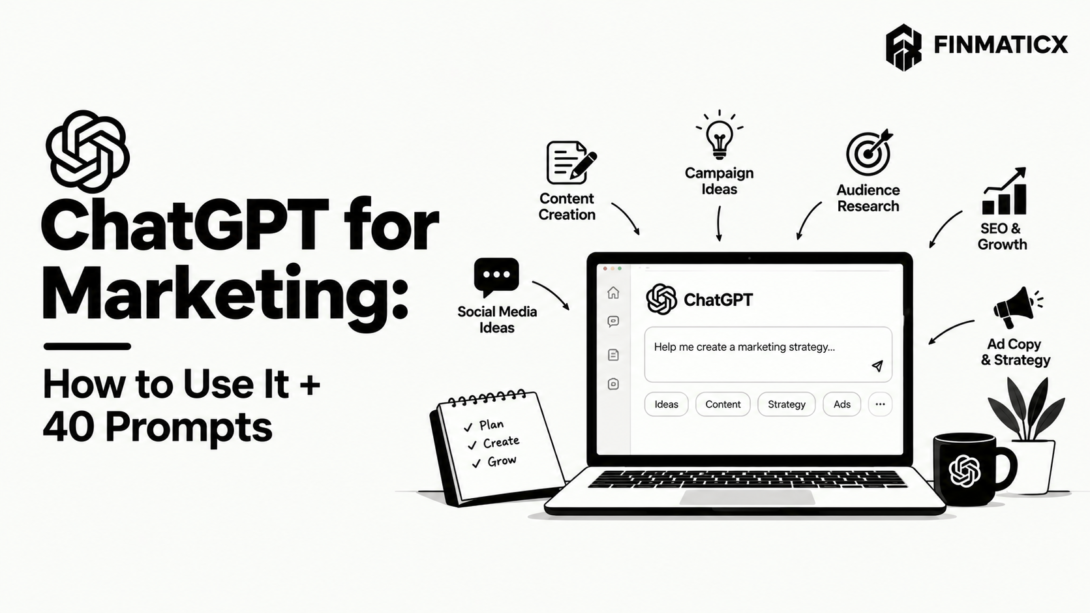
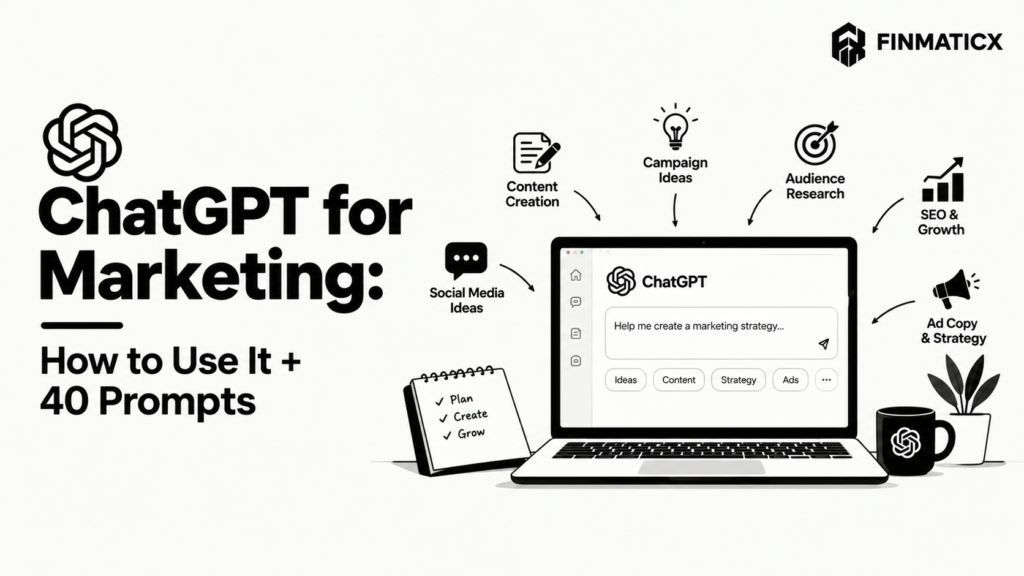
ChatGPT for marketing is no longer an experiment. In September, OpenAI CEO Sam Altman put a slide behind him at the company’s developer conference showing that ChatGPT now reaches 1.2 billion people every week, as Engadget’s live blog reported. Your customers are asking it questions about your category right now, and the marketers competing with you are using it to plan, write, and test.
How common is it? In HubSpot’s 2026 State of Marketing survey of more than 1,500 marketers, 86.4% said their teams use AI, and only 1.7% don’t use it and don’t plan to, according to HubSpot. The top ways teams use AI extensively are content creation (42.5%), media creation (37.2%), and administrative task automation (35.6%).
So the real question isn’t whether to use it. It’s how to use ChatGPT for marketing in a way that saves time without making your brand sound like everyone else. This guide gives you a practical answer: a 7-step workflow, a setup that keeps your brand voice consistent, 40 copy-and-paste prompts, and an honest look at SEO, ads, and risks. Where we calculated or interpreted something ourselves, we say so.
Key Takeaways
- Use ChatGPT as a fast first-draft and thinking partner, not a final publisher. The best results come from giving it your facts, voice samples, and constraints, then editing like a human.
- Set it up once. Custom instructions, Projects, and custom GPTs keep your brand voice and product facts in every chat, as OpenAI’s own training materials recommend.
- Treat AI search as a new channel. AI assistants still send a small share of website referrals, but ChatGPT accounts for most of it and it’s growing.
- Mind the rules. Google doesn’t ban AI content but does punish mass-produced, low-value pages, and the FTC bans fake reviews, including AI-generated ones.
- Ads inside ChatGPT are real. A self-serve Ads Manager opened to US advertisers on May 5, 2026.
What Is ChatGPT for Marketing?
ChatGPT for marketing means using OpenAI’s AI assistant to speed up and improve marketing work. Common uses include researching audiences and competitors, outlining and drafting content, writing email and ad variations, analyzing campaign data, and building repeatable workflows with custom GPTs and Projects, all reviewed by a human before anything goes live.
In plain English: ChatGPT does the heavy first pass, and you provide the judgment, the facts, and the final edit.
ChatGPT for Marketing at a Glance (October 2026)
| Metric | Figure | Source |
|---|---|---|
| ChatGPT weekly users | 1.2 billion (announced September 29, 2026) | Engadget |
| Marketers using AI | 86.4% (HubSpot survey of 1,500+ marketers) | HubSpot |
| AI chatbots’ share of website referrals | About 0.35% in July 2026, vs. about 30% for traditional search (Ahrefs data across 107,300 sites) | Tom Riley summary of Ahrefs data |
| ChatGPT’s share of AI referrals | Roughly 75% to 79%, depending on the study | SE Ranking |
| Paid plans (US) | Go $8, Plus $20, Pro $100/$200/$500, Business $25 per user ($20 billed annually) | OpenAI pricing page, Lindy |
| Ads in ChatGPT | Pilot began February 9, 2026; self-serve Ads Manager open to US advertisers since May 5, 2026 | DashThis |
Where ChatGPT Helps Marketers (and Where It Doesn’t)
Before you build workflows, know what ChatGPT is good at. OpenAI’s own marketing resource page groups the use cases into campaign planning, competitor research, creative development, data-driven insights, and visual brand communication, per OpenAI Academy. Here’s how that plays out in practice (the right-hand column is our view).
| Strong Fit | Needs a Human in the Lead |
|---|---|
| Brainstorming angles, hooks, and subject lines | Choosing the strategy and the brand’s point of view |
| First drafts and outlines from your notes | Original reporting, expert quotes, and proprietary data |
| Repurposing one asset into many formats | Final fact-checking and legal review |
| Summarizing reviews, tickets, and survey comments | Interpreting what the results mean for your business |
| Writing spreadsheet formulas and cleaning data | Brand-risk decisions (crises, sensitive topics) |
| Drafting variations for A/B tests | Deciding which test to run and what counts as a win |
The pattern is simple. ChatGPT is fast at producing options. People are better at picking the right one.
Which ChatGPT Plan Is Best for Marketing?
OpenAI’s plan lineup has changed a lot in 2026, and details shift often, so check OpenAI’s pricing page before you buy. As of early October 2026, trackers that checked the pages report this lineup:
| Plan | US Price | Marketer Notes |
|---|---|---|
| Free | $0 | Good for trying prompts; limited usage; ads shown in some markets |
| Go | $8 per month | Launched globally January 16, 2026; still ad-supported; lighter on advanced tools |
| Plus | $20 per month | The default paid plan for individuals; ad-free; includes Deep Research and Agent mode |
| Pro | $100, $200, or $500 per month | Heavy users; higher usage limits |
| Business | $25 per user monthly ($20 billed annually), two-seat minimum | Team workspace with admin and data controls; renamed from Team |
| Enterprise | Custom | Larger organizations with extra controls |
Sources: Lindy, NoCode.mba, Layer3 Labs, GeoToolbox. Plans, limits, and features change frequently.
Our take for most marketers: a solo marketer or freelancer usually does well with Plus, while a team handling customer data or brand-sensitive work should look at Business so there’s a shared workspace and admin controls. Free and Go users see ads, while Plus, Pro, Business, and Enterprise don’t, per DashThis.
Other AI assistants exist too, and most of the prompts in this guide work in them. This article focuses on ChatGPT because that’s what most marketers ask about.
Set Up ChatGPT for Marketing: Instructions, Projects, and Custom GPTs
The biggest quality jump doesn’t come from a clever prompt. It comes from giving ChatGPT your context once so you don’t have to repeat it. OpenAI recommends three layers.
1. Custom Instructions and Memory
OpenAI’s training materials explain that you can set instructions at several levels: in your profile settings, inside a specific project, or in a single chat for a one-off change. Memory can also store tone, formats, and terminology for reuse, according to OpenAI Academy’s customization guide. For marketers, that means saving your brand voice once.
2. Projects
Projects let you work from shared context across conversations, per OpenAI’s Using ChatGPT guide. Create one Project per brand or campaign and upload the files that matter: your voice guide, product facts, customer research, and past top-performing content.
3. Custom GPTs
Custom GPTs are tailored versions of ChatGPT for repeat work, with their own instructions, files, and tools, as described on OpenAI Academy. One of OpenAI’s own marketing examples is a “campaign copy crafter” that writes and A/B-tests ad copy, social posts, and email subject lines while enforcing brand voice.
Want to see a custom assistant in action? Finmaticx’s Finmaticx GPT is an example of an AI chat tool built for a specific audience.
Build a Brand Voice Kit
Save this as a file in your Project. It gives ChatGPT everything it needs to sound like you.
| Section | What to Include |
|---|---|
| Who we are | One paragraph on what you sell, to whom, and why it matters |
| Voice traits | 3 to 5 adjectives, each with a “this, not that” example |
| Do-say examples | 3 on-brand samples (real copy you love) |
| Don’t-say examples | 3 off-brand samples and a banned-words list |
| Reading level and format | Sentence length, paragraph length, and heading rules |
| Non-negotiable facts | Pricing, claims you can and can’t make, legal disclaimers |
| Audience notes | Who we write for and what they already know |
Copy-Ready Custom Instruction
You are a senior marketing editor for [brand]. Write in the voice described in the attached Brand Voice Kit. Use only facts from our files or the text I provide; if a fact is missing, write [needs fact] instead of guessing. Keep paragraphs short and avoid clichés. Offer 2 options when I ask for headlines or hooks. Flag any claim that might need legal review.
A Simple Prompt Formula That Works
OpenAI’s prompting guidance boils down to a few steps: say what the task is, who it’s for, and why it matters, then describe the output you want. Even with newer models that infer context well, specifying role, audience, and format gives the most accurate results, according to OpenAI Academy.
We use a six-part formula:
- Role: “Act as a B2B email marketer.”
- Context: Your product, audience, and goal.
- Inputs: Paste the facts, data, or draft to work from.
- Task: The exact thing to produce.
- Format: Table, bullets, word count, or tone.
- Guardrails: What not to do (“don’t invent statistics”).
Example. Instead of “write an email about our sale,” try:
Act as an email marketer for [brand]. Our audience is [segment], and the goal is [metric]. Here are the offer details: [paste]. Write a 100-word promotional email with 2 subject lines and one CTA. Use only the details I gave you. Don’t claim scarcity unless I state it.
If you’d rather not write these from scratch, Finmaticx’s free AI prompt generator can build structured prompts for you.
How to Use ChatGPT for Marketing: The 7-Step Workflow
Here’s a repeatable workflow for almost any marketing task, from a blog post to an ad campaign.
Step 1: Write the brief. Define the goal, audience, channel, constraints, and the metric that will tell you it worked. Five minutes here saves an hour later.
Step 2: Gather your inputs. Collect product facts, voice samples, customer quotes, and any data. ChatGPT works best on your material, not on guesses.
Step 3: Research with the right tool. For market and competitor scans, use search or Deep Research and ask for sources. OpenAI’s pricing page lists Deep Research as included with Plus, Business, and Enterprise, per Wikipedia’s summary. Verify any figure it returns.
Step 4: Prompt for options. Ask for several angles, not one answer. Compare, mix, and choose.
Step 5: Draft with constraints. Give it the outline, the voice kit, and the rule “only use facts I provided.” Mark gaps with a placeholder.
Step 6: Edit like a human. Add your expertise, real examples, and proprietary data. Cut anything generic. This is the step that separates helpful content from filler.
Step 7: Fact-check, test, and learn. Verify every claim, run an A/B test where you can, and feed what worked back into your Project instructions.
40 ChatGPT Prompts for Marketing (Copy and Paste)
Replace anything in [brackets] with your details. These prompts are our own and designed to work with the workflow above. Always review the output before using it.
A. Strategy and Research (6 Prompts)
1. Audience personas
Act as a senior market researcher. Build 3 customer personas for [product] sold to [market]. For each, list goals, frustrations, buying triggers, objections, and where they look for information. Mark every assumption so I can validate it with real data.
2. Competitor teardown
Here is text from 3 competitor pages: [paste]. Compare positioning, target customer, claims, pricing model, and proof points in a table. Then list 5 gaps we could own.
3. Positioning statements
Using this product description [paste], write 5 positioning statements in the format: “For [audience] who [need], [product] is a [category] that [benefit], unlike [alternative], because [proof].” Flag which claims need evidence.
4. 90-day marketing plan
Create a 90-day marketing plan for [business] with a budget of [amount], channels [list], and a goal of [metric]. Use a table by month with actions, owner, and KPI. Then list the 3 biggest risks.
5. Messaging pillars
Based on this positioning [paste], propose 4 messaging pillars. For each, give a one-line proof point and the customer objection it answers.
6. Campaign concepts
Brainstorm 10 campaign concepts for [goal] targeting [audience]. For each, give the big idea, the hook, the best channel, and one risk. Rank them by effort versus expected impact.
B. Content and SEO (7 Prompts)
7. Topic cluster
Create a topic cluster for [topic]: 1 pillar page and 10 supporting articles. Give the search intent for each (informational, commercial, or transactional) and internal-link ideas. Do not invent search volumes.
8. SEO outline
Write an SEO outline for the keyword [keyword] for [audience]. Include H2 and H3 headings, questions to answer, places where I should add data (use [source needed] placeholders), and an FAQ.
9. Constrained first draft
Draft the section “[H2 title]” in about 300 words using our voice guide [paste]. Use short paragraphs and active voice. Use only facts from the notes below. If a fact is missing, write [needs fact]. Notes: [paste].
10. Meta titles and descriptions
Write 5 meta titles (60 characters or fewer) and 5 meta descriptions (120 to 155 characters) for this page [paste]. Include the keyword [keyword] naturally and a clear benefit.
11. Content refresh
Here is an article from [year]: [paste]. List outdated claims, sections missing versus current search intent, and weak sentences. Suggest edits instead of a full rewrite.
12. Repurposing
Turn this blog post [paste] into a LinkedIn post, a 5-email mini series, a 60-second video script, and 3 short hooks. Keep every claim identical to the source.
13. Fact-check list
List every factual claim in this draft [paste] in a table: the claim, its type (statistic, date, quote, product detail), and how I should verify it. Don’t judge whether it’s true; just flag what needs a source.
C. Email and Lifecycle (5 Prompts)
14. Welcome sequence
Write a 4-email welcome sequence for [brand]. For each email, give the purpose, 2 subject line options, preview text, a body under 120 words, and one CTA.
15. Subject line angles
Give 12 subject lines for [campaign] across 4 angles (curiosity, benefit, urgency, social proof), each under 45 characters. Avoid spam trigger words and anything misleading.
16. Win-back email
Write a re-engagement email for customers inactive for 90 days. Tone: [tone]. Offer: [offer]. Include a friendly opt-out line.
17. Segmentation ideas
Given these data fields [list], propose 8 audience segments and a different message angle for each. Note what data I’d need to build each segment.
18. Plain-text rewrite
Rewrite this promotional email [paste] as a plain-text note from a real person at [company], 90 words maximum, with one clear next step.
D. Social Media (5 Prompts)
19. Four-week calendar
Create a 4-week content calendar for [platform] for [brand] with 3 posts per week. For each post, give the pillar, format, hook, and CTA.
20. Hook bank
Write 15 first-line hooks for posts about [topic], each 12 words or fewer. No clickbait I can’t back up.
21. Comment replies
Here are 10 comments on our post: [paste]. Draft replies in our voice and flag any that need a human, such as complaints, legal issues, or medical questions.
22. Carousel
Turn this insight [paste] into a 7-slide carousel. Give a title for each slide and no more than 20 words per slide.
23. Social listening summary
From these 50 brand mentions [paste], summarize sentiment, the most praised features, the top complaints, and 3 content ideas.
E. Paid Ads (5 Prompts)
24. Search ad copy
Write 15 headlines (30 characters or fewer) and 4 descriptions (90 characters or fewer) for a responsive search ad for [product] targeting the keyword [keyword]. No unverifiable claims.
25. Social ad variants
Write 6 ad variants (primary text up to 125 characters plus a headline up to 40 characters) across 3 angles: problem, benefit, and proof. Use a different CTA for each.
26. Message match check
Compare this ad copy [paste] with this landing page text [paste]. List any mismatches in promise, tone, or offer, and suggest fixes.
27. Negative keyword ideas
Suggest 40 negative keyword candidates for [product] and explain why each might waste spend. Group them by intent.
28. A/B test plan
Design 4 A/B tests for this ad set [paste]. For each, give the hypothesis, the one variable changed, the success metric, and a stop rule.
Building ad angles at speed? Finmaticx’s Ads GPT is made for exactly this kind of brainstorm.
F. Ecommerce and Product Pages (4 Prompts)
29. Product description
Write a 120-word product description for [product] using only these specs: [paste]. Don’t add specs I haven’t provided. Include 3 benefit bullets.
30. Category page copy
Write 150 words of category-page copy for [category] that helps shoppers choose. Mention [keywords] naturally and include a short buying guide.
31. FAQs from reviews
From these customer reviews [paste], create 8 product-page FAQs answering the most common pre-purchase questions. Don’t quote reviews directly.
32. Review responses
Draft empathetic replies to these 5 negative reviews [paste]. Don’t promise refunds or make claims I haven’t approved. Flag any that need escalation.
G. Analytics and Reporting (4 Prompts)
33. Campaign analysis
Here is a CSV of campaign results [upload]. Identify the top and bottom performers by [metric], any anomalies, and 3 hypotheses to test next. Show your math.
34. Executive report
Turn these weekly metrics [paste] into a one-page report: a headline, what changed, likely reasons (as hypotheses), and next actions.
35. Survey themes
Summarize these open-ended survey responses [paste] into themes with counts and 3 representative quotes each.
36. Spreadsheet formulas
Write a Google Sheets formula to [task] using columns [list], and explain how it works in plain language.
H. Customer Insight and AI Search (4 Prompts)
37. Voice of customer
From these support tickets [paste], list the top 10 phrases customers use to describe their problem, and suggest how to use their exact words in our copy.
38. Buyer questions
List 25 questions a buyer asks before purchasing [product], grouped by funnel stage and phrased the way people ask an AI assistant.
39. Answer-first rewrite
Rewrite this section [paste] so it opens with a direct 40-to-60-word answer, followed by a short list and a table. Keep every fact unchanged.
40. Perception check
Act as a buyer asking: “[question about our category]”. Which brands would you suggest and why, and what criteria would you use? Then compare that with our positioning [paste]. (Treat the result as a starting point, not as measured data.)
Using ChatGPT for Marketing in SEO and AI Search
ChatGPT matters to SEO in two ways: as a tool you use to create content, and as a channel where your brand may be recommended.
Does Google Penalize AI Content?
No, not by default. Google’s guidance says appropriate use of AI or automation isn’t against its guidelines, while using automation to produce content mainly to manipulate rankings violates its spam policies. It also says AI content gets no special advantage: if it’s helpful, original, and demonstrates E-E-A-T, it might do well. That’s from Google Search Central.
The risk is volume without value. Google’s scaled content abuse policy, introduced in March 2024, applies whether content comes from automation, humans, or a mix, as ClearPost explains. So don’t generate hundreds of near-identical pages. Use ChatGPT to speed up work, then add original expertise, data, and editing.
AI Search as a Channel: What the Data Shows
AI assistants send a small slice of web traffic, but it’s growing:
| Finding | Figure | Source |
|---|---|---|
| AI assistants’ share of tracked referrals (July 2026) | About 0.35%, vs. about 30% for traditional search | Tom Riley summary of Ahrefs data |
| ChatGPT’s share of referral traffic, April to May 2026 | Rose from 0.23% to 0.32% | SE Ranking |
| ChatGPT outbound referral growth | Up 206% year over year (January 2025 to January 2026, US clickstream data) | Tom Riley summary of Semrush data |
| Homepage links in ChatGPT referrals | Rose from about 26% to 29% of ChatGPT referral traffic to about 62% to 63% after a May 2026 update | Similarweb |
| ChatGPT’s share of generative AI web traffic | Fell from about 76% (June 2025) to about 53% (May 2026) as rivals grew | Similarweb |
Two cautions. First, studies disagree on how well AI referrals convert. Some report AI visitors converting far better than organic visitors, while one study of 973 websites found organic outperformed ChatGPT referrals by roughly 13% for transactional purchases, per a summary by Marshal. Test it on your own site. Second, a lot of AI-influenced traffic is invisible in analytics: one Similarweb panel study, as summarized by Crispy Content, found that 55.9% of AI-influenced visits show up as branded search, not as referral.
How to Become the Answer (Practical Steps)
These steps are our recommendations, based on how answer engines work and the data above:
- Answer questions directly. Start sections with a clear 40-to-60-word answer (prompt 39 above helps).
- Use clear structure. Descriptive headings, tables, and short lists are easy for AI systems to extract.
- Publish original data and expertise. AI tools can summarize commodity information, so unique findings give them a reason to cite you.
- Cover the question set. Use prompt 38 to map what buyers ask at each stage.
- Keep facts current. Date your content and update it.
- Track brand mentions in AI answers by asking the same questions regularly and logging which brands appear.
For more on how AI tools are reshaping content discovery, see our AI tools hub.
Advertising on ChatGPT: What Marketers Should Know
ChatGPT isn’t only a tool for making ads. It’s now a place to run them.
Timeline
- January 16, 2026: OpenAI announced plans to bring ads to ChatGPT.
- February 9, 2026: A labeled ad pilot went live for Free and Go users in the US.
- May 5, 2026: OpenAI opened a self-serve Ads Manager in beta to all US advertisers, dropped the minimum spend, and added CPC bidding alongside CPM.
- Since then: Availability has expanded to dozens of countries. Reports put the number at 52 to 63 as of September 2026, so check OpenAI’s help center for your market.
Sources: DashThis, The Growth Syndicate, Flyweel.
How It Works and What It Costs
Ads appear at the end of answers, labeled as sponsored, for Free and Go users only. Plus, Pro, Business, and Enterprise users don’t see them. Advertisers can bid on CPM or CPC. Reported benchmarks are about $25 to $60 CPM and a recommended starting CPC bid of $3 to $5, though pricing is still changing as the platform matures. Launch-period pricing was about $60 CPM with a $200,000 minimum for managed partners, so figures from early 2026 are out of date.
Treat all pricing as a moving target. Start with a small test, measure against your normal channels, and watch for changes.
Want the full story of how ChatGPT’s ad business came together? Read our ChatGPT ads case study.
Agents and Automation for Marketing Teams
ChatGPT has moved beyond chat. At its September 29 developer conference, OpenAI introduced always-on agents it calls “dots,” a lower-cost model (GPT-6.1 Sol), and tools for building apps inside ChatGPT, according to Engadget and Improvado’s recap. Agent mode, which can take multi-step actions online, has been available on paid plans since 2025 (it’s included on Plus and above).
What does that mean in practice? Some tasks marketers can hand off, with review:
- Scheduled summaries of campaign metrics
- Monitoring competitor pricing pages or announcements
- Drafting weekly reports from connected data
- Routine research and list-building
A rule of thumb from us: automate the repeatable, review the public-facing. Never let an agent publish, spend budget, or email customers without a human approving it.
ChatGPT for Marketing: Risks and Guardrails
Using ChatGPT for marketing carries real risks. Here’s how to manage them.
| Risk | What Can Go Wrong | Guardrail |
|---|---|---|
| Made-up facts | Invented stats, quotes, or product claims | Provide source material, require [needs fact] placeholders, and verify every claim (prompt 13) |
| Generic output | Content that sounds like every competitor | Add original data, examples, and a strong voice kit |
| Scaled low-value content | Google may treat mass-produced pages as spam | Publish fewer, better pages with real expertise and human editing |
| Fake reviews and testimonials | Legal exposure | Never generate reviews or testimonials; see below |
| Privacy | Pasting confidential customer or financial data | Use work plans with admin controls and follow your company policy |
| Brand and legal claims | Unapproved promises, health or finance claims | Route sensitive copy through legal review |
| Over-reliance | Skills and judgment erode | Keep humans in charge of strategy and approvals |
The FTC Rule on Fake Reviews
The US Federal Trade Commission’s rule on consumer reviews and testimonials took effect October 21, 2024. It prohibits fake or false reviews and testimonials, including those generated by AI that misrepresent a real experience or come from someone who doesn’t exist, and it allows civil penalties for knowing violations, according to the FTC and its business Q&A. Law firm analysis from Wilson Sonsini also advises against drafting reviews for customers, including with AI tools. The safe approach: use ChatGPT to analyze real reviews (prompts 31 and 35) and to draft replies, never to invent them.
This article isn’t legal advice. If your marketing involves regulated claims, check with a lawyer.
Common Mistakes When Using ChatGPT for Marketing
- Prompting without context. “Write a blog post” produces filler. Give audience, goal, facts, and format.
- Publishing the first draft. Always edit, add expertise, and fact-check.
- Asking it for statistics. Provide the data yourself, or ask it to leave a placeholder.
- Ignoring brand voice. Without a voice kit, everything drifts toward the same bland tone.
- Using it for everything. Some work, such as customer interviews and original research, needs people.
- Not measuring. If you don’t track time saved and results, you can’t tell what’s working.
- Forgetting disclosure and compliance. Know your channel’s ad policies and the FTC’s rules.
How to Measure ROI From ChatGPT
Marketers consistently report time savings as the main benefit of AI, but you should measure your own. Track a few simple numbers before and after adopting a workflow:
| Metric | How to Measure |
|---|---|
| Time per task | Log hours for a blog post, email, or report before and after |
| Output | Count assets shipped per week (not as a goal by itself) |
| Quality | Editor scores, revision rounds, or reader engagement |
| Performance | Open rates, click-through rates, conversion rates, and cost per acquisition |
| Cost | Subscription cost versus hours saved at your team’s hourly rate |
Run controlled tests where you can: for example, A/B test AI-assisted subject lines against human-only ones. And remember that more content isn’t automatically better. HubSpot’s survey found 83.5% of marketers expect to produce more content and 73.1% report increased workloads, per a summary of HubSpot’s 2026 data, so quality control matters as much as speed.
A 30-Day Rollout Plan
| Week | Focus | Output |
|---|---|---|
| Week 1 | Setup | Build your Brand Voice Kit; create a Project; save custom instructions |
| Week 2 | Pick 3 repeatable tasks | Choose tasks such as email drafts, meta descriptions, and report summaries; build a custom GPT or saved prompt for each |
| Week 3 | Test | Run A/B tests; compare time and quality against your old process |
| Week 4 | Document and scale | Write down what worked, set review rules, and train the team |
ChatGPT for Marketing FAQ
How do I use ChatGPT for marketing? Give ChatGPT clear context (audience, goal, brand voice, and facts), ask it for options or a first draft, then edit and fact-check before publishing. Set up a Project and custom instructions so your brand voice carries across chats.
Is ChatGPT good for marketing? Yes, for speed and idea generation. It’s strong at brainstorming, first drafts, repurposing, and summarizing feedback. It’s weaker at original strategy, proprietary insight, and fact-checking, which still need people.
What are the best ChatGPT prompts for marketing? The best prompts specify a role, context, inputs, the task, the format, and guardrails. This guide includes 40 copy-ready prompts across strategy, content, email, social media, ads, ecommerce, analytics, and AI search.
Can ChatGPT write marketing copy? Yes. It can draft emails, ads, social posts, and product descriptions. Give it your voice samples and facts, and review everything for accuracy, tone, and legal claims.
Is AI-generated content bad for SEO? Not by default. Google says appropriate use of AI is fine, but content made mainly to manipulate rankings, especially at scale with little value, violates its spam policies. Add original expertise and editing.
Which ChatGPT plan should marketers use? Many individuals do well with Plus ($20 per month), which is ad-free and includes Deep Research and Agent mode. Teams handling sensitive data should look at Business. Check OpenAI’s pricing page for current details.
Does ChatGPT show ads? Yes, for Free and Go users in markets where ads are live. Plus, Pro, Business, and Enterprise users don’t see ads.
Can I advertise on ChatGPT? Yes. OpenAI opened a self-serve Ads Manager to US advertisers on May 5, 2026, with no account minimum and CPC and CPM bidding. Availability has since expanded to more countries.
How many people use ChatGPT? OpenAI said in September 2026 that ChatGPT reaches 1.2 billion people weekly, up from 900 million in February 2026.
How many marketers use AI? HubSpot’s 2026 State of Marketing found 86.4% of marketers use AI, while only 1.7% neither use it nor plan to.
How much traffic does ChatGPT send to websites? Still a small share. Ahrefs data summarized for July 2026 shows AI assistants at about 0.35% of tracked referrals, versus about 30% for traditional search, though ChatGPT referrals have been growing quickly.
Can ChatGPT write product reviews? It shouldn’t be used to create fake reviews. The FTC’s rule bans fake or false reviews and testimonials, including AI-generated ones. Use ChatGPT to analyze real reviews and draft replies instead.
Can ChatGPT analyze marketing data? Yes. You can upload spreadsheets or paste data and ask for summaries, anomalies, and hypotheses. Check the math, and avoid uploading confidential data unless your plan and company policy allow it.
What are the biggest risks of using ChatGPT for marketing? Made-up facts, generic content, mass-produced low-value pages, legal exposure from fake testimonials or unapproved claims, and privacy issues. Human review and a clear workflow reduce all of them.
More AI and Marketing Resources on Finmaticx
If this guide was useful, explore these resources on Finmaticx. You can also browse the business case studies category.
Free tools
- Finmaticx GPT: an AI chat assistant built for the Finmaticx audience.
- Ads GPT: brainstorm ad angles and copy.
- Free AI Prompt Generator: build structured prompts quickly.
- Free AI Business Name Generator: naming ideas for a new brand.
- AI Tools Hub: all of Finmaticx’s AI tools in one place.
Related reading
- ChatGPT Ads Case Study: How OpenAI Built a Billion-Dollar Ad Business in Months
- Nike Case Study: Business Model, Strategy and Revenue Breakdown: how a brand builds around storytelling.
- Weightworld Case Study: UK to Pan-European D2C Empire: direct-to-consumer marketing at scale.
- How Does Shopify Make Money? 101 Revenue Breakdown: the platform behind many online stores.
- How Does NerdWallet Make Money? 5 Revenue Streams Explained (2026): referral marketing economics.
- How Does Klarna Make Money? Full Business Model Explained (2026)
Want to know who writes this and why? Read What Is Finmaticx? Mission, Purpose and How It Helps Businesses, learn more about us, or explore Finmaticx AI’s free tools. Have a topic you’d like us to cover next? Contact us.
Sources and Methodology
ChatGPT’s product, pricing, and ad details change quickly. We cross-checked figures against OpenAI’s own resources where available and against multiple independent trackers, and we label estimates and our own interpretations in the text. Where sources disagreed (for example, the number of countries with ChatGPT Ads, or AI referral conversion rates), we say so. The 40 prompts are original to this article. Data was last checked on October 15, 2026.
OpenAI resources
- OpenAI Academy: ChatGPT for marketing
- OpenAI Academy: Prompting, Customizing ChatGPT, and Custom GPTs
- OpenAI: Using ChatGPT
- ChatGPT plans and pricing
Platform news, plans, and ads
- Engadget: OpenAI DevDay 2026 live blog and Improvado: DevDay 2026 recap
- Pricing trackers: Lindy, NoCode.mba, Layer3 Labs, and GeoToolbox
- ChatGPT Ads: DashThis, The Growth Syndicate, and Flyweel
- Wikipedia: ChatGPT Deep Research
Marketing data and AI search
- HubSpot: 2026 State of Marketing and Milan Novotny: marketing productivity statistics
- SE Ranking: ChatGPT referral traffic, May 2026
- Similarweb: generative AI stats
- Tom Riley: AI referral traffic statistics, Marshal: AI search traffic value, and Crispy Content: AI referral traffic
Policy and compliance